



The Evolving Landscape of Wholesale Peptides in the UAE
Quick Answer: To successfully source wholesale peptides in the UAE, buyers must partner with suppliers offering batch-specific HPLC/MS documentation, cold-chain logistics, and strict EDE compliance. Avoid grey-market vendors to prevent customs seizures in Dubai or Abu Dhabi, ensuring all research compounds arrive intact and fully documented.
When sourcing wholesale peptides in the UAE, bulk buyers face a rapidly maturing bioscience market. As research laboratories, academic institutions, and procurement professionals expand their operations across Dubai, Abu Dhabi, and the wider GCC, the demand for high-purity research materials has surged. However, this growth has brought an influx of unverified international vendors, turning what should be a straightforward procurement process into a complex logistical operation.
Procurement teams must ensure that suppliers comply with the Emirates Drug Establishment (EDE) import regulations to avoid costly border seizures. Furthermore, they must guarantee compound purity via rigorous third-party analytical testing. This guide breaks down exactly what B2B buyers and informed researchers need to evaluate before placing bulk orders, how to verify supplier documentation, and the logistical realities of importing and handling research compounds in the Emirates.
Navigating UAE Compliance and Customs Clearance
The regulatory framework governing medical and research products in the United Arab Emirates underwent a significant transformation with Federal Law No. 38 of 2024. This legislation fundamentally reorganized how compounds are classified, imported, and distributed, placing much tighter controls on the entire supply chain.
The Role of the Emirates Drug Establishment (EDE)
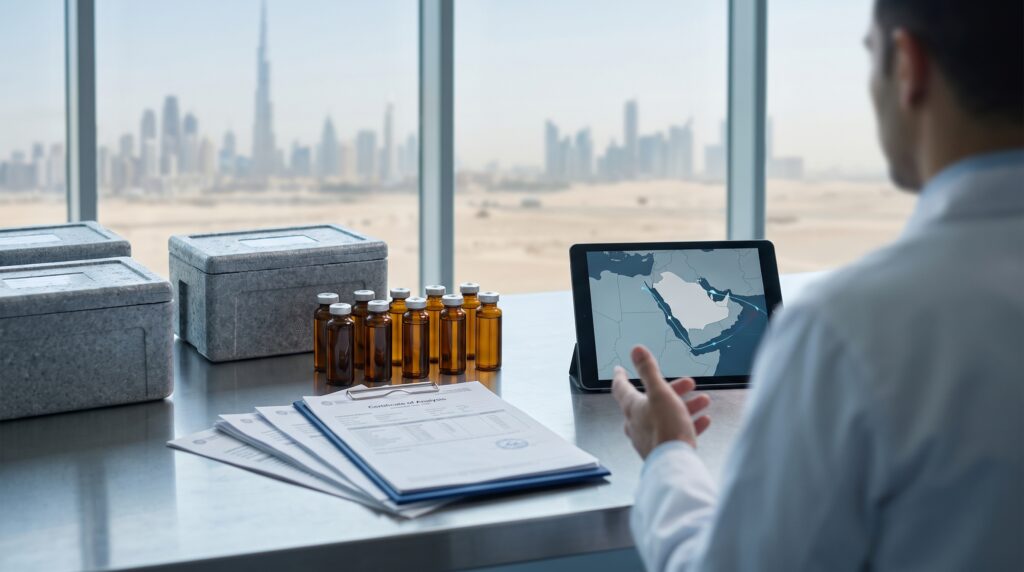
Today, the Emirates Drug Establishment (EDE) and the Ministry of Health and Prevention (MOHAP) actively monitor import pathways. How a peptide is classified—whether as a raw research material, cosmetic ingredient, or pharmaceutical—determines the exact documentation required for entry into ports like the Dubai Airport Freezone (DAFZA) or Jebel Ali.
For large-scale importers, generic commercial invoices and unlabelled shipments are no longer viable. Legitimate B2B importers must clearly define their incoterms and ensure the cargo is explicitly manifested as “Laboratory Research Materials.” While compounded clinical therapies require a licensed compounding pharmacy and direct physician oversight, raw research peptides rely on a separate, highly documented B2B supply chain.
The Danger of Grey Market Seizures
Many overseas laboratories offer seemingly attractive pricing for bulk peptides but fail to provide the necessary compliance paperwork. Unlicensed grey market shipments—especially bulk powders arriving without clear research declarations, Material Safety Data Sheets (MSDS), or commercial invoices detailing exact chemical compositions—face an exceptionally high rate of seizure by UAE Customs. A seized order results in immediate financial loss and can easily flag the importing company for future compliance audits, severely disrupting ongoing research programmes.
Avoiding Supplier Scams in the GCC
Beyond strict regulatory hurdles, procurement teams must remain vigilant against fraudulent vendors operating in the global B2B space. Local UAE business networks have increasingly reported sophisticated operations specifically targeting buyers of raw research materials.
The ‘Escalation Scam’
The most prevalent threat in this sector is the “escalation scam.” Unverified overseas suppliers initially hook a buyer with an exceptionally cheap trial order or a massive bulk discount. The payment is finalized via non-reversible means, and the vendor provides a tracking number.
However, a few days later, the buyer is contacted by a “shipping agent” claiming the package is stuck at UAE customs. They demand an immediate “clearance fee,” “toxicology permit fee,” or “insurance deposit”—frequently hovering around $800 to $1,500 USD—to release the goods. In reality, the package was never shipped. Legitimate peptide suppliers never spring hidden customs fees on buyers after the fact; all shipping costs, incoterms, and clearance responsibilities are clearly defined before the invoice is ever paid.
Payment and Support Red Flags
Professional B2B suppliers offer secure payment gateways and maintain dedicated commercial support channels. If a supplier insists solely on cryptocurrency for massive bulk orders, refuses to process standard wire transfers, or lacks a responsive WhatsApp or direct-line support system during UAE business hours, procurement teams should proceed with extreme caution.
The Documentation Standard: COA and HPLC/MS
When evaluating a peptide wholesale supplier in the UAE, the conversation must begin and end with analytical documentation. Visual inspection of a lyophilized “puck” reveals absolutely nothing about its purity, synthesis byproducts, or stability.
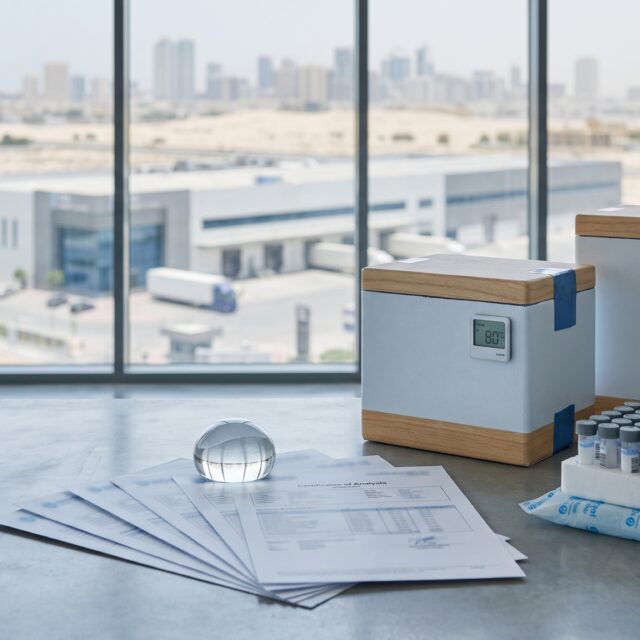
Professional sourcing requires the mandatory review of a Certificate of Analysis (COA) supported by High-Performance Liquid Chromatography (HPLC) and Mass Spectrometry (MS) data.
What to Verify on a COA
Before committing to a bulk purchase, research buyers must request batch-specific documentation and rigorously verify the following fields:
- Purity Percentage (HPLC): High-grade research peptides should demonstrate a purity of 98% or higher via HPLC. This indicates the percentage of the target peptide relative to synthesis impurities like truncated sequences or deletion peptides.
- Mass Verification (MS): The MS report must confirm that the synthesized product’s mass-to-charge ratio matches the theoretical molecular weight of the desired peptide sequence, confirming its exact identity.
- Net Peptide Content (NPC): Often confused with purity, NPC measures the actual ratio of peptide to counterions (typically Trifluoroacetic acid or acetate salts) and residual moisture. A COA should clearly delineate NPC so researchers can execute accurate dosing calculations for their in vitro or in vivo assays.
- Batch Traceability: The COA must list a specific batch or lot number that matches the physical labels on the bulk vials you receive.
Cold-Chain Logistics for Bulk Peptides UAE
The climate of the GCC presents a unique, ongoing challenge for peptide stability. While lyophilized (freeze-dried) peptide powders are inherently more stable than reconstituted liquid solutions, prolonged exposure to extreme heat—a common occurrence during summer transit or un-airconditioned customs holds in Dubai—can rapidly degrade delicate amino acid bonds, rendering the research material useless.
Protecting Structural Integrity During Transit
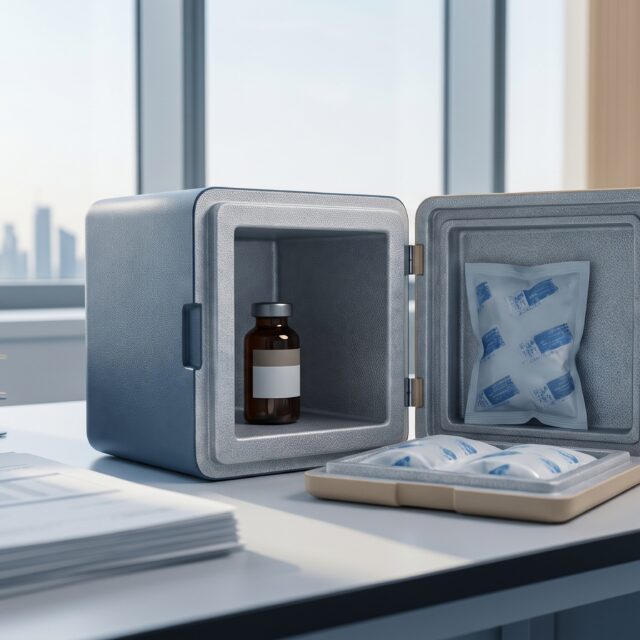
Temperature-controlled logistics (cold-chain handling) are vital for bulk procurement. A reliable B2B supplier utilizes insulated medical packaging, phase-change materials (medical-grade ice packs), or dry ice, alongside expedited shipping networks (such as priority DHL or specialized courier services) to ensure the internal temperature of the parcel remains stable during transit.
Internal Receiving Protocols
Procurement teams must also have internal receiving protocols firmly established. Upon arrival at the laboratory or facility, bulk lyophilized peptides should be immediately logged into inventory systems and transferred to appropriate storage. For long-term preservation, raw peptides should be stored in a dedicated, temperature-monitored freezer at -20°C, away from light and excessive moisture.
How to Choose a Wholesale Partner
Selecting a supplier for large-scale research procurement goes far beyond simply checking prices on a spreadsheet. The ideal partner acts as an extension of your own quality control and logistics teams.
Key Evaluation Metrics for Buyers
- Testing Transparency: Does the supplier openly share recent HPLC/MS reports, or do they guard them behind paywalls or vague promises of “in-house testing”?
- Local Operational Knowledge: Do they understand the distinction between EDE-regulated medical devices and pure research materials? Can they route shipments efficiently through UAE ports of entry without causing documentation delays?
- Communication and Support: Time zones and logistical friction require rapid communication. Suppliers offering direct commercial support via dedicated account managers are infinitely more reliable than those relying on generic email ticketing systems.
- Stock Availability and Lead Times: For uninterrupted research programmes, you need a supplier with consistent inventory who actually synthesizes or stocks their own material, rather than drop-shipping from third-party labs with unpredictable lead times.
At NOVA Labs, we understand the exacting standards required by GCC researchers and procurement teams. We prioritize verifiable third-party testing, robust logistics tailored for the UAE climate, and transparent commercial support. If your facility requires reliable supply chains for specialized compounds, you can enquire about wholesale peptides directly through our dedicated B2B portal. Alternatively, researchers looking to evaluate our product quality on a smaller scale can explore our complete research shop to view our current inventory and documentation standards.
Conclusion
Securing wholesale peptides in the UAE requires a highly diligent approach to compliance, logistics, and quality assurance. As the regulatory landscape under Federal Law No. 38 matures, the era of casual, undocumented grey market importing is rapidly coming to a close.
Successful procurement now depends entirely on partnering with suppliers who provide unimpeachable COA and HPLC/MS documentation, guarantee cold-chain integrity during transit, and understand the nuances of UAE customs clearance. By prioritizing transparency and robust supply chain management, research facilities can protect their investments and ensure the integrity and reproducibility of their scientific endeavours.
Disclaimer: All products mentioned in this article are strictly for laboratory research purposes only and are not intended for human or animal consumption, diagnostic, or therapeutic use.
*
References
- Ministry of Health and Prevention (MOHAP) UAE: Federal Law No. 38 of 2024 on Medical Products and Pharmacy Profession.
- Emirates Drug Establishment (EDE) Policy Framework for the Importation of Laboratory Reagents and Raw Materials.
- International Air Transport Association (IATA): Temperature Control Regulations (TCR) for Bioscience Materials in the Middle East.
- How to Register Peptides in the UAE: A Regulatory Guide for Brands and Manufacturers
- Importing Pharmaceuticals and Medical Devices to the UAE: A Comprehensive Guide
- Peptides Compounding Pharmacy Dubai – CureCell
- Peptide Supplier UAE | B2B Research Peptide Supply, COA & OEM – BT BioLabs
- Exploring the Peptide Market in UAE/GCC – Looking for Vendors : r/SmallBusinessUAE
Frequently asked questions
What documentation is required for wholesale peptides in the UAE?
Bulk buyers must prioritize a Certificate of Analysis (COA) supported by High-Performance Liquid Chromatography (HPLC) and Mass Spectrometry (MS) data. Detailed commercial invoices and clear "Research Only" declarations are also essential for customs.
How are bulk peptides protected from UAE heat during shipping?
Reliable suppliers utilize cold-chain logistics, employing insulated packaging and medical-grade refrigerants (like phase-change materials) to protect the structural integrity of lyophilized peptide powders during transit and GCC customs clearance.
What is a peptide escalation scam?
This is a common B2B fraud where unverified overseas vendors demand surprise customs clearance or insurance fees—often ranging from $800 to $1,500—after the initial order is placed, holding a fake shipment hostage to extract more funds.
Why do grey market peptide shipments get seized at UAE customs?
Shipments lacking proper analytical documentation, accurate commercial invoices, or necessary Emirates Drug Establishment (EDE) import clearances are routinely seized due to strict enforcement of UAE import laws governing chemical and biological materials.
How can I evaluate a peptide wholesale supplier in the UAE?
Procurement teams should evaluate suppliers based on their ability to provide batch-specific third-party testing, their understanding of UAE cold-chain logistics, their secure payment options, and their transparency regarding stock availability and dedicated B2B support channels.
Nova Labs buyer tools
Ready to verify stock, testing and delivery?
Use the product page and lab report section to check availability, documentation, delivery timing and support before placing an order.
- COA / test-report checks
- UAE delivery context
- Cold-chain handling
- COD and card payment options
- WhatsApp support