


Procuring specialised compounds for in vitro or mucosal transport studies requires a deep understanding of chemical stability and format-specific logistics. While lyophilised (freeze-dried) powders remain the industry standard for long-term storage, the rise of the pre-mixed peptide nasal spray has offered researchers a targeted delivery format for specific investigational models. However, evaluating these aqueous solutions introduces a new layer of complexity, particularly in the extreme climate of the UAE and the wider GCC.
Unlike traditional formats, liquid compounds are highly susceptible to thermal degradation. A procurement decision cannot rely on purity claims alone; it must factor in formulation buffering, continuous cold-chain logistics, and rigorous independent testing to ensure the compound remains structurally intact upon arrival. This guide details how UAE researchers can evaluate nasal spray peptides, verify supplier documentation, and navigate the specific challenges of domestic versus international shipping.
What is a Research Peptide Nasal Spray?
A research peptide nasal spray is a pre-mixed, aqueous compound formulated for immediate intranasal delivery in laboratory settings. Unlike lyophilised vials, nasal spray peptides allow researchers to investigate mucosal transport and blood-brain barrier penetration without reconstitution, though they require strict continuous refrigeration.
In physiological research models, these sprays are primarily utilised to study direct pathways to the central nervous system. By delivering the peptide via the olfactory and trigeminal nerve pathways, researchers aim to bypass systemic circulation and the blood-brain barrier. This specific method of delivery is highly valuable in preclinical neurological or neuro-inflammatory studies, where traditional subcutaneous administration might yield poor cerebral bioavailability.
However, because these compounds arrive already suspended in an aqueous solution—typically bacteriostatic water combined with specific pH buffers—their structural integrity is inherently more fragile than unmixed powders. Understanding this chemical reality is the first step in successful procurement.
Peptide Nasal Spray vs Vial: Understanding Chemical Stability
When comparing a peptide nasal spray vs vial, the primary difference lies in thermodynamic stability. Lyophilised vials contain peptides that have been freeze-dried, removing water molecules from the environment. Without water, hydrolytic degradation is virtually halted, allowing sealed vials to remain stable at room temperature for several weeks during transit, and for years when stored in a laboratory freezer (-20°C).
Aqueous formulations face an entirely different set of challenges. Because water molecules interact directly with the peptide backbone, they accelerate several degradation pathways:
- Hydrolysis: The cleavage of chemical bonds by the addition of water, breaking the peptide chain into smaller, inactive fragments.
- Deamidation: A reaction primarily affecting asparagine and glutamine residues, which can alter the compound’s structure and receptor-binding affinity.
- Oxidation: The interaction of the liquid compound with oxygen, frequently affecting methionine and tryptophan residues, particularly once the spray bottle is opened and exposed to atmospheric air.
Due to these vulnerabilities, pre-mixed liquid sprays mandate continuous cold-chain management (2°C to 8°C). Furthermore, their shelf life is significantly shorter. While a sealed, refrigerated nasal spray may maintain its integrity for several months, its viable lifespan typically drops to 15 to 30 days once opened and repeatedly exposed to ambient air and moisture during testing.
The Threat of UAE Heat to Peptide Nasal Sprays UAE Sourcing
The most critical error researchers make when ordering peptide nasal sprays UAE bound is underestimating the impact of international logistics. In Dubai, Abu Dhabi, and across the GCC, summer temperatures frequently exceed 40°C. Airport tarmacs, customs holding warehouses, and standard delivery vans can easily reach temperatures upwards of 50°C.
Exposing an aqueous peptide to intense heat for even a few hours can rapidly and completely denature the compound, rendering it biologically inactive before it ever reaches the laboratory bench. International dropshipping of pre-mixed nasal sprays is, therefore, a remarkably high-risk procurement strategy.
To mitigate this risk, researchers should strictly avoid international transit for liquid formulations. Instead, procurement should focus on local suppliers operating with domestic, climate-controlled warehousing. A UAE-based supplier can dispatch stock from a refrigerated inventory and execute active-cooling, last-mile delivery directly to the facility. This eliminates the uncertainty of customs clearance delays and guarantees that the cold chain remains unbroken.
How to Verify COA and Quality Standards
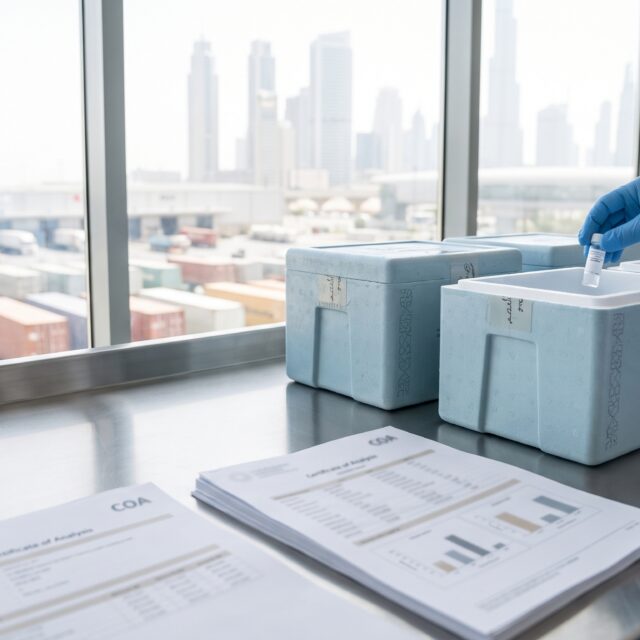
A Certificate of Analysis (COA) is the foundational document for verifying any research compound. For nasal spray peptides, the margin for error is small, making independent third-party testing non-negotiable. Procurement staff must verify two primary analytical results:
- High-Performance Liquid Chromatography (HPLC): This measures the purity of the compound. For research-grade applications, the benchmark purity should be ≥99% (or at minimum ≥98%).
- Liquid Chromatography-Mass Spectrometry (LC-MS): This confirms the molecular weight, proving that the chemical structure matches the requested peptide and has not degraded into fragments.
Crucially, buyers must never trust a static PDF provided via email or uploaded to a supplier’s website, as these are easily manipulated. Reputable testing facilities, such as Janoshik Analytical, provide a unique ‘Task ID’ and ‘Unique Key’ on every report. Researchers should independently navigate to verify.janoshik.com and input these credentials to confirm the report’s authenticity and ensure it applies to the current batch being sold.
Assessing Concentration and Metered Labelling
Quality verification also extends to accurate labelling. When sourcing a research peptide nasal spray, the packaging must clearly state the total volume, total peptide mass, and the output per spray. For example, a 10 mL bottle containing 10 mg of a given compound should yield approximately 100 metered sprays at 0.1 mL per spray, delivering 100 mcg per spray. If a supplier fails to provide this precise volumetric breakdown, it indicates a lack of formulation expertise.
Worked Procurement Examples: KPV, DSIP, and Semax
To illustrate how these procurement checks apply in practice, let us examine three compounds frequently sought in mucosal transport studies:
- KPV Nasal Spray: KPV (Lysine-Proline-Valine) is a tripeptide investigated in preclinical models for its role in inflammatory pathways. Because of its short amino acid sequence, it requires careful pH buffering in an aqueous solution. Procurement checks should ensure the COA confirms a high purity threshold, as degradation can quickly render such short-chain peptides inert.
- DSIP Nasal Spray: Delta Sleep-Inducing Peptide is a nonapeptide often studied for its interaction with neurological sleep architecture and stress responses. Due to its intended target in the central nervous system, researchers frequently select a nasal spray format to evaluate rapid blood-brain barrier traversal. Proper LC-MS verification is essential here to confirm that the full nine-amino-acid sequence is intact.
- Semax Nasal Spray: Originally developed to study neuroprotection and cognitive pathways, Semax is a synthetic analogue of adrenocorticotropic hormone (ACTH). It is exceptionally sensitive to thermal shifts. If a Semax formulation is exposed to typical GCC transit temperatures without active refrigeration, its efficacy will plummet, reinforcing the necessity of localised, cold-chain supply.
Local Logistics: Why GCC Researchers Trust NOVA Labs
When conducting sensitive in vitro or mucosal transport evaluations, the integrity of your materials dictates the reliability of your data. This is why forward-thinking laboratories in the UAE are shifting away from risky international imports in favour of domestic procurement.
NOVA Labs provides a strategic advantage for UAE-based researchers by holding inventory locally in climate-controlled facilities. This operational model eliminates the thermal degradation risks associated with customs delays. With active cold-chain handling, cash-on-delivery (COD) options for institutional buyers, and direct WhatsApp support for immediate stock and batch inquiries, procurement staff can confidently source highly sensitive aqueous compounds.
Researchers looking to secure HPLC-verified, cold-chain preserved formulations can explore domestic inventory directly through the NOVA Labs shop.
Procurement Checklist
Selecting a peptide nasal spray over a lyophilised vial offers distinct advantages for neurological and mucosal transport studies, but it introduces stringent storage and handling requirements. To ensure laboratory success and protect research budgets, UAE buyers must adopt strict procurement criteria.
Buyer Checklist for Liquid Peptides:
- Verify the third-party COA via the testing facility’s official portal (e.g., verify.janoshik.com).
- Confirm HPLC purity of ≥98% and matching LC-MS molecular weight.
- Ensure the supplier provides accurate metered volume and concentration labelling.
- Reject international dropshipping for aqueous formats; source only from suppliers with local, climate-controlled stock in the UAE.
- Implement immediate 2°C to 8°C refrigeration upon receiving the compound.
By demanding transparent documentation and prioritising unbroken domestic logistics, researchers can confidently utilise nasal spray formulations for high-stakes preclinical models.
Disclaimer: The products mentioned in this article are for research purposes only and are not intended for human consumption or therapeutic use.
*
References
- Nose-to-Brain Delivery of Therapeutic Peptides as Nasal Aerosols. National Center for Biotechnology Information. Available at: https://www.ncbi.nlm.nih.gov/pmc/articles/PMC9502087/
- Designing Formulation Strategies for Enhanced Stability of Therapeutic Peptides in Aqueous Solutions: A Review. National Center for Biotechnology Information. Available at: https://www.ncbi.nlm.nih.gov/pmc/articles/PMC10056213/
- Storage and handling guidelines for custom peptides. PubMed. Available at: https://pubmed.ncbi.nlm.nih.gov/21488043/
- Nose-to-Brain Delivery of Therapeutic Peptides as Nasal Aerosols
- Designing Formulation Strategies for Enhanced Stability of Therapeutic Peptides in Aqueous Solutions: A Review
- Storage and handling guidelines for custom peptides
Frequently asked questions
What is a research peptide nasal spray?
A research peptide nasal spray is a pre-mixed, aqueous peptide formulation designed for intranasal delivery in laboratory settings. Researchers use this format primarily to study mucosal transport and direct blood-brain barrier penetration via the olfactory nerve.
How long is a peptide nasal spray stable for?
Unopened peptide nasal sprays can remain stable for several months when continuously refrigerated between 2°C and 8°C. However, once opened and exposed to air during laboratory use, the shelf life typically reduces to 15 to 30 days due to oxidation and hydrolysis.
Should I choose a peptide nasal spray vs vial?
Lyophilised (freeze-dried) vials offer superior long-term stability and are ideal for standard in vitro research. Nasal sprays are preferable only when the experimental design specifically requires investigating intranasal delivery or rapid central nervous system pathways.
How do I verify the quality of nasal spray peptides in the UAE?
Quality must be verified by checking a third-party Certificate of Analysis (COA) containing HPLC and LC-MS testing. Buyers should validate the report directly on the testing laboratory's website, such as verify.janoshik.com, to ensure the batch is authentic and ≥98% pure.
Nova Labs buyer tools
Ready to verify stock, testing and delivery?
Use the product page and lab report section to check availability, documentation, delivery timing and support before placing an order.
- COA / test-report checks
- UAE delivery context
- Cold-chain handling
- COD and card payment options
- WhatsApp support