
Researchers and procurement specialists in the UAE are rapidly shifting toward integrated, multi-peptide delivery devices to streamline laboratory protocols and reduce physical handling errors. The klow pen has emerged as a preferred pre-calculated research device, combining four prominent peptides into a single, highly stable solution. However, transitioning from standard lyophilized vials to a pre-filled, dial-graduated format requires a firm understanding of compound interactions, regional storage logistics, and supplier purity verification.
For UAE-based laboratories, navigating the peptide market means overcoming significant local hurdles: extreme ambient heat, complex supply chains, and fluctuating distributor standards. This guide breaks down the KLOW formulation, how to verify analytical documentation, and what to expect from active cold-chain logistics when sourcing locally.
What is the KLOW Pen? A Quick Overview
The klow pen is a pre-filled, dial-graduated research device containing an 80 mg multi-peptide blend of GHK-Cu, BPC-157, TB-500, and KPV. Designed for laboratory precision, this format eliminates manual reconstitution, significantly reducing the risk of contamination and structural degradation common with traditional peptide vials.
The standard KLOW formulation features a 5:1:1:1 mass ratio engineered for parallel in-vitro investigation. Specifically, a single pen cartridge contains:
- 50 mg of GHK-Cu (Copper peptide)
- 10 mg of BPC-157 (Body Protection Compound)
- 10 mg of TB-500 (Thymosin Beta-4 fragment)
- 10 mg of KPV (Lysine-Proline-Valine)
By integrating these four compounds into one pre-mixed, pH-balanced system, researchers can observe their combined synergistic effects on cellular cultures, extracellular matrix remodeling, and inflammatory modulation pathways without the inherent inconsistencies of manual daily mixing.
Why the KLOW Blend Pen Research Format Outperforms Vials
Traditional peptide research relies heavily on lyophilized (freeze-dried) powder housed in glass vials. Before these peptides can be applied to a cellular assay or an experimental model, they must be manually reconstituted with bacteriostatic water. This physical handling introduces multiple variables that can compromise an experiment.
Reconstitution Stress vs. Dial-Graduated Precision
Manual reconstitution is inherently stressful for delicate peptide structures. The physical force of injecting water into a vacuum-sealed vial, followed by swirling or accidental shaking, can subject the amino acid chains to significant shear stress. This trauma often leads to rapid degradation or aggregation of the peptides before the trial even begins.
The klow blend pen research format resolves this by arriving pre-reconstituted in a sterile, strictly controlled laboratory environment. The dial-graduated mechanism allows investigators to dispense precise, micro-measured volumes of the solution directly onto their assay. This closed-system approach heavily mitigates the risks of cross-contamination, calculation errors, and handling-induced physical degradation.
Synergistic Modeling and the Deep Blue Complex
Researchers often study GHK-Cu, BPC-157, TB-500, and KPV together because they influence complementary biological pathways. GHK-Cu is intensely studied for its role in upregulating collagen synthesis and tissue remodeling. BPC-157 and TB-500 are primarily investigated for their accelerated cellular repair mechanisms, while KPV is isolated for its targeted anti-inflammatory properties.
When evaluating a pre-mixed KLOW formulation, researchers will immediately notice the distinctive deep blue color of the liquid. This is the natural visual signature of the GHK-Cu (copper) complex. Because this formulation contains a high concentration of GHK-Cu (62.5% of the total peptide mass), the vibrant blue hue serves as a baseline visual indicator of the compound’s presence before analytical testing begins.
Evaluating the KLOW Pen UAE Market: Procurement Checks
For procurement staff looking to buy klow pen devices in the local market, assessing supplier credibility is the most critical step. The barrier to entry for generic peptide suppliers is low, making third-party verification and transparent operational practices essential.
Standard market pricing for verified KLOW Blend injector pens in the UAE currently ranges from 950 AED to 1,150 AED. Prices significantly below this threshold should be treated with deep skepticism, as high-yield synthesis, multi-compound purification, and strict cold-chain logistics command a baseline operational cost.
When evaluating a supplier, buyers must prioritize rigorous, verifiable documentation over marketing claims. The presence of a batch-matched Certificate of Analysis (COA) is the only objective proof of what is inside the cartridge.
Deconstructing the COA: How to Verify Your Peptides
A legitimate supplier will never ask a researcher to rely on trust. Premium distributors link every batch of KLOW pens to a specific, independent laboratory report, often from recognized industry standard-bearers like Janoshik Analytical. Here is what to look for on a multi-peptide COA:
- HPLC-UV/VIS Purity: High-Performance Liquid Chromatography separates the compounds in the solution. You should expect to see distinct, well-defined peaks corresponding to each peptide, with an aggregate chromatographic purity target of ≥99%.
- Mass Spectrometry (MS): While HPLC confirms purity, MS confirms identity. It ensures that the molecular weights of the molecules in the solution exactly match the established molecular weights of GHK-Cu, BPC-157, TB-500, and KPV.
- Third-Party Server Verification: A PDF can be easily manipulated. Reliable suppliers provide COAs that include a unique tracking number or QR code. Researchers should always scan this code or enter the key directly into the testing laboratory’s official server to verify that the results are authentic and unmodified.
Storage, Cold-Chain Logistics, and UAE Delivery Constraints
The most prominent operational challenge for UAE laboratories is the climate. Reconstituted liquid peptides in injector pens are highly temperature-sensitive and photolytic (susceptible to degradation by light).
The Physics of Thermal Degradation
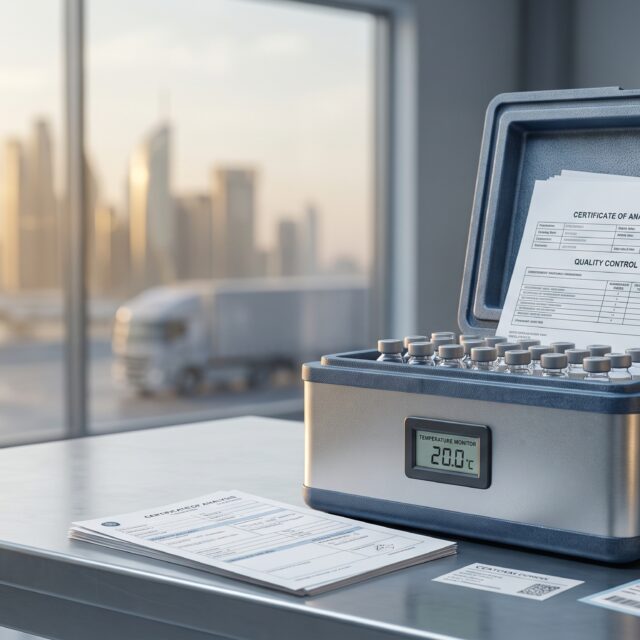
Once a peptide is in a liquid state, its molecular bonds become far more vulnerable to hydrolysis and oxidation. The klow pen must be kept strictly refrigerated between 2°C and 8°C at all times. It should also be shielded from direct UV and fluorescent light, and under no circumstances should the liquid be frozen, as ice crystal formation will irreversibly destroy the peptide structures.
Because the UAE and wider GCC experience extreme ambient temperatures for the majority of the year, standard shipping methods are entirely inadequate. If a pre-filled peptide pen spends 24 hours in the back of an unairconditioned delivery van in Dubai, its experimental viability will be compromised by thermal degradation.
Regional Logistics Solutions
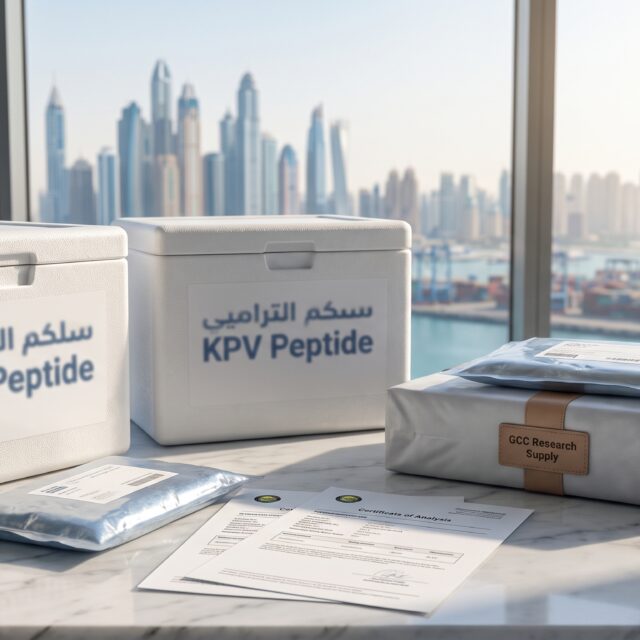
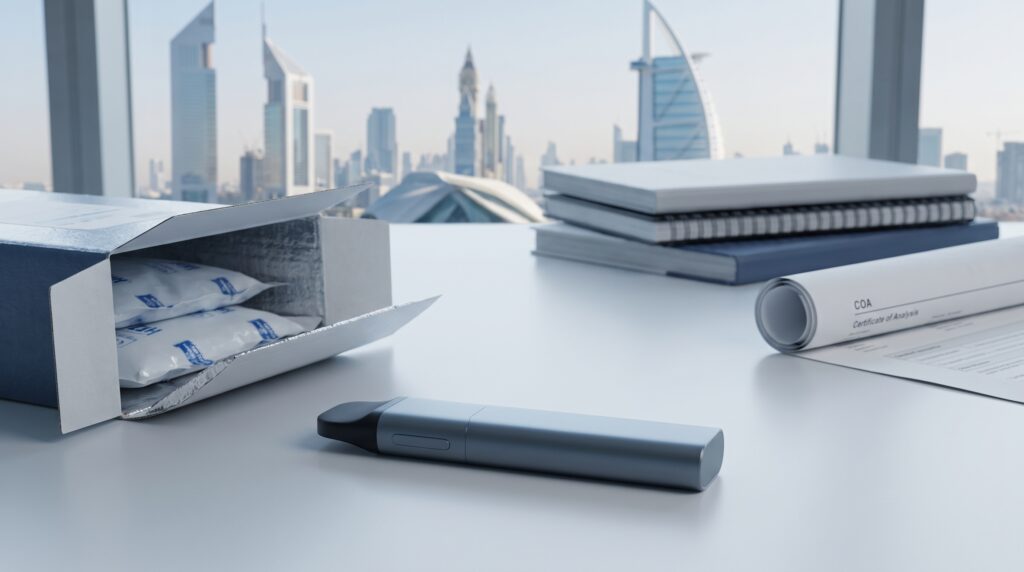
To ensure the compound arrives at the laboratory bench intact, suppliers must utilize active cold-chain logistics and heavily insulated transit packaging. Specialized cold packs and thermal barriers are required to maintain the 2°C to 8°C window from the moment the package leaves the fulfillment center until it is signed for by the laboratory technician.
For time-sensitive research, local stock availability is a massive advantage. Purchasing from suppliers with Dubai-based warehousing circumvents the friction of international customs delays, which often result in temperature excursions. Top-tier regional suppliers offer highly efficient UAE next-day peptide delivery, with same-day courier options frequently available within Dubai city limits, and guaranteed next-day arrival for Abu Dhabi, Sharjah, and Ajman.
Where to Source the KLOW Blend Pen with Confidence
Procuring complex, multi-peptide formulations demands a supplier that understands the distinct requirements of scientific buyers. NOVA Labs provides the UAE research sector with rigorously tested, high-stability compounds backed by transparent logistics.
When evaluating the KLOW Blend Pen at NOVA Labs, buyers benefit from immediate access to batch-specific, third-party Janoshik testing. Every pen is synthesized to exact mass ratios (50mg GHK-Cu, 10mg BPC-157, 10mg TB-500, 10mg KPV) and validated for ≥99% chromatographic purity.
Understanding the commercial realities of the UAE market, NOVA Labs also supports vital local payment structures. Cash on Delivery (COD) remains highly preferred by regional procurement departments, and direct WhatsApp support ensures researchers can easily request current stock levels, verify specific batch COAs, or coordinate precise delivery windows to ensure a technician is present to transfer the pens to a laboratory refrigerator.
Bottom Line for Researchers
The KLOW Blend Pen represents a significant leap forward in multi-peptide handling, removing the structural stresses of manual reconstitution and providing an exceptionally precise dial-graduated dispensing mechanism. However, the viability of this format is entirely dependent on two factors: rigorous analytical verification via third-party HPLC/MS testing, and flawless cold-chain execution to protect the liquid formulation from the extreme UAE climate.
By prioritizing transparent COAs, insisting on localized thermal shipping, and utilizing suppliers that understand regional research constraints, laboratories can confidently integrate this synergistic stack into their experimental models.
Disclaimer: The products mentioned in this article are strictly for in-vitro research purposes only and are not intended for human or animal consumption, diagnostic, or therapeutic use.
References
- Klow Stack (GHK-Cu, BPC-157, TB-500 & KPV) Formulation Data – RegenMed Research.
- Batch Testing Results and Chromatographic Analysis – SHLabz UAE.
- Nova Labs Review 2026: UAE Peptide Supplier COA and Cold-Chain Audit – Peptides Defined.
- Thermal Degradation of Liquid Peptides in In-Vitro Settings – Plastic Surgery Key Analytical Data.
- Klow Stack (GHK-Cu, BPC-157, TB-500 & KPV) – RegenMed
- Batch Testing Results | SHLabz
- Peak Labs · High-Purity Research Peptides · UAE
- Emirates Peptides: UAE Peptides for Laboratory Research
- Nova Labs Review 2026: UAE Peptide Supplier COA and Cold-Chain Audit – Peptides Defined
- KLOW Peptide Blend: What Is It and What Does the Research Show? – Plastic Surgery Key
Frequently asked questions
What is the klow pen used for?
The klow pen is a dial-graduated research device designed for laboratory use. It contains a pre-mixed, 80 mg liquid formulation of GHK-Cu, BPC-157, TB-500, and KPV, allowing researchers to dispense precise micro-doses for in-vitro cellular assays without manual mixing.
How should the KLOW Blend Pen be stored in the UAE?
Because the peptides are pre-reconstituted in a liquid state, the pen must be strictly refrigerated between 2°C and 8°C. It must be protected from extreme UAE ambient heat, shielded from light, and never frozen to prevent structural degradation.
How can I verify the purity of a KLOW pen?
Purity is verified by reviewing a batch-specific Certificate of Analysis (COA) from an independent laboratory, such as Janoshik Analytical. Researchers should check the HPLC-UV/VIS results for ≥99% purity and scan the provided QR code to authenticate the document directly on the testing lab's server.
Does NOVA Labs offer Cash on Delivery (COD) for peptide pens?
Yes, to accommodate local UAE and GCC procurement preferences, NOVA Labs offers Cash on Delivery (COD) alongside standard secure digital payment methods, ensuring flexibility for laboratory buyers.
Why is the liquid inside the KLOW pen blue?
The deep blue color of the liquid is the natural visual signature of the GHK-Cu (copper peptide) complex, which accounts for 62.5% of the total 80 mg peptide mass in the standard formulation.
Nova Labs buyer tools
Ready to verify stock, testing and delivery?
Use the product page and lab report section to check availability, documentation, delivery timing and support before placing an order.
- COA / test-report checks
- UAE delivery context
- Cold-chain handling
- COD and card payment options
- WhatsApp support