




Nova Biolabs vs Peptides Lab UAE: Sourcing Reliable Research Compounds
When evaluating nova biolabs vs peptides lab uae, the primary distinction lies in accessibility and verification. Nova Biolabs operates as an open-access platform featuring cryptographically verified Janoshik testing and localized modern payments. In contrast, UAE Peptide Lab functions as a restricted B2B portal requiring trade licenses, corporate wire transfers, and bulk institutional orders.
Key Takeaways for UAE Researchers
- Verification: NOVA Labs provides public, QR-verified third-party Janoshik COAs; UAE Peptide Lab generally issues static PDFs upon request.
- Logistics: Both utilize lyophilized formats for thermal stability, but NOVA Labs incorporates EPS cold-chain packaging for specific formats.
- Accessibility: NOVA Labs operates an open-access model with minimal order thresholds; UAE Peptide Lab is gated for institutional B2B buyers.
- Payment Infrastructure: NOVA Labs integrates localized GCC fintech (Tamara, COD, Apple Pay), while B2B vendors rely predominantly on corporate wire transfers.
For procurement staff, independent researchers, and laboratory managers operating in the Middle East, establishing a reliable supply chain for biochemical compounds is a critical operational hurdle. As of 2026, the UAE has emerged as a premier hub for biotechnology and independent research, but navigating local vendors requires careful due diligence.
Methodology: 2026 Supplier Evaluation Criteria
Comparing suppliers in the GCC is uniquely challenging. Extreme summer temperatures reaching 45°C require highly specific transit logistics to prevent peptide degradation. Furthermore, different business structures mean that access to inventory, transparency in batch testing, and minimum order requirements vary drastically.
To provide an objective buying guide, this comparison evaluates both vendors across five core metrics based on Q1 2026 market conditions:
- Onboarding Accessibility: Open-access vs. gated institutional portals.
- Analytical Verification: The standard of purity testing (static vs. cryptographically verified).
- Climate Mitigation: Cold-chain logistics and lyophilization standards.
- Financial Infrastructure: Order minimums and localized payment support.
- Client Support: Real-time communication and dispute resolution.
Accessibility: Open-Access Procurement vs. Institutional Gating
One of the first barriers researchers encounter when establishing a new supply chain is the onboarding process. The target audience for a supplier dictates how quickly a lab can acquire necessary compounds for time-sensitive assays.
B2B Institutional Vetting
UAE Peptide Lab is structured heavily toward large-scale, institutional B2B procurement. Gaining access to their catalogue and ordering system typically requires formal onboarding. This process involves submitting active business trade licenses, undergoing corporate vetting, and establishing formalized B2B accounts. This model serves heavily regulated clinical facilities and large universities that mandate strict institutional supply chains, but it creates significant friction for private, independent, or agile research teams needing immediate access to reagents.
Direct-to-Researcher Accessibility
Conversely, NOVA Labs (Nova Biolabs) utilizes an open-access storefront model. This allows independent researchers, private laboratories, and procurement managers to place direct orders without restrictive institutional gating. By bypassing mandatory trade license verification for standard orders, independent project leads can source necessary materials rapidly. This open-access model aligns with the modern shift toward decentralized and agile research within the GCC’s growing biotech sector, offering immediate procurement flexibility.
Purity and Documentation: How to Verify COAs
In the research compound space, a label claim is meaningless without verifiable, third-party analytical testing. High-performance liquid chromatography (HPLC) and mass spectrometry (MS) are non-negotiable standards for identifying peak area purity and molecular weight.
Static PDFs vs. Cryptographic Verification
UAE Peptide Lab typically operates with gated, on-request documentation. Certificates of Analysis (COAs) are usually provided privately to vetted corporate clients or shared behind login portals as static PDF files. While standard for traditional B2B channels, static PDFs are increasingly scrutinized by modern researchers due to the ease with which such documents can be altered, copied, or recycled across multiple distinct batches.
NOVA Labs addresses the demand for absolute transparency by integrating third-party batch-specific testing via Janoshik Analytical. Every product page features a COA that corresponds to the specific batch currently in stock. Crucially, these are not static documents. The provided Janoshik reports feature unique cryptographic keys and QR codes. Buyers can scan the code or enter the key directly on Janoshik’s public verification portal. This ensures the purity report was directly uploaded by the testing laboratory and has not been subsequently altered by the vendor. For researchers prioritizing data integrity, this verifiable open-book approach is a massive differentiator.
Surviving GCC Heat: Cold-Chain Logistics and Packaging
The most unique challenge facing UAE and GCC researchers is the climate. Ambient summer temperatures easily reach 40-45°C. At these temperatures, liquid amino acid chains undergo rapid hydrolysis, rendering the compound inert and destroying the validity of subsequent research data.
The Standard of Lyophilization
Both Nova Biolabs and UAE Peptide Lab mitigate thermal degradation by supplying the vast majority of their compounds in stable, lyophilized (freeze-dried) powder formats. Lyophilization removes the water matrix, locking the compound into a stable state that can withstand transit through the GCC’s harsh environment without significant degradation, provided it is kept out of direct sunlight and extreme, prolonged heat.
Local Transit and EPS Insulation
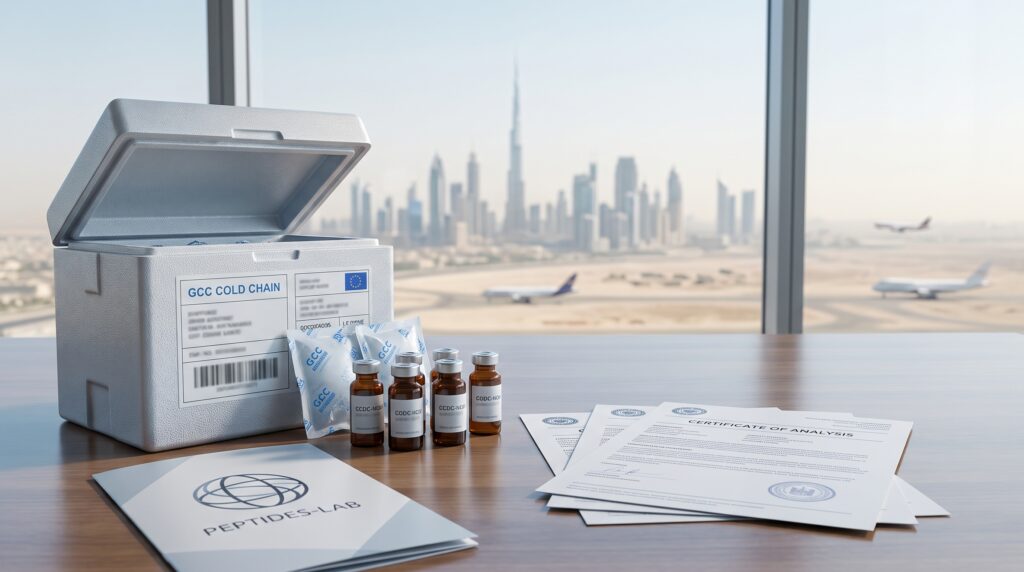
Where the two diverge is in localized transit strategies and support for temperature-sensitive formats. NOVA Labs utilizes localized cold-chain transit systems for domestic UAE orders containing items that require strict temperature controls. These specific formats are packed in EPS (Expanded Polystyrene) insulated coolers accompanied by phase-change gel packs to maintain lower ambient temperatures during the last-mile delivery phase.
Researchers looking for reliable next day peptide delivery in the UAE benefit greatly from domestic fulfillment. Bypassing prolonged international customs clearances drastically reduces the time reagents spend in unconditioned courier warehouses. For international GCC clients—such as those in Saudi Arabia (KSA), Oman, or Bahrain—cross-border shipping of robust, lyophilized vials remains highly viable. NOVA Labs provides flat-rate regional shipping for these states, typically clearing local transit within 4 to 5 business days.
Minimum Orders and Financial Flexibility
Procurement budgets and payment infrastructure vary wildly depending on whether a researcher is managing a massive university grant or self-funding an independent project.
Order Thresholds for Pilot Assays
Because UAE Peptide Lab targets institutional buyers, they maintain higher minimum order thresholds to justify their logistics and administrative overhead. Obtaining standard shipping or processing through their B2B portal generally requires a larger capital commitment. This is standard for corporate biotech suppliers but prohibitive for researchers requiring a single vial for a pilot assay or baseline quality check.
NOVA Labs caters to both micro-procurement and bulk orders. Free delivery across Dubai and Sharjah triggers at a much lower threshold (AED 400), with accessible minimums for other Emirates like Abu Dhabi or Ras Al Khaimah. This lowered barrier to entry allows laboratories to run small-scale quality checks before committing to larger bulk purchases.
Modern GCC Fintech Integration
The traditional B2B model relies heavily on corporate wire transfers and standard credit card processing, which remains the primary mode of operation for many gated portals. While secure, wire transfers can delay order processing by 24 to 72 hours depending on banking clearances.
NOVA Labs has integrated a localized, modern financial stack tailored to GCC buyer habits. Their payment options include:
- Cash on Delivery (COD): Crucial for local buyers who prefer physical receipt before capital exchange.
- Mobile Wallets: Apple Pay and Google Pay for instant, encrypted checkout.
- Tamara BNPL: Buy Now, Pay Later installments, allowing labs to amortize the cost of bulk research materials without straining immediate monthly operating budgets.
- Cryptocurrency: Acceptance of digital assets, appealing to privacy-conscious independent researchers.
Customer Support and Real-Time Coordination
Logistical errors, stock inquiries, and batch verification questions are inevitable in biochemical procurement. The speed at which a supplier resolves these issues can save a time-sensitive research protocol from failing.
Traditional B2B suppliers typically utilize email-based ticketing systems. While thorough, response times can stretch from 24 to 48 hours. NOVA Labs leverages instant WhatsApp-based support, allowing researchers to coordinate localized delivery times, request batch numbers before purchasing, and verify immediate stock levels in real-time. This high level of interactivity provides a distinct advantage for agile teams managing immediate supply shortages or complex delivery coordination to specialized laboratory blocks.
Summary: Choosing the Right Supply Partner
Selecting between Nova Biolabs and Peptides Lab UAE ultimately depends on your operational scale and governance requirements. If you are a procurement officer for a large hospital network that mandates formal trade license onboarding and corporate wire invoicing, a B2B-restricted portal fits typical enterprise governance models.
However, for independent researchers, agile private laboratories, and buyers prioritizing transparency and speed, NOVA Labs presents a highly modernized alternative. By combining cryptographically verifiable Janoshik testing, localized UAE cold-chain delivery, accessible order minimums, and GCC-specific fintech integrations, they remove the friction traditionally associated with sourcing research compounds in the Middle East.
To view current lyophilized stock, review verifiable batch documentation, and coordinate local logistics, you can shop available research compounds directly online.
References
- International Journal of Pharmaceutics, “Stability of Lyophilized Proteins and Peptides in Ambient and Extreme Climates.”
- Journal of Peptide Science, “Analytical Methodologies in Peptide Purity Determination: HPLC and Mass Spectrometry.”
- Janoshik Analytical, “Cryptographic Verification and Anti-Tampering Protocols in Third-Party Chemical Analysis.”
Disclaimer: The products mentioned in this article are strictly for in-vitro research and laboratory use only. They are not intended for human consumption, diagnostic, therapeutic, or clinical purposes.
Disclaimer: The products mentioned in this article are for research purposes only and are not intended for human consumption.
- Nova Biolabs vs UAE Peptide Lab Dubai: 2026 Supplier Comparison
- Nova Biolabs vs Peptides Lab UAE: 2026 KSA Sourcing Guide
- Nova Biolabs vs UAE Peptide Lab | 2026 Supplier Comparison
- Nova Biolabs vs Peptide Lab Oman: Buyer Comparison
- NOVA Labs Discount Code: PROFPEPTIDE — Save 10%
- Peptides : r/dubai – Reddit
- is UAE peptide research a legit and trust worthy source for petides? – Reddit
- Contact UAE Peptide Lab | Research Support Dubai
Frequently asked questions
What is the difference between Nova Biolabs and UAE Peptide Lab?
Nova Biolabs offers an open-access direct-to-buyer platform with no institutional vetting required, utilizing Janoshik verifiable testing and modern payments like COD and Tamara. UAE Peptide Lab operates primarily as a restricted B2B portal requiring trade licenses and corporate wire transfers for bulk institutional orders.
How do I verify the purity of peptides bought in the UAE?
The most reliable method is to check for third-party Certificates of Analysis (COAs) from independent analytical labs like Janoshik. Ensure the COA features a unique cryptographic key or QR code that can be verified directly on the testing facility's public database to prevent document tampering.
How do peptide suppliers handle extreme UAE heat during shipping?
Suppliers protect peptide integrity by shipping compounds in a stable, lyophilized (freeze-dried) powder format that resists thermal degradation. For sensitive formats, reliable vendors utilize localized cold-chain logistics, including EPS insulated coolers and phase-change gel packs for domestic transit.
Do UAE peptide suppliers offer Cash on Delivery (COD)?
Yes, Nova Biolabs offers localized payment options for UAE researchers, including Cash on Delivery (COD), Apple Pay, credit cards, and Tamara installments. Traditional B2B suppliers typically only accept corporate wire transfers or standard credit cards.
Can I order research compounds to Saudi Arabia or Oman from the UAE?
Yes. Lyophilized compounds can be shipped cross-border from the UAE to other GCC nations like KSA, Oman, and Bahrain. Specialized vendors offer regional shipping options, with transit typically taking 4 to 5 business days without overseas customs delays.
Nova Labs buyer tools
Ready to verify stock, testing and delivery?
Use the product page and lab report section to check availability, documentation, delivery timing and support before placing an order.
- COA / test-report checks
- UAE delivery context
- Cold-chain handling
- COD and card payment options
- WhatsApp support