
Sourcing research peptides in the Gulf region means navigating strict regulatory frameworks, extreme summer heat, and rigorous analytical standards. For laboratory professionals looking to procure experimental compounds like Kisspeptin-10, the process requires extreme precision. Recent regulatory shifts and the inherent chemical fragility of this specific peptide demand a thorough understanding of local supply chains.
This guide breaks down how informed buyers can confidently evaluate vendors, verify purity documentation, and ensure secure, temperature-controlled delivery within the Emirates to maintain the integrity of their in-vitro assays.
Quick Answer: How to Buy Kisspeptin UAE Securely
To successfully buy Kisspeptin UAE, researchers must prioritize domestic stock to bypass customs delays under current EDE regulations. Always demand batch-specific HPLC purity testing above 98% and choose a local supplier offering reliable cold-chain logistics to prevent rapid peptide oxidation during transit.
Navigating EDE Regulations: Why Local UAE Stock is Non-Negotiable
The regulatory environment for medical and research products in the Emirates was fundamentally restructured with the implementation of Federal Decree-Law No. (38). This legislation centralized the oversight of all pharmacological and experimental compounds under the Emirates Drug Establishment (EDE), a body that assumed duties previously managed by MOHAP.
For procurement officers and principal investigators planning to order Kisspeptin in the UAE, understanding this regulatory shift is critical. In 2024, the EDE launched a comprehensive enforcement initiative against unapproved peptide suppliers, penalizing unauthorized sources and initiating severe action against unlawful consumer sales or medical claims. The regulatory mandate is unambiguous: vendors must operate with strict legal compliance, and these compounds must be strictly isolated for in-vitro or non-human laboratory research.
Consequently, importing research peptides directly via international airmail now carries immense friction and high seizure risks. Packages arriving from overseas that lack precise, pre-approved analytical documentation are routinely intercepted at borders. Attempting to bypass local networks frequently results in outright parcel rejection or, worse, prolonged thermal degradation of the compounds while they sit in unconditioned customs facilities.
Partnering with locally stocked UAE distributors is the only viable solution. Domestic suppliers manage the complex bulk importation legally, maintaining sterile, climate-controlled warehousing in Dubai or Abu Dhabi. By sourcing locally, your laboratory neutralizes international customs risks, eliminates transit delays, and ensures compliance with regional procurement laws.
Decoding the COA: HPLC Purity and Mass Spectrometry for Kisspeptin-10
Transparency is the cornerstone of any credible scientific transaction. Kisspeptin-10 (KP-10) is a specific 10-amino-acid peptide sequence studied for its binding affinity to the KISS1 receptor. Its efficacy in cellular research settings depends entirely on its structural integrity. Before committing research funds, buyers must demand a recent, batch-specific Certificate of Analysis (COA).
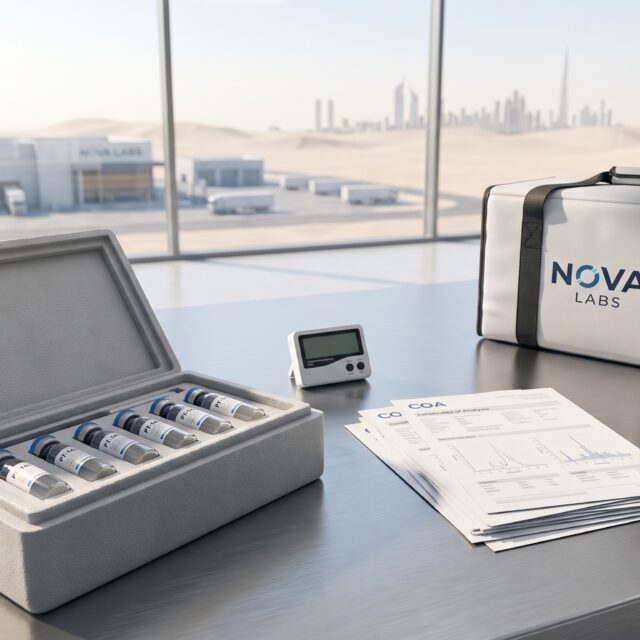
A reliable COA features two critical forms of third-party analytical testing: High-Performance Liquid Chromatography (HPLC) and Mass Spectrometry (MS).
High-Performance Liquid Chromatography (HPLC)
HPLC testing separates the components in a sample mixture, allowing researchers to evaluate the exact percentage of the target peptide versus residual chemical impurities left over from the synthesis process. When reviewing an HPLC chromatogram, buyers should look for a singular, sharply defined main peak. You should expect an HPLC purity rating of 98% or higher. Anything lower introduces unknown chemical variables into your experimental data, potentially skewing assay results and wasting laboratory resources.
Mass Spectrometry (MS)
Mass Spectrometry verifies the exact molecular weight of the compound. It ensures that the peptide sequence synthesized by the manufacturer precisely matches the theoretical mass of Kisspeptin-10. This is especially vital for KP-10 because its amino acid sequence contains both methionine and tryptophan residues. These specific residues are incredibly prone to oxidation if improperly synthesized or mishandled. Oxidative impurities—where an oxygen atom binds to the methionine, increasing the mass by roughly 16 Daltons—will show up clearly on a rigorous MS report. If a vendor cannot produce verifiable analytical testing demonstrating the absence of oxidized variants, they should be disqualified from your procurement list.
Overcoming GCC Heat: Cold-Chain Logistics and Next-Day Delivery
The climate in Dubai and the wider GCC presents a formidable challenge for peptide procurement. With ambient summer temperatures frequently exceeding 40 degrees Celsius, standard e-commerce courier services are entirely inadequate for transporting chemically fragile compounds.
Kisspeptin-10 is particularly vulnerable to thermal stress. Exposure to temperatures above 8 degrees Celsius rapidly accelerates the oxidation of the aforementioned methionine residues, degrading the peptide and rendering it useless for precise cellular study. Therefore, suppliers must utilize temperature-aware, cold-chain courier networks to prevent denaturation during transit.
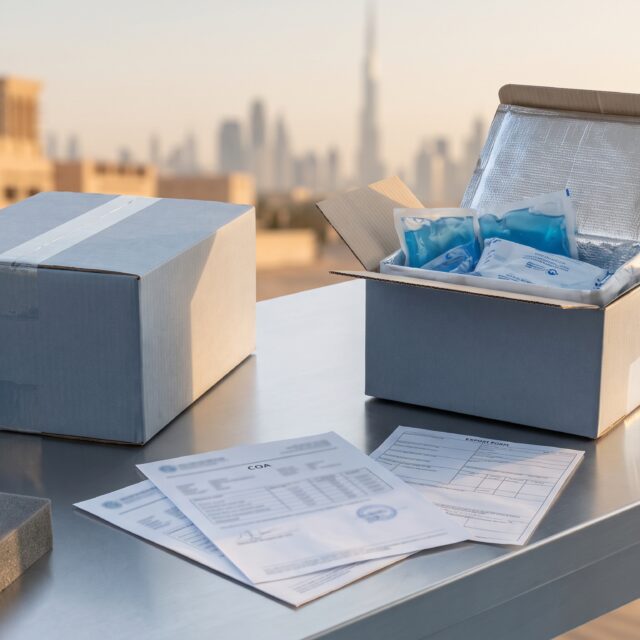
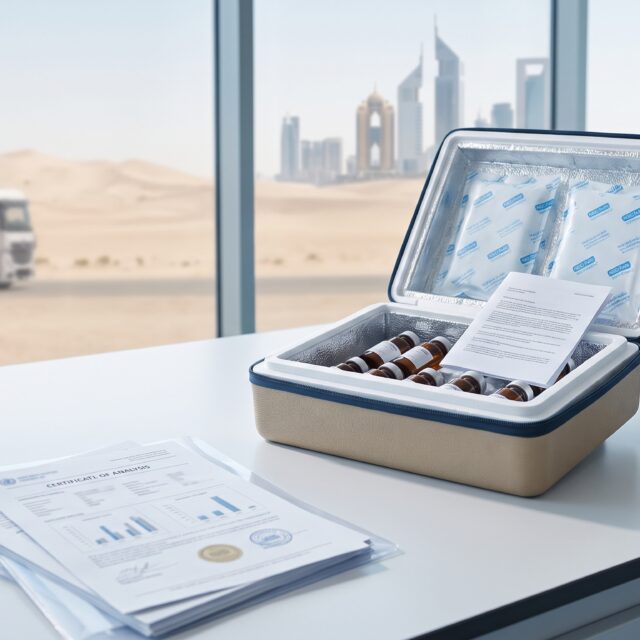
To combat the extreme local climate, reliable vendors offer robust logistics tailored to the region. Researchers should leverage specialized domestic shipping networks, such as peptides UAE next-day delivery, which guarantee that compounds spend the minimum possible time in transit. This specialized infrastructure utilizes heavily insulated, discreet packaging—often incorporating medical-grade cold packs—to maintain optimal temperature ranges from the warehouse directly to your laboratory bench. This uninterrupted cold chain ensures the compound’s structural integrity is perfectly preserved upon arrival.
Laboratory Handling and Storage Realities for KP-10
Understanding the difference in stability between lyophilized powder and reconstituted liquid is vital for long-term laboratory storage and experiment planning.
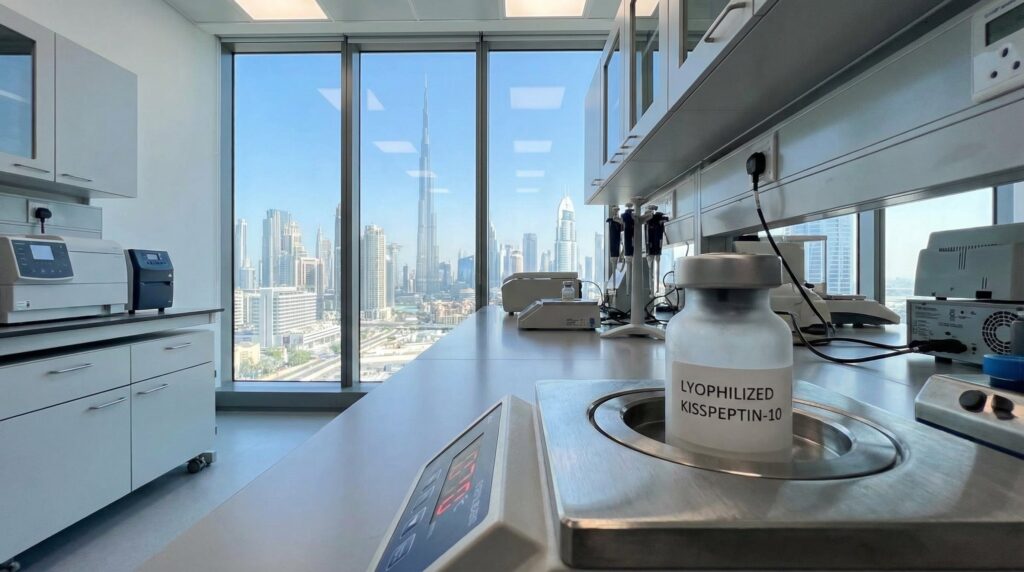
In its lyophilized (freeze-dried) state, Kisspeptin-10 can remain remarkably stable. If stored in a dedicated laboratory freezer at -20 degrees Celsius, away from light and moisture, unopened vials can maintain their 98%+ purity for up to two years. Researchers buying in bulk to secure batch consistency across a multi-month study should ensure their facility can accommodate strict sub-zero storage.
However, once the peptide is reconstituted with sterile bacteriostatic water for in-vitro assays, the stability window shrinks dramatically. Reconstituted peptide solutions degrade rapidly at room temperature. They must be strictly refrigerated at 2 to 8 degrees Celsius and should ideally be utilized within 28 days. Proper aseptic technique during reconstitution—such as avoiding direct forceful streams of solvent onto the lyophilized puck—is also necessary to prevent mechanical shearing of the peptide bonds.
Friction-Free Procurement: Payment, Security, and Supplier Support
Beyond compound purity and cold-chain logistics, the purchasing experience itself defines a superior supplier. Procurement staff and institutional researchers should look for vendors that offer clear, locally adapted operational standards that respect the privacy and security of the laboratory.
A major indicator of a trustworthy UAE supplier is the availability of flexible, secure payment methods. Top-tier distributors now offer Cash on Delivery (COD) options within the Emirates. This allows buyers to physically verify the arrival and condition of their temperature-controlled package before releasing funds, completely removing the financial risk often associated with opaque international peptide orders.
Furthermore, responsive localized customer support is essential. Sourcing high-grade laboratory materials often requires technical clarity and real-time stock verification. Suppliers that provide direct local support—such as immediate WhatsApp assistance—demonstrate a commitment to the regional research community. This allows for rapid communication regarding specific COA requests, batch number confirmations, documentation for institutional compliance, and precise delivery scheduling.
Sourcing a Comprehensive Peptide Catalog
While Kisspeptin-10 may be the primary focus for a specific cellular study, modern laboratories rarely operate on a single compound. Researchers frequently require a diverse suite of experimental peptides to complete comprehensive assay protocols or comparative binding studies.
Consolidating your procurement with a single, highly regulated local supplier streamlines documentation, simplifies institutional accounting, and significantly reduces cumulative shipping overhead. Researchers can systematically review inventory, verify real-time local stock, and access related analytical documentation by exploring a centralized catalog.
To view the complete range of locally stocked research compounds and verify their respective batch testing data, browse the full NOVA Labs shop. Choosing a comprehensive, compliant supplier ensures your lab avoids unnecessary downtime and maintains a consistent, verifiable chain of custody for all experimental materials.
Conclusion and Next Steps
Securing high-purity research materials in the Gulf requires strategic diligence, especially under the rigorous frameworks established by the EDE. When you set out to buy Kisspeptin in the UAE, success depends on demanding transparent HPLC and MS testing, understanding the critical nature of cold-chain logistics, and partnering with a vendor that prioritizes local compliance and domestic stock availability.
By focusing on these verifiable metrics and prioritizing vendors with specialized local delivery networks, UAE researchers can proceed with complete confidence. Careful procurement ensures that your laboratory’s experimental data will be built on a foundation of uncompromised, structurally verified peptide integrity.
*
Disclaimer: The products and information mentioned in this article are strictly for in-vitro laboratory research and analytical purposes only. They are not intended for human consumption, animal use, therapeutic application, or diagnostic purposes. Always adhere to your institution’s safety and handling guidelines when managing experimental compounds.
References
- United Arab Emirates Federal Decree-Law No. (38) on the Emirates Drug Establishment (EDE) guidelines and pharmacological research compounds.
- Gulf News (2024). UAE Cracks Down on Unapproved Medical Suppliers and Influencers.
- Real Peptides Journal (2024). Storage Protocols for Methionine Oxidation Prevention in Research Peptides.
- VaultLabs Hub. Research Peptides UAE Regulatory Overview.
- PeptideLaws.com. United Arab Emirates Peptide Laws & Regulations.
Disclaimer: The products mentioned in this article are for research purposes only and are not intended for human consumption.
- Nova Biolabs vs Peptides Lab UAE: 2026 Buyer Comparison
- UAE Cracks Down on Unapproved Peptide Weight-Loss Drugs: 71 Sources and 14 Influencers Face Action – Gulf News
- United Arab Emirates Peptide Laws & Regulations – PeptideLaws.com
- Does Kisspeptin Need Refrigeration? (Storage Guide) – Real Peptides
- Kisspeptin-10 5mg UAE – Buy Research-Grade Peptide, HPLC-Tested
- Kisspeptin-10: Complete Research Guide (Specs, Reconstitution, Storage)
- Research Peptides UAE Regulatory Overview | VaultLabs Hub
Frequently asked questions
Is it legal to buy Kisspeptin in the UAE for laboratory research?
Yes, under current EDE regulations, qualified researchers and institutions can legally procure peptides like Kisspeptin strictly for in-vitro and non-human laboratory research, provided they source from compliant local distributors.
Does Kisspeptin-10 require cold-chain delivery in Dubai?
Yes, Kisspeptin-10 is chemically fragile and vulnerable to thermal degradation. Temperatures above 8 degrees Celsius can rapidly oxidize its methionine residues, making cold-chain delivery essential in the GCC climate.
How long does lyophilized Kisspeptin remain stable in a lab?
When kept in its lyophilized (freeze-dried) powder form, Kisspeptin can remain stable for up to two years if stored correctly in a dedicated laboratory freezer at -20 degrees Celsius.
What documentation should I check before I order Kisspeptin in the UAE?
Buyers should always request a batch-specific Certificate of Analysis (COA) that includes third-party High-Performance Liquid Chromatography (HPLC) showing at least 98% purity, alongside precise Mass Spectrometry (MS) results to rule out oxidation.
How long does reconstituted Kisspeptin last in the fridge?
Once reconstituted with bacteriostatic water for in-vitro assays, Kisspeptin liquid must be refrigerated between 2 and 8 degrees Celsius and should be utilized for research purposes within 28 days to prevent compound degradation.
Nova Labs buyer tools
Ready to verify stock, testing and delivery?
Use the product page and lab report section to check availability, documentation, delivery timing and support before placing an order.
- COA / test-report checks
- UAE delivery context
- Cold-chain handling
- COD and card payment options
- WhatsApp support