
Finding high-quality research compounds in the Gulf Cooperation Council (GCC) requires rigorous due diligence and a deep understanding of analytical chemistry. For academic laboratories, independent researchers, and informed procurement staff, finding reliable sources for HPLC tested peptides Bahrain researchers can trust presents unique challenges. Buyers must navigate strict local import guidelines, decipher complex laboratory data, and protect delicate compounds from the region’s intense thermal extremes.
To ensure your research yields accurate and reproducible data, relying on a supplier’s marketing claims is never sufficient. Purity must be independently proven, and logistics must be flawless. This comprehensive guide explains how to read analytical testing reports, avoid untrustworthy vendors, and secure stable delivery of research compounds directly to your facility in Bahrain.
Quick Guide to Sourcing HPLC Tested Peptides in Bahrain
Key Takeaways: Sourcing HPLC tested peptides in Bahrain requires strict verification of third-party COAs and mass spectrometry data. Buyers must ensure batch numbers match physical vials, confirm supplier cold-chain shipping protocols to combat GCC heat, and verify laboratory compliance with Bahrain’s NHRA and OFOQ customs regulations.
For researchers sourcing these materials, bypassing the guesswork is critical. Reviewing a supplier’s transparent laboratory documentation and ensuring regional logistical competence is the mandatory first step before initiating any procurement order.
Decoding HPLC and Mass Spectrometry Data
When evaluating a new compound, the standard metrics of quality rely heavily on two specific analytical techniques. A reputable HPLC tested peptides supplier in Bahrain will prominently feature these tests for every single batch they synthesise and distribute. During Solid Phase Peptide Synthesis (SPPS), truncation and deletion errors can occur, creating impurities that must be isolated and measured.
High-Performance Liquid Chromatography (HPLC)
High-Performance Liquid Chromatography (HPLC) is the gold standard for quantifying peptide purity. It operates by dissolving the sample in a specific solvent and forcing it through a densely packed column under extremely high pressure. Because different molecules possess varying polarities and sizes, they travel at different speeds (retention time). The machine separates the primary peptide sequence from any synthetic impurities, unreacted amino acids, or degradation byproducts.
In high-quality research environments, a purity level of 99% or greater is the benchmark. The HPLC chromatogram will display a single, sharp, dominant peak representing the target compound. The purity is calculated by measuring the Area Under the Curve (AUC) of this primary peak relative to any smaller peaks (impurities) along the baseline. A flat baseline with minimal noise and one towering peak is the hallmark of premium synthesis.
Mass Spectrometry (LC-MS)
While HPLC tells you how pure a substance is, it does not confirm what the substance actually is. That is the critical role of Mass Spectrometry (MS), often coupled directly with Liquid Chromatography (LC-MS).
By ionizing the sample and measuring the exact mass-to-charge ratio (m/z), MS compares the actual molecular weight of the vial’s contents to the theoretical mass of the desired amino acid sequence. If the mass perfectly aligns with the target sequence, identity is confirmed. If a supplier only provides an HPLC report without an accompanying MS scan, the fundamental identity of the compound remains unverified, rendering the purity data useless.
How to Verify a Certificate of Analysis (COA)
A Certificate of Analysis (COA) is the primary document bridging the gap between a supplier’s claims and laboratory reality. Unfortunately, the digital age has made it alarmingly easy for untrustworthy vendors to fabricate, plagiarise, or digitally alter PDF reports. When searching for an HPLC tested peptides shop in Bahrain, researchers should scrutinise the documentation using the following rigorous criteria:
- Independent Third-Party Testing: Legitimate COAs come from recognised, independent analytical laboratories rather than a supplier’s own internal testing desk. Facilities such as Janoshik Analytical, MZ Biolabs, or Lypholabs are globally recognised for their strict, unbiased testing protocols.
- Batch Number Matching: The batch number prominently displayed on the COA must perfectly match the physical label on the vial you receive. Generic COAs that lack batch numbers—or represent tests conducted years ago—are massive red flags.
- Verification Links or Keys: Modern analytical laboratories include a unique alphanumeric verification code, QR code, or direct URL on their reports. Researchers should be able to visit the independent lab’s website, enter the key, and download the original, unedited document directly from their servers.
- Testing Scope: A complete COA should detail appearance, solubility, HPLC purity, MS identity, and, where applicable, net peptide content or counter-ion analysis (such as TFA removal verification).
At NOVA Labs, transparency is central to our operational standard. We invite all prospective buyers to review our latest COA test reports to see precisely how batch-specific, independent verification should be structured.
Defeating the GCC Heat: Storage and Logistics
The GCC climate is famously unforgiving, with summer temperatures routinely exceeding 45 degrees Celsius (113 degrees Fahrenheit). Delicate research compounds are highly susceptible to environmental stress. Heat exposure accelerates degradation processes such as hydrolysis, oxidation (particularly of methionine and tryptophan residues), and deamidation, which can quickly ruin even the purest HPLC-verified batches.
Climate-Resilient Shipping
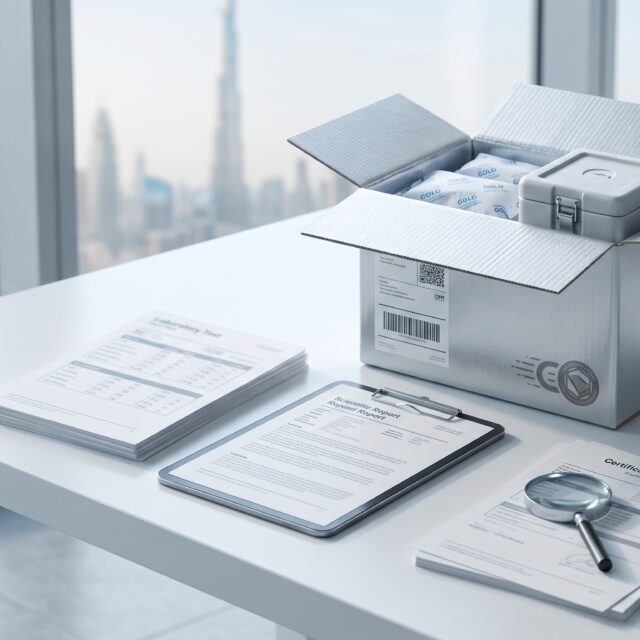
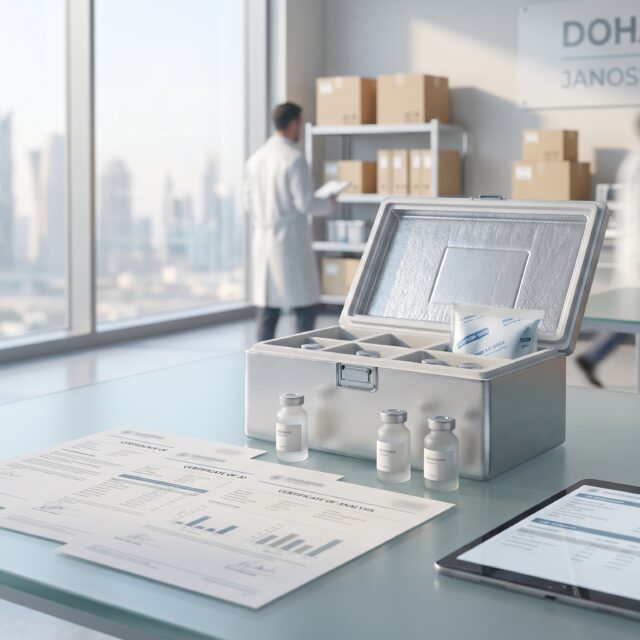
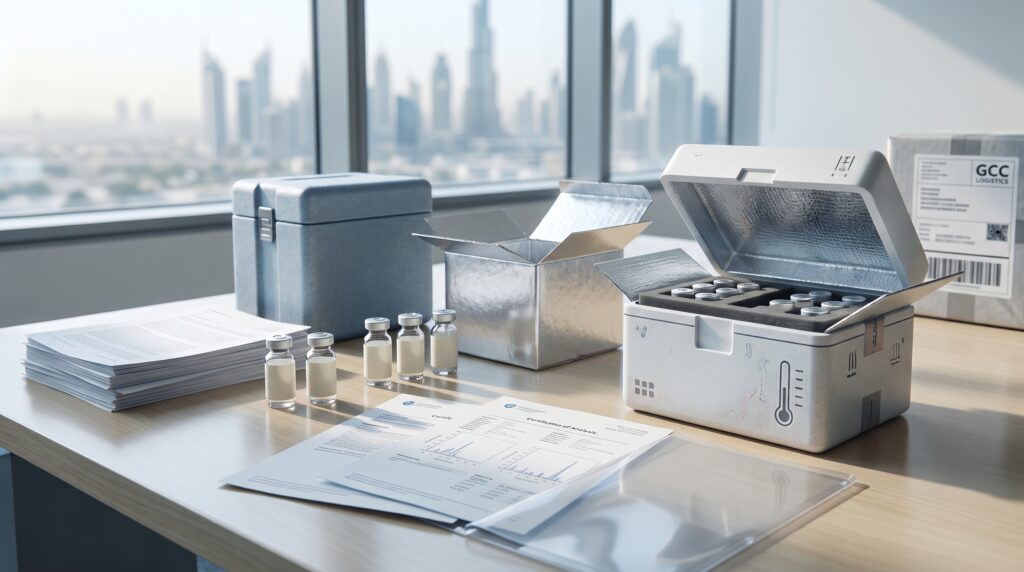
Procuring HPLC tested peptides in Bahrain from overseas suppliers often involves lengthy delays in customs or extended layovers on sun-baked airport tarmacs. This is why local GCC sourcing—utilising established hubs in the UAE or Bahrain—is highly recommended. Reputable suppliers must utilize passive cooling solutions, such as phase-change materials (PCM) and robust thermal insulated packaging, to maintain structural integrity during the crucial last-mile delivery. Avoiding weeks of transit time is the best defense against thermal degradation.
Long-Term Laboratory Storage
Once the product safely arrives at your facility, proper handling protocols must take over immediately to preserve the compound’s half-life:
- Lyophilised (Freeze-Dried) Vials: Unopened vials should be stored frozen immediately upon receipt. For long-term stability (months to years), temperatures between -20°C and -80°C are required.
- Equilibration to Room Temperature: This is a frequently overlooked but critical step. When removing a frozen vial for research, you must allow it to sit in a desiccator or airtight container for 15 to 30 minutes until it equilibrates to room temperature. Opening a cold vial immediately pulls moisture from the ambient air into the lyophilised powder, triggering rapid hydrolysis and degrading the peptide before research even begins.
- Reconstituted Liquids: Once a diluent (such as bacteriostatic water) has been added to the vial, the compound must be refrigerated continuously between 2°C and 8°C. If your experimental design requires multiple uses over an extended period, aliquot the reconstituted solution into smaller vials. Never freeze a peptide after it has been reconstituted, as the formation of ice crystals will irreparably destroy the fragile molecular bonds.
Navigating Import Logistics and the OFOQ System
Bahrain operates a strict regulatory environment to ensure the safety, traceability, and legality of imported chemical compounds. The National Health Regulatory Authority (NHRA) oversees these imports, and the customs clearance process is managed heavily through the electronic OFOQ system.
When individual buyers or academic procurement departments attempt to import unverified compounds directly from overseas manufacturers (often based in the US or China), they risk having their packages flagged due to improper documentation. This frequently leads to items being misclassified as unauthorised medicines, resulting in swift confiscation, exorbitant storage fees, or profound transit delays.
By selecting a supplier that already operates seamlessly within the GCC logistics network and provides transparent, research-only documentation, buyers can largely avoid prolonged customs friction. Regional suppliers understand how to correctly classify in-vitro research chemicals to ensure smooth passage through Bahraini customs checkpoints.
Evaluating Your Supplier: Payment and Support
Whether you are procuring compounds for a large-scale academic institution or a private independent analysis firm, the criteria for choosing a supplier should remain exacting. Look for operations that excel in the following areas:
- Publicly Accessible Data: Easy, ungated access to recently updated, third-party COAs covering both HPLC and LC-MS parameters.
- Local GCC Infrastructure: Rapid shipping windows (typically 1-3 days regionally) that bypass international customs delays and mitigate heat exposure.
- Clear Communication & Support: Access to responsive customer support, such as direct WhatsApp business lines, to handle urgent logistical queries, stock checks, or COA clarifications.
- Secure Procurement Options: Flexibility in payment methods is vital. Look for secure encrypted card gateways, corporate purchase order capabilities, or modern alternative payments that ensure your procurement process is secure and trackable.
By prioritising these foundational factors, you actively secure the integrity of your research materials from the moment they leave the laboratory to the moment they enter your facility’s storage freezer.
Conclusion and Next Steps
For researchers evaluating HPLC tested peptides in Bahrain, taking the time to verify analytical documentation is non-negotiable. Ensure that both purity (via high-resolution HPLC) and identity (via Mass Spectrometry) are unequivocally backed by an independent, verifiable third party. Pair this stringent due diligence with a supplier who intrinsically understands the unique thermal, logistical, and customs-related challenges of the Bahrain market, and you will effectively safeguard both your budget and your critical research outcomes.
Ready to source verified compounds with complete confidence? Browse our latest stock and shop for research peptides at NOVA Labs, where analytical transparency and seamless regional logistics meet.
*
Disclaimer: The products mentioned in this article are exclusively intended for in-vitro research and laboratory experimentation purposes only. They are not intended for human consumption, clinical application, therapeutic use, or any form of internal administration.
References
- Lypholabs | Precision HPLC Testing for Peptides & Compounds
- MZ Biolabs | Analytical Testing for Peptides & Small Molecules
- Bahrain – Prohibited and Restricted Imports – International Trade Administration
- Importation – National Health Regulatory Authority Bahrain
- Peptide Storage and Handling Guidelines – GenScript
Disclaimer: The products mentioned in this article are for research purposes only and are not intended for human consumption.
Frequently asked questions
What does HPLC tested mean for research peptides?
HPLC stands for High-Performance Liquid Chromatography. It is an analytical testing method used to verify the purity of a peptide by separating the primary compound from any synthetic impurities or degradation byproducts, ensuring high precision for laboratory research.
How can I verify a peptide COA in Bahrain?
You can verify a Certificate of Analysis (COA) by checking that the printed batch number exactly matches your physical vial. Always look for a verification code, QR code, or link that connects directly back to the independent testing laboratory's server, such as MZ Biolabs or Janoshik.
Why is cold-chain shipping important for peptides in the GCC?
The extreme heat in the GCC, routinely exceeding 45°C, can rapidly degrade delicate peptide structures through hydrolysis and oxidation. Climate-resilient shipping using insulated packaging and phase-change materials protects these sensitive compounds during regional transit.
How should I store lyophilised peptides once they arrive?
Unopened lyophilised (freeze-dried) peptides should be immediately stored in a freezer at temperatures between -20°C and -80°C. Critically, always allow the vial to reach room temperature before opening to prevent ambient moisture condensation and subsequent degradation.
Can I import unverified peptides directly into Bahrain?
Importing unverified compounds directly from overseas can result in packages being flagged by the NHRA or delayed in the OFOQ customs system. Sourcing from regional GCC suppliers with proper research documentation ensures faster, compliant customs clearance.
Nova Labs buyer tools
Ready to verify stock, testing and delivery?
Use the product page and lab report section to check availability, documentation, delivery timing and support before placing an order.
- COA / test-report checks
- Bahrain delivery context
- Cold-chain handling
- COD and card payment options
- WhatsApp support