



Finding high-quality, verifiable research compounds in the GCC can be a complex process. For researchers and procurement specialists in Muscat, Salalah, Sohar, and across the Sultanate, securing reliable analytical materials requires navigating two distinct challenges: evaluating complex supplier testing claims and managing regional logistics. From the intense summer heat that routinely exceeds 45°C to the strict import requirements enforced by Omani customs, buyers must look beyond basic marketing claims to ensure they are sourcing pure, stable, and compliant materials.
Whether you are operating a commercial testing laboratory, an academic institution, or evaluating compounds for independent in vitro study, this guide provides a proof-heavy framework for evaluating peptide suppliers in Oman. We will cover the exact mechanics of reading a Certificate of Analysis (COA), understanding Mass Spectrometry (MS) data, spotting red flags from low-trust vendors, and ensuring your shipment clears the Bayan customs system without friction.
Sourcing HPLC Tested Peptides in Oman
Quick Answer: To securely source hplc tested peptides oman, researchers must verify lot-specific Certificates of Analysis (COAs) that include clear high-performance liquid chromatography integration tables and Mass Spectrometry (MS) data. Purchasing from GCC-based suppliers ensures faster transit, minimizing thermal exposure, and provides localized documentation optimized for Oman’s Bayan customs clearance.
When evaluating a potential supplier for research reagents, the presence of verified analytical data is non-negotiable. Synthesizing peptides is a complex biochemical process that inherently produces impurities, such as truncated amino acid sequences or residual solvents like trifluoroacetic acid (TFA). Identifying and quantifying these byproducts is the primary function of analytical testing.
High-Performance Liquid Chromatography (HPLC) Explained
HPLC is the recognized analytical gold standard for verifying the purity of a synthetic peptide. The process involves dissolving the peptide in a specific solvent matrix and passing it through a column under extreme high pressure. Because different molecules possess varying chemical properties—such as size, charge, and hydrophobicity—they travel through the column at different velocities.
The resulting output, known as a chromatogram, displays a series of peaks. The primary peak represents the target peptide sequence. The area under this specific peak, when compared to the total area of all detected peaks (which represent impurities), determines the exact purity percentage of the sample. For most in vitro research applications, a purity of 98% or higher is considered standard.
Mass Spectrometry (MS) Validation
While HPLC confirms how pure a sample is, it cannot definitively confirm what the sample is. This is where Mass Spectrometry becomes mandatory. MS is required to confirm the compound’s structural identity and precise molecular weight.
By ionizing the sample (often using techniques like ESI or MALDI-TOF) and measuring the mass-to-charge ratio of the resulting ions, MS ensures that the exact sequence of amino acids was synthesized correctly. It verifies that no amino acids were skipped or incorrectly substituted during the synthesis phase. When searching for a verified supplier in Oman, researchers must insist on seeing both HPLC purity percentages and corroborating MS structural data.
Decoding a Certificate of Analysis (COA)
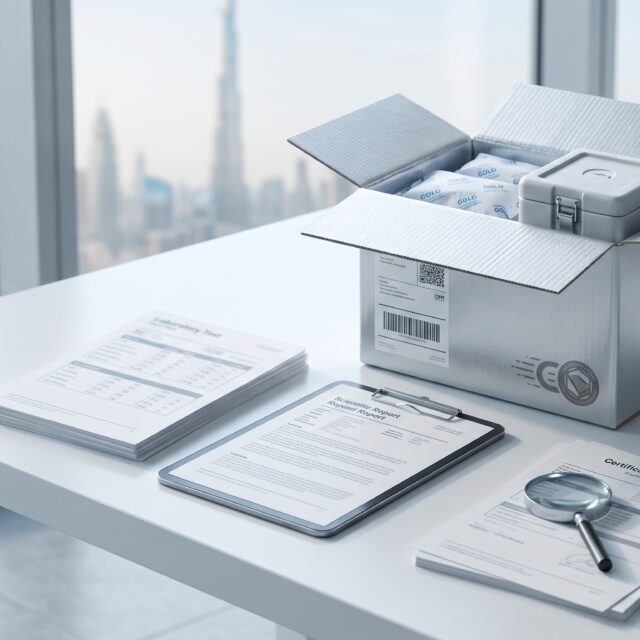
A Certificate of Analysis is the critical document that bridges the gap between a supplier’s marketing claims and laboratory reality. Buyers and procurement officers must know how to dissect this documentation to separate legitimate suppliers from those utilizing fabricated or recycled paperwork.
When you review verified COA and lab results, look for these mandatory verification fields:
- Matching Batch and Lot Numbers: The batch number printed on the physical vial you receive must perfectly match the batch number listed on the COA. If a vendor provides a “sample” COA with no specific batch linkage, there is zero guarantee that the document applies to the specific chemical lot you are purchasing.
- Detailed Integration Tables: A legitimate HPLC report will include a detailed integration table beneath the chromatogram. This table systematically breaks down the retention time, peak area, and percentage for every single compound detected in the sample run.
- Testing Dates and Validity: Peptides are highly stable when lyophilized and stored correctly. However, testing documents dated three or four years ago suggest either stagnant inventory or a failure by the supplier to test subsequent synthesis runs. Recent, batch-specific testing is essential.
- Independent Third-Party Verification: Internal laboratory reports are a good starting point, but independent, third-party testing from accredited analytical laboratories provides a significantly higher tier of trust and objectivity.
Red Flags: Identifying Forged Testing Documents
The rising global demand for research compounds has unfortunately led to a proliferation of forged, altered, or misleading testing documents. Omani researchers must remain vigilant for these common signs of deception:
- Perfectly Clean Baselines: Real-world HPLC chromatograms display a baseline with minor electrical or chemical noise. A perfectly flat, straight line leading up to a single, mathematically flawless peak often indicates the image was digitally altered or generated via software.
- Missing Axis Parameters: If the chromatogram lacks clear labeling for retention time (x-axis) and absorbance/intensity (y-axis), the graph is functionally useless for scientific review.
- Generic Copy-Paste Formatting: Low-tier suppliers may use identical COA templates for vastly different molecular compounds, simply altering the header text while leaving the raw integration data untouched. Ensure the molecular weight listed matches the known theoretical weight of the compound.
By demanding verifiable transparency and analyzing the data critically, you protect both the integrity of your research data and your institutional budget.
Navigating Oman’s Extreme Heat: Transit and Storage
One of the most pressing concerns for buyers in Oman and the broader GCC is the extreme regional climate. With summer temperatures routinely exceeding 45°C (113°F) in Muscat and interior regions, researchers naturally worry about compound degradation during cross-border transit.
The Resilience of Lyophilized Peptides
Most premium research peptides are shipped in a lyophilized (freeze-dried) state. During the lyophilization process, water is entirely sublimated from the compound under a vacuum, leaving behind a stable crystalline powder.
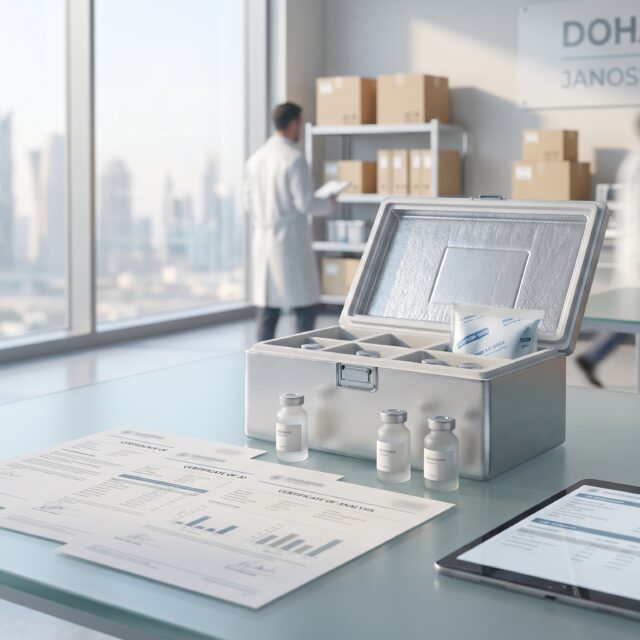
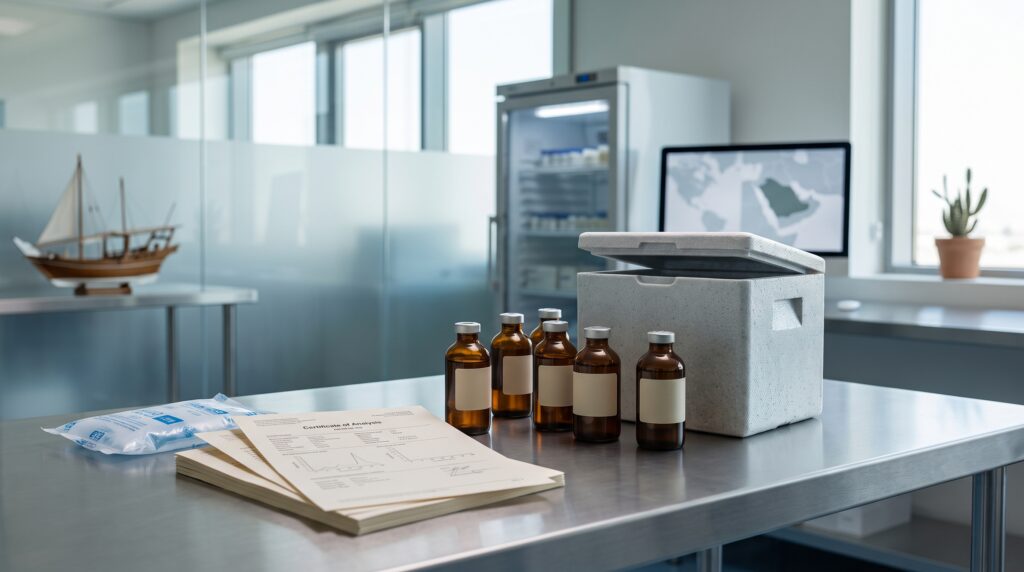
Scientific stability studies demonstrate that properly lyophilized peptides are remarkably robust. They can withstand ambient temperatures of 40°C at elevated humidity for several weeks while retaining 96% or more of their original purity. Because they are shipped in this dormant, dehydrated state, lyophilized peptides do not require strict cold-chain logistics during the brief window they spend in standard courier transit to Oman.
Laboratory Storage Protocol Post-Delivery
The thermodynamic rules change entirely once the peptide is received and reconstituted (mixed with bacteriostatic water or a specific solvent for testing). Once wet, the peptide bonds become immediately fragile and highly susceptible to bacterial degradation, UV light damage, and thermal breakdown.
Reconstituted peptides must be stored immediately in a laboratory refrigerator at 2°C to 8°C (36°F to 46°F) and handled with extreme care to prevent physical shearing of the molecular chains.
Oman Customs (Bayan) and GCC Import Protocols
Shipping research materials into the Sultanate of Oman requires precise adherence to local regulatory frameworks. The Directorate General of Customs utilizes the Bayan system, a highly efficient digital platform for clearing imports. However, the system’s efficiency relies entirely on the accuracy and completeness of the importer’s documentation.
When importing research chemicals, customs officials—often working alongside the Ministry of Commerce, Industry and Investment Promotion (MoCIIP) or the Royal Oman Police (ROP) customs division—look for specific markers of compliance:
- Accurate HS Classification Codes: Research chemicals must be accurately classified under the Harmonized System. Misclassification is the primary cause of customs seizures, shipment delays, or unexpected demurrage fees at the port or airport.
- Material Safety Data Sheets (MSDS): A comprehensive MSDS detailing the compound’s chemical properties, handling risks, and environmental storage requirements must accompany the physical shipment.
- Clear Commercial Invoices: Values must be accurately declared. Undervaluing shipments to avoid standard GCC duties is heavily penalized.
- End-Use Declarations: For institutional buyers, commercial import licenses are standard. For individuals bringing in compounds for independent study, Oman Customs may require technical documentation ensuring the compounds are strictly for in vitro research and do not violate local Ministry of Health guidelines for restricted pharmaceuticals.
Partnering with a supplier deeply familiar with GCC customs frameworks drastically reduces the friction of cross-border procurement.
Payment, Support, and UAE-Based Procurement
When evaluating where to source analytical compounds, geographic proximity, documentation accuracy, and responsive customer support are major differentiating factors. Sourcing from overseas suppliers in North America or East Asia often results in extended transit times (sometimes exceeding 14 days), increasing the risk of prolonged thermal exposure and highly complex, unpredictable customs entanglements.
Working with a premium, UAE-based supplier like NOVA Labs offers a distinct geographic and operational advantage for Omani buyers. Because shipments originate within the GCC network, cross-border transit via couriers like Aramex or DHL is significantly faster—often arriving in Muscat within 2-4 business days. This drastically reduces the window of environmental exposure.
Furthermore, NOVA Labs prioritizes the exact documentation standards required for high-level institutional research. Every batch is subjected to rigorous HPLC and MS testing, ensuring molecular accuracy and purity. Buyers have direct access to these batch records, removing the guesswork from procurement. With secure, mainstream credit card payment gateways (avoiding risky crypto-only requirements), dedicated WhatsApp support for real-time logistics tracking, and an extensive catalog of verified compounds, finding the right materials is straightforward and secure. You can explore the full range of validated compounds via our online peptide shop.
Conclusion: Prioritizing Proof over Promises
Procuring reliable research materials in Oman does not have to be a gamble. By understanding the critical importance of Mass Spectrometry and HPLC integration tables, you can confidently evaluate any supplier’s Certificate of Analysis. Factoring in the robust nature of lyophilized compounds during regional transit, and preparing the correct documentation for Oman’s Bayan customs system, ensures your materials arrive safely and retain their peak analytical efficacy.
Always demand verifiable transparency, prioritize regional GCC logistics to mitigate extreme heat exposure, and verify batch-specific data before committing your laboratory’s research budget.
Disclaimer: All products mentioned and sold by NOVA Labs are strictly for laboratory research and in vitro purposes only. They are not intended for human consumption, animal consumption, diagnostic, or therapeutic use. Buyers must ensure compliance with all local laws and safety protocols during handling.
References
- Bachem. (2023). Handling and Storage Guidelines for Peptides. Retrieved from Bachem Technical Library.
- Particle Peptides. (2022). Do Peptides Degrade During Shipping Without Refrigeration? Facts vs. Myths.
- Directorate General of Customs, Oman. Permit to Import Chemical and Cosmetic Products. Retrieved from customs.gov.om
- Oman Ministry of Commerce, Industry & Investment Promotion (MoCIIP). Regulations on Chemical Imports via Bayan.
- World Customs Organization (WCO). Harmonized System (HS) Nomenclature for Laboratory Reagents.
Disclaimer: The products mentioned in this article are for research purposes only and are not intended for human consumption.
- Handling and Storage Guidelines for Peptides – Bachem
- Do Peptides Degrade During Shipping Without Refrigeration? Facts vs. Myths
- Does Peptide Shipping Require Cold Chain? Research – Next Level Pharm
- Import unapproved medicine into Oman | Everyone.org
- OMAN: New Safety Rules for Cosmetics and Personal Care Imports – HKTDC Research
Frequently asked questions
What is the exact difference between HPLC and MS testing for research peptides?
HPLC (High-Performance Liquid Chromatography) measures the purity of the peptide by separating its components to identify and quantify impurities like residual solvents. MS (Mass Spectrometry) measures the exact molecular weight, confirming the structural identity and ensuring the amino acid sequence was synthesized correctly.
Will lyophilized peptides degrade in Oman's summer heat during transit?
When shipped in a lyophilized (freeze-dried) state, peptides are highly stable and can withstand ambient temperatures up to 40°C for several weeks without significant degradation. They only become fragile and require strict refrigeration after they are reconstituted with a solvent or bacteriostatic water.
What documentation is required to clear research peptides through Oman's Bayan customs?
To successfully clear the Bayan customs system, shipments typically require an accurate commercial invoice, correct HS classification codes, a complete Material Safety Data Sheet (MSDS), and a legitimate Certificate of Analysis (COA) detailing the chemical nature of the shipment.
How can researchers verify if a peptide COA is legitimate or altered?
A legitimate COA must feature a batch number that perfectly matches the physical vial, a detailed HPLC integration table showing retention times and peak areas, labelled axis parameters on the chromatogram, and ideally, verifiable third-party testing credentials rather than just internal lab branding.
Nova Labs buyer tools
Ready to verify stock, testing and delivery?
Use the product page and lab report section to check availability, documentation, delivery timing and support before placing an order.
- COA / test-report checks
- Oman delivery context
- Cold-chain handling
- COD and card payment options
- WhatsApp support