

Procuring specialised compounds in the UAE has fundamentally shifted. For procurement teams, laboratory managers, and informed buyers looking to source reference materials, the local market presents a mix of high-end clinical providers and independent research suppliers. Because the physical stability of these materials is heavily influenced by the extreme local climate, evaluating a supplier requires more than just checking stock availability.
Discerning buyers must actively assess batch-specific documentation, understand the difference between clinical and research regulations, and verify that appropriate logistics are in place to protect the structural integrity of the compound during transit. This guide outlines exactly what to check before placing an order in the UAE market.
Buy BPC-157 in Dubai: Quick Answer
To buy BPC-157 in Dubai safely, researchers must source from local UAE suppliers offering batch-specific HPLC purity reports and strict cold-chain logistics. Avoiding international shipping delays is crucial, as lyophilised peptides degrade rapidly when exposed to standard couriers during extreme GCC summers.
Buyer Checklist:
- Local Inventory: Ensure the supplier holds physical stock within the UAE.
- Documentation: Request a batch-specific Certificate of Analysis (COA) with HPLC and Mass Spectrometry data.
- Purity Standard: Verify peak-area purity of at least 99% at lambda=214 nm.
- Physical State: Purchase only lyophilised powder, never pre-mixed liquid solutions.
- Transit Method: Confirm the use of refrigerated courier transport maintained between 2°C and 8°C.
The Shift to Localized Sourcing
Historically, procurement involved ordering from international suppliers in the United States, Europe, or Asia, and waiting weeks for customs clearance. This pipeline carried the severe risk of shipments sitting in unregulated, unairconditioned transit facilities. Today, the most reliable route is sourcing from UAE-based entities that hold localized inventory.
Buying locally eliminates international transit delays, mitigates customs friction, and significantly reduces the time the compound spends outside a controlled laboratory environment. However, a local presence alone is not a guarantee of quality. Buyers must scrutinise the operational transparency of the supplier, paying close attention to analytical testing, transit protocols, and customer support infrastructure.
Evaluating a BPC-157 Supplier in the UAE
The cornerstone of any peptide procurement decision is analytical verification. High-quality suppliers do not expect buyers to rely on marketing claims; instead, they provide verifiable, third-party analytical data confirming the exact specifications of the current batch.
How to Read Batch-Specific Documentation
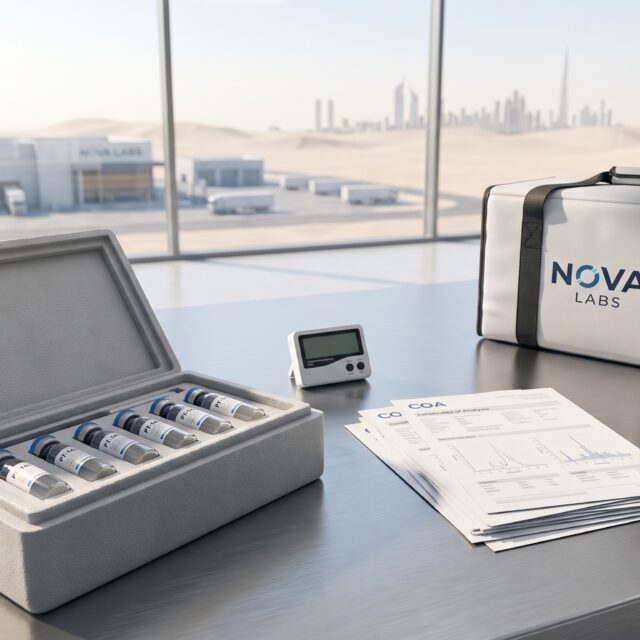
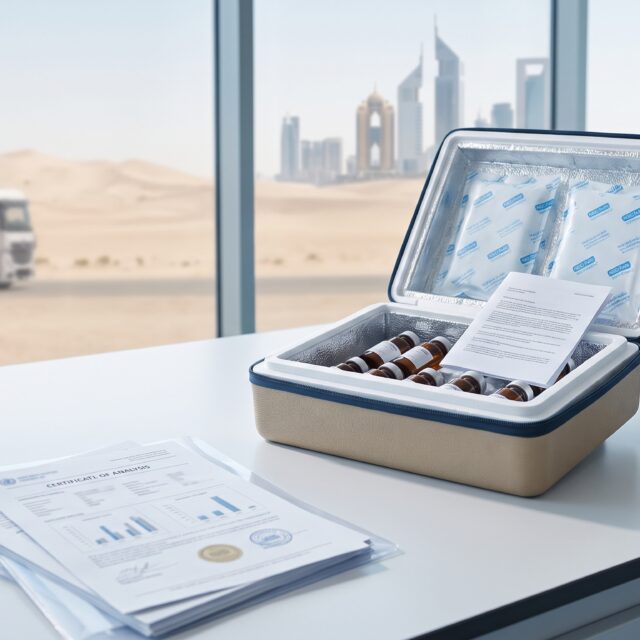
When evaluating a supplier for BPC-157, the Certificate of Analysis (COA) is the primary document of interest. A legitimate COA should not be a generic manufacturer printout from several years ago. It must clearly trace back to the specific batch currently being sold.
Informed buyers should look for two primary forms of analytical data: High-Performance Liquid Chromatography (HPLC) and Mass Spectrometry (MS) reports.
- HPLC Reports: These tests confirm the compound’s purity percentage. For research-grade BPC-157, the industry standard demands a peak-area purity of at least 99 percent, typically evaluated at lambda=214 nm. This specific wavelength is utilized because peptide bonds absorb light strongly at 214 nm, effectively revealing any fragmented or incomplete peptide chains in the sample.
- Mass Spectrometry: This data confirms the exact molecular weight, verifying that the compound is indeed BPC-157 and not a cheaper, mislabeled substitute.
If a supplier obscures testing dates, hides the independent testing facility’s name, or refuses to provide this documentation prior to purchase, buyers should source their materials elsewhere. Transparency is non-negotiable in scientific procurement.
Clinical Sourcing vs. Research Supply: UAE Regulations
The regulatory environment in the UAE is strict, clearly separating clinical therapies from laboratory research materials. Understanding these distinctions is vital for making an informed and compliant purchasing decision.
With the oversight of the Emirates Drug Establishment (EDE) and the Ministry of Health and Prevention (MoHAP), the UAE maintains robust regulatory initiatives targeting unauthorised sources and the illegal marketing of unapproved peptides. Under these clear guidelines, peptides cannot be clinically administered to humans unless specifically registered for that purpose or utilised within approved, supervised clinical trials. BPC-157 is currently classified as an unapproved drug for human therapeutic use.
This framework has polarized the market. On one side, legitimate retail options for self-directed in-vitro studies are strictly labelled and sold as research-grade reference materials. These are intended solely for controlled laboratory environments, cell culture assays, and analytical calibration. On the other side, non-compliant vendors may attempt to sell materials accompanied by dosage instructions or human-use claims—a clear violation of local regulations that responsible researchers must avoid.
Furthermore, researchers involved in sports science must note that BPC-157 has been on the World Anti-Doping Agency (WADA) Prohibited List under Section S0 (Non-Approved Substances) since 2022, making its use strictly prohibited in professional and competitive sports.
The Science of BPC-157: In-Vitro Research Scope
To understand why high-purity procurement is so critical, it is helpful to look at how BPC-157 is utilized in the laboratory. BPC-157 (Body Protection Compound-157) is a synthetic pentadecapeptide consisting of 15 amino acids, originally derived from a protective protein found in human gastric juice.
In purely in-vitro settings, researchers use BPC-157 reference materials to study specific cellular behaviors, such as:
- Fibroblast Migration Assays: Observing how the peptide influences the movement and proliferation of tendon fibroblasts in petri dishes, providing baseline data for tissue remodeling studies.
- Angiogenesis Models: Investigating the compound’s effect on endothelial cell tube formation, exploring its interaction with the nitric oxide (NO) system and vascular endothelial growth factor (VEGF) expression.
- Oxidative Stress Assays: Evaluating the peptide’s capacity to stabilize cells exposed to reactive oxygen species (ROS) in controlled culture environments.
Any impurities, heavy metals, or degraded fragments in the reference material can drastically alter these sensitive assay results, leading to flawed data. This underscores the absolute necessity for >99% purity and strict cold-chain handling.
Cold-Chain Logistics: Handling Peptides in the GCC Climate
The extreme ambient temperatures in the UAE present a unique, persistent challenge for compound stability. Peptides are complex molecular structures highly sensitive to heat, light, and agitation, making the logistics of local delivery just as important as the manufacturing process.
Lyophilised vs. Pre-Reconstituted Stability
High-quality peptide formulations are shipped exclusively as a lyophilised (freeze-dried) powder. In this state, the moisture has been completely removed, drastically slowing degradation. Lyophilised BPC-157 is relatively stable and can withstand brief temperature fluctuations, provided the vial remains vacuum-sealed and protected from UV light. Reconstitution—the process of adding bacteriostatic water to the powder—should only occur immediately prior to laboratory application.
Pre-reconstituted formats (such as pre-mixed liquid solutions) are highly temperature-sensitive. Once in liquid form, compounds must remain in a strict cold-chain environment from the moment of dispatch to final arrival. Due to the rapid degradation of liquid peptides in the intense GCC heat, informed buyers typically avoid pre-mixed solutions entirely.
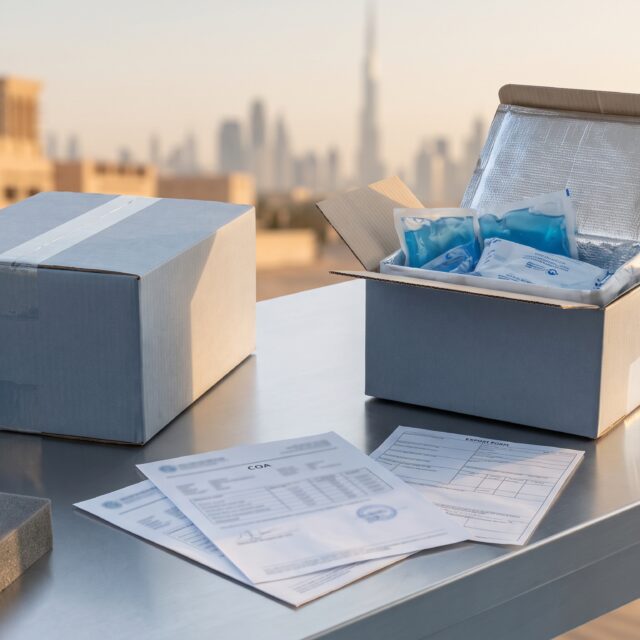
For procurement within the UAE, shipping requires specialised handling. Suppliers must utilise refrigerated courier vehicles maintained between 2 and 8 degrees Celsius. Standard delivery services using loose ice packs in uninsulated boxes are largely insufficient for sustained transit during a Dubai summer. When choosing a vendor, verifying their physical delivery infrastructure is critical. For instance, platforms that offer Dubai same-day peptide delivery via dedicated, temperature-controlled networks provide a significant advantage in preserving the structural integrity of the research material.
Payments, WhatsApp Support, and Purchasing Confidence
The transactional experience in the UAE differs considerably from Western markets. Local buyers expect flexibility in payment terms and highly responsive, direct communication, particularly when dealing with high-value scientific materials.
To accommodate regional buying preferences, leading UAE suppliers integrate diverse and secure payment platforms. These typically include standard credit card gateways, Apple Pay, Google Pay, and modern cryptocurrency options. Furthermore, the availability of interest-free instalment systems (such as Tamara or Tabby) and Cash on Delivery (COD) services signals that a merchant has strong local operational infrastructure and absolute confidence in their fulfilment processes.
Equally important is specialized post-purchase support. Given the high-touch nature of sourcing delicate compounds, reliable UAE merchants manage communications via dedicated WhatsApp business lines. This setup allows for immediate resolution of shipping anomalies, rapid processing of same-day damage replacements, and the direct, frictionless distribution of requested analytical documents. A supplier operating an active, knowledgeable support channel demonstrates a long-term commitment to the research community.
Conclusion and Final Sourcing Checklist
Securing high-quality scientific compounds in the GCC requires diligence and an understanding of the regional logistics landscape. To reliably source BPC-157, laboratory managers and researchers must evaluate the full spectrum of a supplier’s operations—from analytical transparency to temperature-controlled logistics. By demanding verifiable third-party testing and rigorous handling protocols, buyers can confidently procure stable, high-purity reference materials for their laboratory work.
Ready to source verifiable compounds for your next in-vitro study? Explore full analytical documentation and procure lyophilised BPC-157 reference materials through NOVA Labs’ secure UAE platform today.
*
Disclaimer: The products and compounds mentioned in this article are strictly for laboratory research and in-vitro applications only. They are not intended for human consumption, clinical application, or therapeutic use.
References
- Emirates Drug Establishment (EDE) / Ministry of Health and Prevention (MoHAP) Federal Law regulations on unapproved pharmaceutical compounds.
- World Anti-Doping Agency (WADA) 2024 Prohibited List (Section S0 – Non-Approved Substances).
- United States Pharmacopeia (USP-NF) Guidelines for High-Performance Liquid Chromatography (HPLC) analytical standards in peptide synthesis.
- Journal of Applied Physiology: In-vitro angiogenesis and fibroblast migration assay protocols.
Disclaimer: The products mentioned in this article are for research purposes only and are not intended for human consumption.
- BPC-157 – NOVA Labs
- UAE Cracks Down on Unapproved Peptide Weight-Loss Drugs: 71 Sources and 14 Influencers Face Action – Gulf News
- Best Peptide Therapy in Dubai | EDEN AESTHETICS
- BPC-157 5 mg — Research Compound | Wellness Labs UAE
- Buy BPC-157 + TB-500 Blend UAE – Emirates Peptides
Frequently asked questions
Is BPC-157 legal to buy in Dubai?
BPC-157 is legally available strictly as a research-grade reference material for in-vitro laboratory studies. It is classified as an unapproved drug for human therapeutic use and cannot be sold for clinical administration under Emirates Drug Establishment guidelines.
How is BPC-157 shipped in the UAE summer heat?
High-quality local suppliers ship BPC-157 as a stable lyophilised powder and utilize dedicated refrigerated courier vehicles maintaining 2 to 8 degrees Celsius. This prevents rapid degradation during GCC transit.
What should I look for on a BPC-157 COA?
A reliable BPC-157 Certificate of Analysis should show third-party HPLC testing confirming a peak-area purity of at least 99 percent at lambda=214 nm, alongside Mass Spectrometry data verifying the molecular weight.
Are BPC-157 and other peptides banned in sports?
Yes, BPC-157 is strictly prohibited in professional and competitive sports. It has been listed on the World Anti-Doping Agency (WADA) Prohibited List under Section S0 (Non-Approved Substances) since 2022.
Why is lyophilised BPC-157 preferred over pre-mixed solutions?
Lyophilised (freeze-dried) powder is significantly more stable during transit and resistant to temperature fluctuations. Pre-reconstituted liquid solutions degrade rapidly in the GCC climate if a strict cold chain is broken at any point.
Nova Labs buyer tools
Ready to verify stock, testing and delivery?
Use the product page and lab report section to check availability, documentation, delivery timing and support before placing an order.
- COA / test-report checks
- Dubai delivery context
- Cold-chain handling
- COD and card payment options
- WhatsApp support