



Navigating Cold Chain Peptide Delivery in Kuwait
Proper cold chain peptide delivery in Kuwait relies on validated thermal packaging and phase-change materials to maintain a secure 2–8°C environment. With local summer temperatures frequently exceeding 45°C, utilising regional GCC fulfilment prevents customs delays, ensuring research compounds remain potent and chemically stable upon arrival.
Quick Answer: Kuwait Peptide Procurement Checklist
To ensure batch integrity when ordering scientific compounds in Kuwait, buyers must verify several critical logistical factors before purchase:
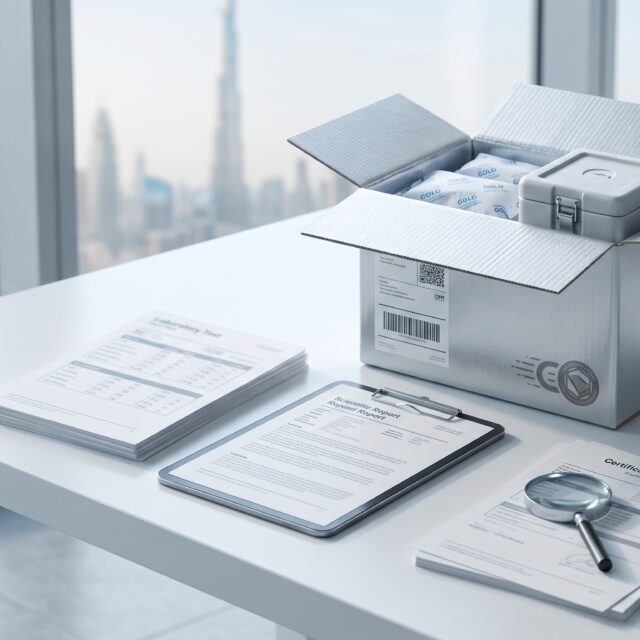
- Thermal Packaging: Insist on vacuum-insulated panels (VIPs) and Phase-Change Materials (PCMs) rather than standard gel ice packs.
- Compound State: Exclusively procure lyophilised (freeze-dried) powders. Pre-reconstituted liquids degrade rapidly in high ambient heat.
- Fulfilment Origin: Source via regional GCC supply routes (like the UAE) to bypass lengthy international customs holds.
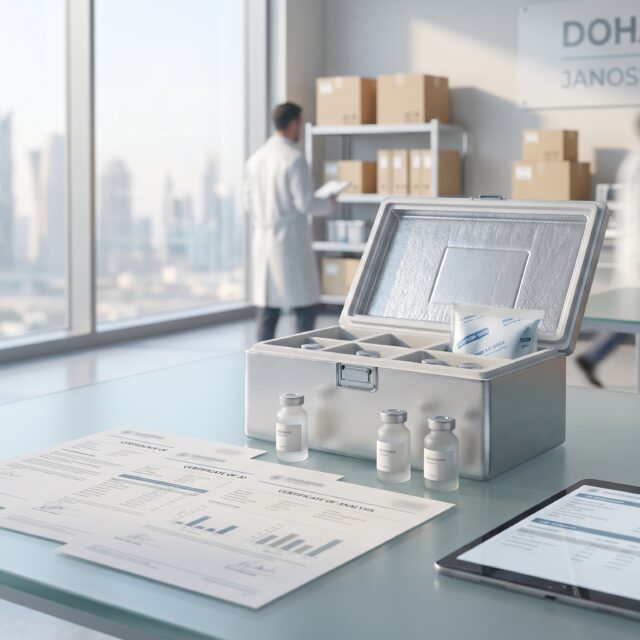
- Documentation: Always require independent, third-party HPLC and Mass Spectrometry Certificates of Analysis (COAs) to confirm baseline purity is >99% prior to transit.
For procurement staff, laboratory researchers, and informed buyers across the Middle East, sourcing high-quality scientific compounds is only half the battle. The true challenge lies in logistics. Kuwait’s extreme desert climate creates a high-stress delivery lane where standard postal services can rapidly degrade temperature-sensitive biological materials. When temperatures regularly climb beyond 45°C during the summer months, the chemical integrity of your order depends entirely on how it is packaged, tracked, and delivered.
Understanding the mechanics behind cold chain peptide delivery in Kuwait is essential for anyone conducting serious research. Without validated thermal preservation, structural degradation pathways accelerate exponentially. This guide examines the critical difference between international and regional shipping routes, the science of molecular preservation in extreme heat, and what you must verify before trusting a supplier with your research investments.
Why Kuwait’s 45°C Heat Threatens Peptide Stability
Peptides are complex chains of amino acids held together by specific sequence bonds. While incredibly versatile for scientific research, these chemical bonds are highly sensitive to environmental stressors—primarily heat, UV light, and moisture.
When a package arrives in Kuwait, it often transitions from an air-conditioned cargo plane to a potentially uncooled airport tarmac or logistics sorting warehouse. If standard, non-insulated shipping methods are used, the internal temperature of the parcel can spike dramatically within minutes.
Heat accelerates the kinetic energy within the peptide structure, stressing the delicate non-covalent bonds that maintain its structural integrity. When exposed to prolonged temperatures above 40°C, the compound can undergo rapid deamidation, hydrolysis, and oxidation. This thermal stress effectively alters the molecular weight and sequence viability, turning a 99% pure analytical sample into degraded, ineffective fragments before the box is even opened in the laboratory.
Lyophilised vs Reconstituted: The Science of Degradation
To properly evaluate logistics risks, buyers must distinguish between the two primary states of research peptides: lyophilised (freeze-dried) powder and reconstituted liquid solutions.
Lyophilised Powder Resilience
Reputable suppliers utilise a commercial lyophilisation process that removes water under low pressure, resulting in a highly stable powder matrix with less than 1% residual moisture. The scientific reality is that high-grade lyophilised peptides are remarkably resilient. Because the near-total absence of water arrests major degradation pathways like hydrolysis, premium freeze-dried powders can withstand ambient temperatures for short transit periods without measurable loss in purity. However, thermal insulation is still required to protect the glass vials from extreme, sudden thermal shocks common in Middle Eastern transit.
The Danger of Reconstituted Liquids
Once a peptide is dissolved in bacteriostatic water or another solvent, its molecular structure becomes highly fragile. Liquid peptides require strict, uninterrupted cold-chain storage at 2–8°C to survive.
Some local competitors in the GCC offer reconstitution services prior to shipping. While convenient for immediate laboratory application, purchasing pre-reconstituted compounds heavily escalates logistical risks in Kuwait. If a liquid peptide is shipped across the region without rigorous, constant refrigeration, it can degrade and lose all biological viability within 24 to 48 hours. For buyers focusing on maximum shelf life and unquestionable batch integrity, acquiring lyophilised powder is universally the safer, more professional choice.
The Customs Bottleneck: International vs Local GCC Shipping
One of the most significant yet under-discussed threats to cold chain peptide delivery in Kuwait is the international customs clearance process.
Standard international couriers shipping from the United States, Europe, or the UK typically take 4 to 10 days to reach Kuwait. However, biological compounds and research chemicals frequently trigger secondary customs inspections. During these administrative delays, packages may sit in uncooled cargo holds or non-temperature-controlled quarantine zones at Kuwait International Airport.
Even the most advanced pharmaceutical cold chain packaging is typically only validated to maintain interior temperatures for 48 to 72 hours. A standard five-day customs hold practically guarantees a temperature breach.
This reality has driven a strong, industry-wide shift toward regional GCC fulfilment. By sourcing from a supplier that dispatches locally from within the UAE or neighbouring Gulf states, buyers bypass the international cargo bottlenecks entirely. Regional courier networks operate with established, rapid clearance protocols across GCC borders. This efficiency allows orders to move from a climate-controlled fulfilment facility to a local Kuwaiti address in a fraction of the time, preserving the thermal envelope of the package.
Anatomy of Proper Cold Chain Packaging
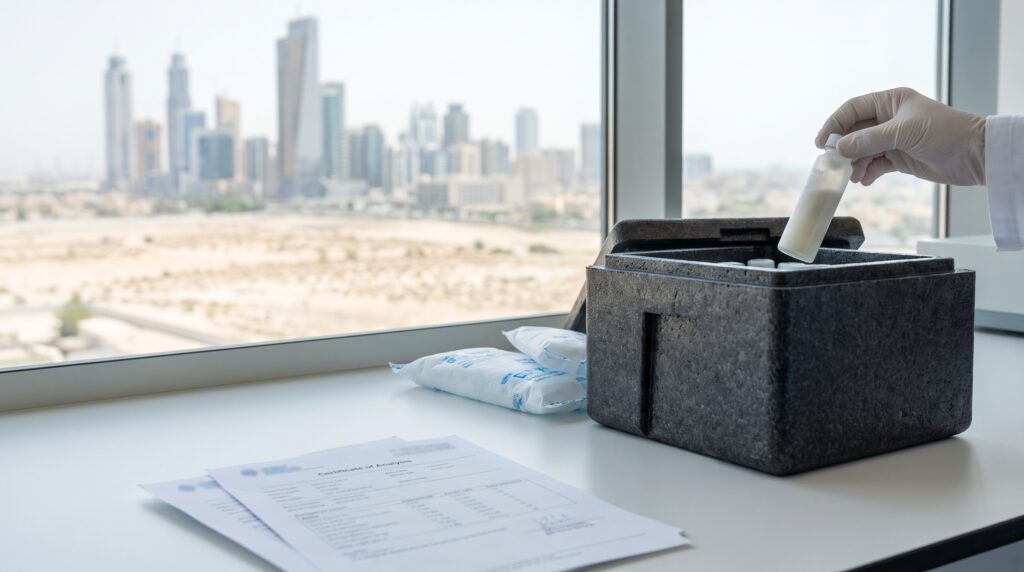
When evaluating a supplier’s logistics, it is vital to understand that true cold chain shipping involves significantly more than tossing a loose ice pack into a cardboard box. In the extreme heat of the GCC, a standard water-based gel pack will completely thaw and reach ambient temperatures within four to six hours.
Sophisticated peptide preservation relies on a scientifically validated thermal system. Professional cold chain packaging typically includes the following layers of protection:
- Thermal Insulated Mailers: High-density polyurethane foam enclosures that drastically slow external heat transfer.
- Vacuum-Insulated Panels (VIPs): Advanced materials that provide significantly higher thermal resistance than standard foam, critical for deflecting the radiant heat of desert environments.
- Phase-Change Materials (PCMs): Unlike water-based ice, PCMs are highly engineered coolants designed to absorb heat and maintain a strict 2–8°C interior environment for up to 72 hours without freezing the lyophilised powder (which could cause micro-fractures in the glass vials).
- Discrete, Protective Housing: Secure, shock-absorbent vial housings that prevent physical agitation, vibration damage, or glass breakage during air transit and final mile delivery.
What to Verify Before Ordering Research Peptides in Kuwait
Before allocating a laboratory budget to biological compounds, discerning buyers should implement a rigorous vetting process. A supplier’s ability to market high purity means very little if their logistics network destroys the product before it reaches your facility.
- HPLC / Mass Spectrometry Verification: Always demand access to independent, third-party Certificates of Analysis (COAs). A credible supplier publishes current batch testing that verifies purity percentages (ideally >99%) and confirms the absolute absence of heavy metals, residual solvents, or unwanted TFA salts.
- Verified Fulfilment Origin: Ascertain exactly where the package is physically shipping from. Relying on a regional hub within the GCC (such as Dubai) drastically reduces transit times and customs exposure compared to transatlantic imports.
- Customer Support and Communication: Logistics in the Middle East can be unpredictable. Look for suppliers who offer responsive, localised support—such as dedicated WhatsApp channels—so that you can coordinate exact delivery windows, preventing packages from being left outside in the intense afternoon heat.
- Payment Flexibility & Security: Secure procurement often requires flexibility. Verify if the supplier offers reliable regional payment gateways or options that accommodate institutional purchasing protocols to lower buyer risk during the transaction.
Secure Procurement with NOVA Labs
At NOVA Labs, we understand that chemical purity must be preserved through every step of the supply chain. Operating strategically out of Dubai, UAE, we have engineered our logistics network specifically to handle the unique environmental and administrative challenges of the Middle East.
By leveraging localized regional infrastructure, we eliminate the lengthy customs delays associated with overseas imports. Our commitment to secure handling means that whether you are evaluating purity reports or tracking a critical shipment across the GCC, you have full transparency into the process.
We provide seamless access to high-purity research peptides that are strictly third-party tested, backed by transparent COAs. For our regional clients, our geographical proximity allows for rapid UAE and regional dispatch, utilising optimized cold-chain packaging systems to protect the molecular stability of every lyophilised vial until it securely reaches your hands.
Conclusion and Next Steps
Procuring sensitive biological compounds in Kuwait requires a proactive, educated approach to logistics. The extreme summer heat, combined with the administrative friction of international shipping, makes standard postal delivery unviable for serious research procurement. By prioritising suppliers who utilise validated cold-chain packaging, dispatch locally from within the GCC, and provide transparent COA documentation, buyers can confidently secure the purity and potency of their research investments.
If you are evaluating suppliers for your next analytical project, prioritise regional stability and rigorous batch testing over cheap, unverified international imports. Protect your research by partnering with a logistics-aware supplier. Explore our verified catalogue today to ensure your next study is backed by uncompromised, lab-verified compounds.
Disclaimer: The products mentioned in this article are strictly for research purposes only and are not intended for human consumption, therapeutic use, or medical treatment.
*
References
- World Health Organization (WHO). “Guidelines on the international packaging and shipping of vaccines.” WHO/IVB/05.23.
- United States Pharmacopeia (USP). “General Chapter <1079> Good Storage and Distribution Practices for Drug Products.”
- International Safe Transit Association (ISTA). “ISTA 7D: Temperature Test for Transport Packaging.”
- Journal of Pharmaceutical Sciences. “Impact of Moisture and Temperature on Lyophilized Protein Stability.”
- GCC Peptides — Research Grade Peptides Kuwait & GCC | 99% Purity Lab Verified
- Cold Chain Shipping: What the Science Actually Says – Lone Star Peptide Co.
- Lyophilized Peptide Shelf Life: Storage Guide for UAE – NOVA Labs
- Do Peptides Degrade During Shipping Without Refrigeration? Facts vs. Myths
- What Happens If You Don’t Refrigerate Peptides? Stability Research – NorthPeptide
- Cold Chain Peptide Shipping Services Explained – RapidFulfillment.com
- Peptides Lab GCC – High-Purity Research Peptides | GCC Supply for Laboratories
Frequently asked questions
Do research peptides degrade during shipping to Kuwait?
Yes, if shipped without proper thermal protection, extreme heat can degrade sensitive compounds. However, high-quality lyophilised (freeze-dried) peptides with less than 1% moisture are highly stable and can survive short transit times in warm environments if insulated properly.
What is the difference between lyophilised and reconstituted peptide shipping?
Lyophilised peptides are in a stable, freeze-dried powder form that resists heat degradation effectively during transit. Reconstituted peptides are liquid solutions that are highly fragile, degrade rapidly in ambient heat, and require strict, uninterrupted refrigeration.
How long does cold chain packaging maintain its temperature?
Professional cold chain packaging utilizing Vacuum-Insulated Panels (VIPs) and Phase-Change Materials (PCMs) is typically validated to maintain a strict 2-8°C interior environment for 48 to 72 hours, depending on external temperatures.
Why is local GCC fulfilment better than international shipping for peptides?
Local GCC fulfilment bypasses international customs bottlenecks, reducing transit times from over a week to just a few days. This eliminates the risk of temperature-sensitive packages sitting in uncooled cargo holds at Kuwait International Airport, preserving compound purity.
Nova Labs buyer tools
Ready to verify stock, testing and delivery?
Use the product page and lab report section to check availability, documentation, delivery timing and support before placing an order.
- COA / test-report checks
- Kuwait delivery context
- Cold-chain handling
- COD and card payment options
- WhatsApp support