


How to Safely Buy PT-141 in Dubai
To safely buy PT-141 in Dubai, researchers must prioritize domestic UAE suppliers offering transparent third-party Certificates of Analysis (COAs) and strict cold-chain logistics. Local sourcing eliminates international customs risks and protects fragile lyophilized peptides from severe degradation caused by extreme Gulf temperatures during transit.
Buyer Checklist: Sourcing Peptides in the UAE
- Verify Compliance: Ensure the supplier strictly labels and sells compounds for “Research Use Only” (RUO) to align with UAE regulations.
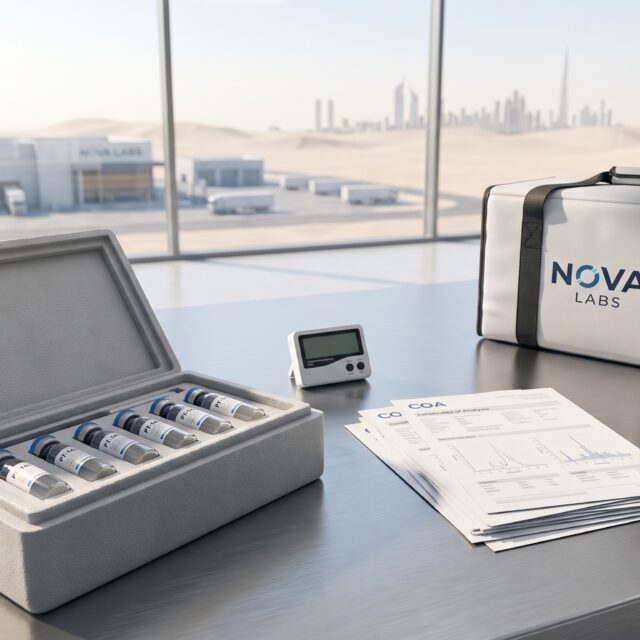
- Demand Independent COAs: Accept only unredacted third-party laboratory reports (such as Janoshik) that confirm both HPLC purity and Mass Spectrometry (MS) identity.
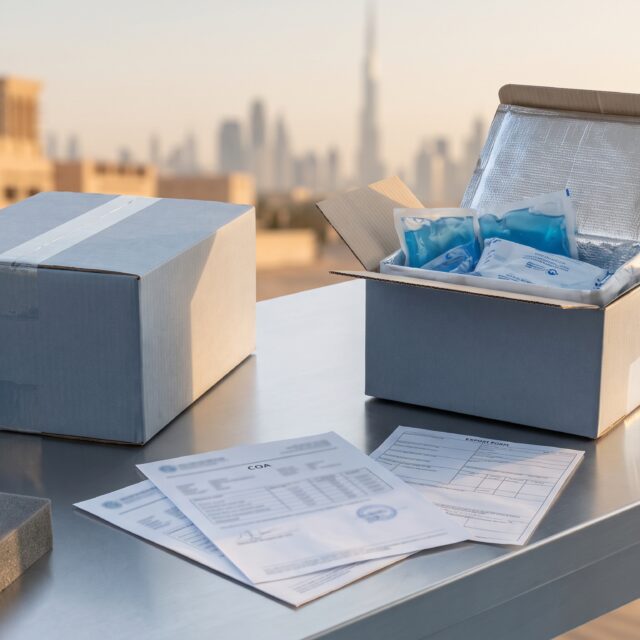
- Require Cold-Chain Logistics: Confirm the supplier uses insulated thermal packaging and localized couriers to prevent heat degradation.
- Source Domestically: Buy from suppliers with existing inventory cleared in the UAE to avoid customs seizures and long international transit times.
- Check Support Options: Look for suppliers offering responsive, localized B2B support (like WhatsApp) and flexible procurement options.
The Role of PT-141 in Laboratory Research
Procuring research peptides in the UAE requires a highly strategic approach. While the global market is flooded with synthetic compounds, researchers operating in the Gulf Cooperation Council (GCC) face unique logistical and regulatory hurdles. PT-141, scientifically classified as Bremelanotide, is a synthetic peptide studied extensively for its binding affinity to melanocortin receptors.
In laboratory settings, PT-141 is frequently utilized in in-vitro assays mapping receptor pathways and evaluating non-vascular mechanisms of cellular response. Because these molecular interactions require pristine compound integrity, ensuring the stability and purity of the peptide from synthesis to the laboratory bench is critical for reproducible data.
International vs. Domestic Sourcing: Navigating UAE Customs
The UAE maintains a highly sophisticated and stringently monitored import infrastructure designed to protect public safety and regulate pharmaceutical and research imports. Historically, many independent researchers and university labs relied on international peptide suppliers located in the US, UK, or China. However, this route presents significant operational risks in today’s regulatory climate.
Recent industry data suggests that international peptide shipments face high customs scrutiny when entering the UAE. Even when overseas vendors offer shipping insurance to offset the financial loss of a seizure, the resulting delays can severely disrupt strict research timelines. The regulatory environment in the UAE is also tightening for unverified compounds. In July 2024, the Emirates Drug Establishment (EDE) launched a major enforcement crackdown targeting unapproved peptide sources, underscoring the government’s commitment to strict biomedical oversight.
Under Federal Decree-Law No. (38) of 2024, medical product regulation and import permits have been consolidated under the EDE. To comply with local regulations, peptides imported for non-clinical laboratory evaluation must be strictly labeled and sold for ‘Research Use Only’ (RUO). Purchasing from domestic suppliers who already hold cleared stock within the UAE eliminates cross-border friction entirely. By sourcing locally, researchers bypass the risk of customs seizures and ensure their procurement aligns flawlessly with domestic RUO compliance standards.
Surviving the Gulf Heat: Cold-Chain Logistics
The most critical environmental factor when ordering PT-141 in Dubai is temperature control. Peptides are complex, fragile amino acid chains that are highly susceptible to physical and chemical degradation when exposed to UV light, excessive agitation, or extreme heat.
During the peak of the UAE summer, temperatures easily exceed 60°C on airport tarmacs or inside un-airconditioned delivery vans. A standard international postal parcel sitting in these conditions will almost certainly cause the lyophilized powder inside the vial to denature. When peptides degrade, their molecular structure breaks down or forms impurities, rendering them useless for precise, controlled research applications.
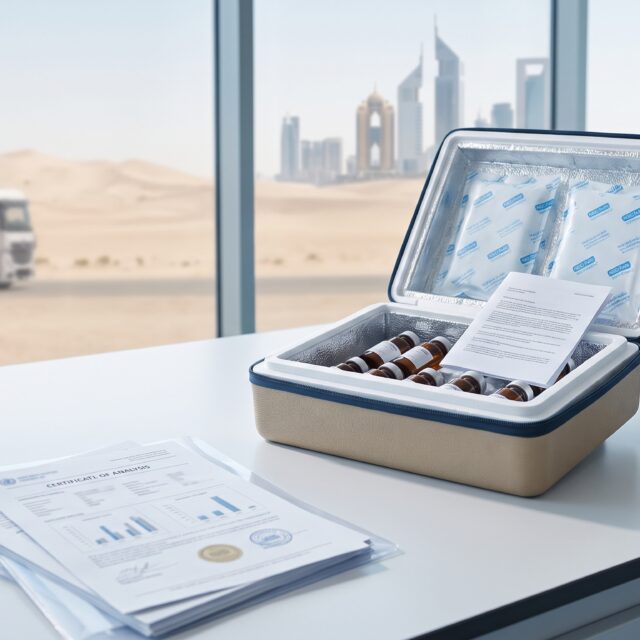
To protect compound integrity, researchers must insist on cold-chain logistics. Premium domestic suppliers utilize specialized packaging—involving heavily insulated thermal mailers and high-capacity gel packs—and coordinate with local, temperature-controlled couriers. This infrastructure ensures the vial remains in a stable environment from the supplier’s climate-controlled warehouse directly to the researcher’s facility.
If you are operating under tight deadlines or require maximum stability for highly sensitive assays, leveraging same-day delivery options across the UAE minimizes the transit window. Fast, localized dispatch guarantees your compounds arrive in pristine condition, ready for immediate refrigeration or reconstitution.
Validating PT-141 Suppliers: The COA Checklist
The global peptide market relies heavily on trust, but in a scientific laboratory, trust must be verified mathematically. The single most important document when sourcing PT-141 is the Certificate of Analysis (COA). Discerning buyers must look past in-house supplier claims and demand comprehensive, independent, third-party testing.
Purity vs. Identity: The HPLC and MS Difference
A robust and reliable COA confirms two entirely distinct metrics: purity and identity. Both are non-negotiable for serious research.
- HPLC (High-Performance Liquid Chromatography): This analytical test measures compound purity by separating the various components in a liquid mixture. A high-quality PT-141 vial should demonstrate an HPLC purity of 99% or higher, indicating a lack of synthetic byproducts or heavy metals. However, HPLC alone only tells you how pure a substance is; it does not confirm what the substance actually is.
- MS (Mass Spectrometry): This test measures the mass-to-charge ratio of ions, effectively providing the precise molecular fingerprint of the peptide. MS is strictly required to confirm that the highly pure substance inside the vial is, in fact, Bremelanotide, and not a cheaper substitute or entirely different compound.
Spotting Forged Reports in the UAE Market
In the current market, Janoshik Analytical is widely recognized as the gold standard for independent, reliable peptide testing. Unfortunately, forged or altered Janoshik reports are frequently used by substandard suppliers to move low-grade stock.
When evaluating a supplier’s COA, look for immediate red flags: redacted task numbers, hidden client names, mismatched dates, or low-resolution images. Legitimate, premium suppliers operate with total transparency. They will provide an unredacted Janoshik task number that you can manually enter at the official Janoshik verification portal to confirm the lab report’s authenticity directly with the testing facility in real-time.
Payment, Support, and GCC Procurement
Sourcing compounds in the GCC often requires localized financial and logistical support that international vendors simply cannot provide. Procurement teams and independent researchers benefit greatly from suppliers who offer flexible, localized payment gateways.
Look for domestic suppliers offering Cash on Delivery (COD) across the UAE, secure local bank transfers, or cryptocurrency options. Furthermore, responsive B2B support is vital. A supplier offering direct WhatsApp communication allows procurement teams to quickly verify stock levels, request updated COAs, or coordinate specific delivery windows before placing a high-value order.
Proper Laboratory Handling and Storage
PT-141 is typically supplied to researchers as a lyophilized (freeze-dried) powder, most commonly in 10mg vials. This specific format provides the highest level of structural stability during transport and storage prior to reconstitution.
While in-clinic peptide therapy is legally offered by licensed Dubai clinics under strict medical supervision, independent researchers must purchase RUO vials strictly for laboratory in-vitro use. Once a vial of PT-141 arrives at the lab, rigorous standard handling protocols must be applied to prevent accidental degradation:
- Visual Inspection: Verify the integrity of the vacuum seal. The lyophilized puck should appear as a solid, uniform white disc or powder, free from discoloration or excessive crystallization.
- Long-Term Storage: Unreconstituted vials must be stored away from ambient light and heat. For long-term preservation (months to years), store the vials in a laboratory freezer at -20°C.
- Reconstitution Protocols: The powder must be reconstituted using bacteriostatic water or sterile water for injection, depending entirely on the experimental design and required cell-culture conditions.
- Post-Reconstitution Care: Once the diluent is added, the peptide bonds become highly fragile. The solution must never be shaken aggressively. Instead, it should be gently swirled until clear, stored in a refrigerator (2°C to 8°C), and utilized within the timeframe dictated by your specific research protocol to avoid efficacy loss.
Securing Verifiable PT-141 from NOVA Labs
For procurement specialists and lead researchers comparing PT-141 suppliers in Dubai, NOVA Labs provides a streamlined, secure, and highly transparent sourcing experience tailored explicitly for the GCC. We understand the specific logistical, environmental, and regulatory challenges of operating in the UAE.
By maintaining our inventory locally, we completely eliminate the customs delays and seizure risks associated with international shipping. Every single batch of PT-141 we supply is backed by transparent, verifiable, third-party Janoshik testing that confirms both HPLC purity (typically >99%) and MS molecular identity. We never redact our reports—researchers can verify our task numbers instantly.
NOVA Labs utilizes strict cold-chain handling protocols and coordinates temperature-controlled local dispatch to ensure your compounds are protected from the harsh UAE climate. We offer flexible local payment options, including UAE-wide Cash on Delivery (COD), and provide highly responsive WhatsApp support to answer any procurement or documentation queries immediately.
Ready to secure premium research compounds without the international hassle? Explore our complete catalogue of research peptides to find verifiable, high-purity PT-141 for your laboratory today.
Conclusion
Sourcing PT-141 in Dubai doesn’t need to be a logistical gamble. By prioritizing local suppliers who can guarantee zero customs friction, secure cold-chain delivery, and transparent third-party COAs, researchers can protect their budgets and ensure the absolute accuracy of their laboratory work. Always demand independent verification for both purity and molecular identity, and ensure your procurement adheres strictly to UAE Research Use Only guidelines to guarantee seamless, compliant research operations.
Disclaimer: The products and information mentioned in this article are strictly for in-vitro research and laboratory applications. They are not intended for human consumption, therapeutic use, or medical treatment.
References
- Gulf News (July 2024). “UAE Cracks Down on Unapproved Peptide Weight-Loss Drugs: 71 Sources and 14 Influencers Face Action.”
- VaultLabs Hub. “Research Peptides UAE Regulatory Overview.”
- Emirates Drug Establishment (EDE). “Federal Decree-Law No. (38) of 2024 on Medical Products.”
- Janoshik Analytical. “Third-Party Peptide Testing: HPLC, Janoshik & Purity.”
- Pharmareg. “Peptide Import & Registration UAE | Licensed Pathway.”
Disclaimer: The products mentioned in this article are for research purposes only and are not intended for human consumption.
- UAE Cracks Down on Unapproved Peptide Weight-Loss Drugs: 71 Sources and 14 Influencers Face Action – Gulf News
- Research Peptides UAE Regulatory Overview | VaultLabs Hub
- PT141 – RegenMed
- Third-Party Peptide Testing: HPLC, Janoshik & Purity
- Peptide Import & Registration UAE | Licensed Pathway – Pharmareg
- dubai peptide laws UAE introduces new law to regulate medicines, pharmacies – FIBAV
- Peptide Shipment Delayed? Cold-Chain Solutions
Frequently asked questions
Is it legal to buy PT-141 in Dubai?
In Dubai, PT-141 is legally available exclusively as a Research Use Only (RUO) compound. It must be purchased strictly for laboratory or in-vitro investigative purposes, in full compliance with Emirates Drug Establishment (EDE) guidelines.
How do I verify a PT-141 supplier in the UAE?
Always request a third-party Certificate of Analysis (COA) that includes both HPLC purity and Mass Spectrometry (MS) identity testing. For Janoshik reports, use the unredacted task number on their official verification portal to ensure the document is authentic.
Why is cold-chain delivery important for peptides in Dubai?
Lyophilized peptides like PT-141 degrade rapidly in extreme heat. During the UAE summer, tarmac temperatures easily exceed 60°C, making insulated packaging and temperature-controlled local couriers essential for preserving the molecular integrity of the compound.
What is the difference between international and domestic PT-141 suppliers?
International suppliers face significant customs scrutiny, seizure risks, and longer transit times that expose peptides to heat degradation. Domestic UAE suppliers offer locally cleared stock, faster cold-chain delivery, and eliminate cross-border customs friction.
How should PT-141 be stored once it arrives at a UAE laboratory?
Unreconstituted lyophilized PT-141 should be stored away from light in a freezer at -20°C for long-term preservation. Once reconstituted for active research, the vial must be kept in a refrigerator between 2°C and 8°C.
Nova Labs buyer tools
Ready to verify stock, testing and delivery?
Use the product page and lab report section to check availability, documentation, delivery timing and support before placing an order.
- COA / test-report checks
- Dubai delivery context
- Cold-chain handling
- COD and card payment options
- WhatsApp support