



Procuring high-quality research compounds in the Middle East requires more than just finding a storefront with active inventory. As the market for advanced biochemicals expands, laboratories, procurement staff, and informed researchers must know how to separate legitimate scientific suppliers from opportunistic dropshippers. Identifying peptide supplier red flags early can save researchers from wasted budgets, degraded compounds, and compromised experimental data.
Operating in the UAE and wider GCC adds another layer of complexity. From extreme summer temperatures in Dubai and Abu Dhabi that threaten compound stability to specific import classification codes, local buyers face unique logistical hurdles. This guide outlines exactly what to check before placing an order, focusing on documentation transparency, pricing realities, and local climate handling.
What Are the Biggest Peptide Supplier Red Flags?
The biggest peptide supplier red flags include missing or unverified Certificates of Analysis (COAs), unrealistically low prices indicating skipped purification steps, non-climate-controlled shipping in high-heat regions like the UAE, and lifestyle marketing that violates strict Research Use Only (RUO) standards.
Key Takeaways: Supplier Evaluation Checklist
- Batch-Specific COAs: Reject any supplier using generic, outdated, or in-house testing PDFs. Demand independent, third-party verification.
- Synthesis Pricing: Extremely low costs usually mean the manufacturer skipped critical HPLC purification, leaving synthesis byproducts in the vial.
- GCC Logistics: Avoid international dropshippers. Look for local UAE inventory to bypass extended customs delays in non-air-conditioned warehouses.
- Strict RUO Compliance: Avoid vendors offering human-use protocols or lifestyle advice; legitimate suppliers sell exclusively for laboratory research.
- Payment Infrastructure: Look for standard UAE merchant processing, local currency (AED) billing, secure Cash on Delivery (COD) options, and responsive support channels.
The 5-Step COA Audit: Don’t Fall for Static PDFs
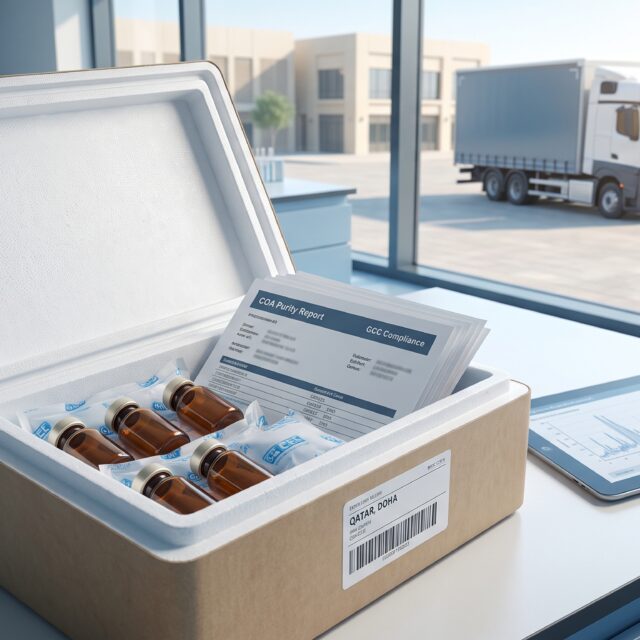
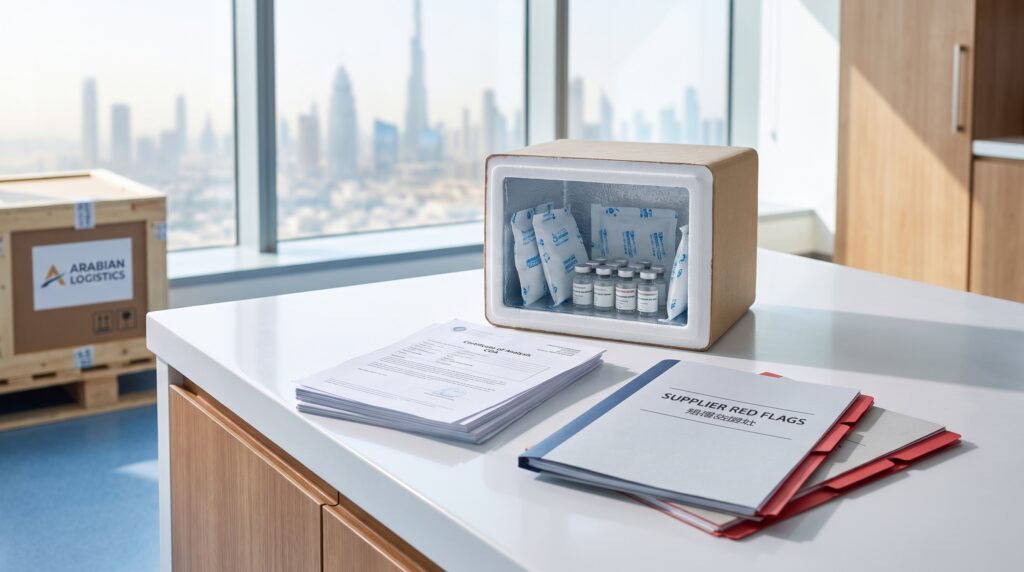
The single most important document in the procurement process is the Certificate of Analysis (COA). However, simply having a link labeled “COA” on a website is not enough. Many low-quality suppliers upload generic, outdated, or manipulated PDFs that do not reflect the actual inventory in their warehouse. A rigorous sourcing audit always starts with thorough documentation verification.
When reviewing a vendor’s testing data, follow these verification steps:
- Batch Number Matching: The lot or batch number printed on the physical vial you receive must exactly match the lot number on the published COA. If a supplier uses one “master” COA for years across multiple batches, the document is meaningless.
- Independent Third-Party Testing: The analysis should be conducted by a recognized, independent analytical laboratory. In-house testing without third-party validation presents a massive conflict of interest and is heavily frowned upon in institutional procurement.
- Verification Keys: Reputable analytical labs issue a unique verification key or barcode on their reports. You should be able to visit the testing lab’s official website, enter the key, and pull up the identical report directly from their servers. If a report lacks a verifiable key, consider the compound unverified.
- HPLC and MS Transparency: The report must include both High-Performance Liquid Chromatography (HPLC) data and Mass Spectrometry (MS) data. HPLC separates the molecules in a solution, allowing analysts to quantify the presence of the primary compound versus impurities. A reliable COA should show a primary peak representing at least 99% purity. Meanwhile, MS measures the mass-to-charge ratio of ions, ensuring the molecular identity matches the expected theoretical weight. Missing either graph is an immediate red flag.
- Recent Testing Dates: Research materials can experience structural degradation over time. If the COA is several years old, it no longer represents the current stability of the compound in the supplier’s inventory.
To see how a transparent documentation system should function in practice, researchers can explore our complete lab results database, which links batch numbers directly to verifiable third-party testing data.
Why Unrealistic Underpricing is a Major Warning Sign
Budget optimization is a priority for any procurement department, but drastically underpriced compounds are one of the most reliable peptide supplier red flags. Understanding why involves a brief look at the science of manufacturing.
Research compounds are synthesized using Solid-Phase Peptide Synthesis (SPPS). This is a highly specialized, multi-step process requiring expensive reagents, sterile environments, and extensive time. After synthesis, the raw compound must undergo rigorous HPLC purification to strip away truncated sequences and synthesis byproducts left over from the cleavage stage.
If a vendor is selling a compound at 50% to 70% below the average market rate, they are not offering a wholesale discount—they are skipping critical purification steps, utilizing degraded raw materials, or heavily underdosing the vials. In chemical synthesis, purity dictates cost. Buying the cheapest available vial often guarantees high levels of contamination. Utilizing contaminated materials will fatally skew in-vitro cellular assays, yield irreproducible results, and ultimately compromise the integrity of your entire experiment.
The UAE Summer Heat Test: Logistics and Cold-Chain Handling
Regional logistics present a unique challenge that many international dropshippers fail to address. In the UAE and wider GCC, summer temperatures routinely exceed 40°C (104°F). Lyophilized (freeze-dried) compounds are relatively stable compared to reconstituted solutions, but prolonged exposure to extreme heat can still cause molecular degradation and loss of structural integrity.
When shipping lyophilized research materials across the GCC, thermal fluctuations can degrade delicate molecular bonds. Standard international couriers may leave parcels in uninsulated sorting facilities where ambient temperatures easily exceed 45°C. A significant red flag for UAE buyers is a supplier that relies exclusively on these standard networks without expedited local routing or climate-aware packaging.
Legitimate local suppliers mitigate this risk by:
- Holding Local Inventory: Shipping directly from warehouses within the UAE prevents compounds from being delayed in lengthy international customs queues.
- Expedited Routing: For institutional buyers in Dubai, Abu Dhabi, or Sharjah, relying on local UAE inventory ensures the transition from a climate-controlled storage facility to the laboratory workbench takes hours rather than days, preserving the integrity of the compounds.
- Proper Import Classification: Reputable vendors ensure products are imported under the correct general-trade chemical HS codes (such as HS 2106.10.00 or HS 3504.00.10) rather than misdeclaring them. Misdeclared packages face seizure or extended delays in hot warehouses while awaiting secondary inspection.
If a vendor cannot clearly explain their handling protocols for high-heat GCC environments, researchers should source their materials elsewhere.
RUO Compliance vs. Lifestyle Marketing
The terminology a supplier uses on their website is a clear indicator of their operational legitimacy. True research compounds are manufactured and sold strictly for Research Use Only (RUO). They are intended for in-vitro cellular assays, mass spectrometry calibration, and controlled laboratory environments.
One of the most glaring peptide supplier red flags is the presence of lifestyle marketing. If a website features before-and-after photos, makes explicit claims regarding physical outcomes, offers human usage protocols, or guarantees specific biological changes, they are operating outside of safe, legal, and ethical industry standards.
Suppliers that flout RUO guidelines often cut corners in manufacturing as well. A vendor willing to illegally market non-approved chemicals as human supplements is rarely investing in strict HPLC purification or expensive third-party batch testing. Professional laboratories will only partner with suppliers whose marketing, labeling, and documentation reflect strict scientific compliance.
Payment Processor Violations and Local Trade Licensing
Financial infrastructure reveals a lot about a company’s structural integrity. Under global payment processing guidelines, the sale of RUO chemicals requires specialized, high-risk merchant underwriting.
If you encounter a supplier using a standard, unmasked checkout gateway for research compounds, they are likely miscoding their transactions to evade merchant rules. This instability often leads to frozen funds, canceled orders, and unfulfilled shipments. Conversely, suppliers that only accept cryptocurrency—offering zero consumer protection or chargeback avenues—present a different type of risk for institutional buyers.
In the UAE, structural legitimacy is further proven by local operational presence. Legitimate vendors manage their operation as a compliant local business. Does the vendor offer local Cash on Delivery (COD)? Do they bill in local currency (AED)? Do they provide dedicated local support, such as a responsive WhatsApp line for procurement inquiries? A supplier offering localized support and secure regional payment gateways has verified inventory on the ground and a vested interest in maintaining a strong local reputation.
Evaluating Scientific Customer Support
Beyond the transactional elements, evaluate how the supplier handles technical inquiries. In a legitimate biochemical supply operation, customer support should be capable of answering basic structural and analytical questions. If you ask a supplier about the solubility of a specific lyophilized compound, the reconstitution requirements for an in-vitro assay, or request clarity on an HPLC readout, and they cannot provide a coherent scientific answer, proceed with extreme caution. Opportunistic dropshippers rarely understand the science behind the products they sell.
Buying Research Materials with Confidence in the UAE
Evaluating a new vendor does not have to be a gamble. By relying on a strict UAE sourcing checklist—demanding batch-specific third-party COAs, avoiding unrealistic synthesis pricing, insisting on local climate-controlled logistics, and verifying RUO compliance—researchers can secure pure, high-quality compounds for their analytical studies.
Transparency, local infrastructure, and verified analytical data are the cornerstones of a trustworthy supply chain. When your laboratory is ready to source high-purity compounds backed by rigorous third-party testing, explore our complete catalog in the NOVA Labs shop to ensure your next study is built on a foundation of uncompromised quality.
Disclaimer: The products mentioned in this article are for research purposes only and are not intended for human consumption or therapeutic use.
References
- Mastercard BRAM Compliance Guide – Operational standards for high-risk scientific merchants.
- Janoshik Analytical – Standard protocols for verifiable third-party biochemical testing.
- UAE Federal Customs Authority – Import guidelines for laboratory and chemical compounds (HS Codes 2106 / 3504).
- Journal of Peptide Science – Overview of Solid-Phase Peptide Synthesis (SPPS) and analytical impurity profiling.
- Buying Research Peptides UAE — the 2026 buyer-evaluation guide – Wellness Labs
- How to Spot a Fake Peptide COA: 5 Red Flags | Peptify UK
- How to Spot a Low-Quality Peptide Supplier: 8 Red Flags – Dissolv Labs
- Nova Labs Review 2026: UAE Peptide Supplier COA and Cold-Chain Audit – Peptides Defined
- NOVA Labs UAE Review 2026: COA Audit, Prices and Delivery – PeptideStat
- Nova Biolabs vs Peptide Lab UAE | 2026 Sourcing Comparison
- How to Avoid Peptide Scams: Best Guide 2026 – PSPeptides
Frequently asked questions
What is the biggest red flag when choosing a peptide supplier?
The most significant red flag is the absence of a batch-specific, verifiable Certificate of Analysis (COA) from an independent third-party laboratory. If a supplier uses a generic or outdated testing document, the purity of the compound cannot be trusted.
How do I know if a peptide COA is fake?
You can verify a COA by checking if the lot number exactly matches the vial, and by entering the report's unique verification key directly on the testing laboratory's official website. Authentic reports will always be hosted on the independent third-party tester's server.
Why are some peptide suppliers so much cheaper?
Drastically lower prices usually indicate that the vendor skipped critical, expensive purification steps like HPLC during Solid-Phase Peptide Synthesis. Underpriced vials are a major red flag for high levels of contamination, degraded raw materials, or severe underdosing.
Does shipping in the UAE summer affect research peptides?
Yes, prolonged exposure to extreme GCC heat inside standard courier hubs can degrade lyophilized compounds. It is crucial to use a local supplier that utilizes rapid, climate-aware routing and domestic inventory to bypass lengthy international customs delays.
Is it safe to buy from a peptide supplier offering dosing protocols?
No. Reputable suppliers sell products strictly for Research Use Only (RUO) and will never provide human-use guidelines, lifestyle advice, or biological outcomes. A vendor providing medical protocols is violating ethical, legal, and safety industry standards.
Nova Labs buyer tools
Ready to verify stock, testing and delivery?
Use the product page and lab report section to check availability, documentation, delivery timing and support before placing an order.
- COA / test-report checks
- UAE delivery context
- Cold-chain handling
- COD and card payment options
- WhatsApp support