
Mastering Peptide Storage Temperature Abu Dhabi
The ideal peptide storage temperature in Abu Dhabi depends on the state of the compound. Unopened lyophilised peptides must be stored at 2–8°C for medium-term use or -20°C for long-term reserves. Once reconstituted, liquid research compounds require strict continuous refrigeration at 2–8°C to prevent rapid molecular degradation.
Key Takeaways for UAE Researchers
- Lyophilised (Powder): Store safely at 2–8°C (viable up to 36 months) or -20°C for multi-year long-term preservation.
- Reconstituted (Liquid): Maintain strict refrigeration at 2–8°C at all times. Never place liquid compounds into standard freezers.
- Handling: Acclimatise cold vials to room temperature before opening to avoid condensation buildup.
- Logistics: Source from domestic UAE suppliers to eliminate international transit delays and destructive tarmac heat exposure.
For research laboratories, academic institutions, and independent buyers in the UAE, sourcing high-quality biomolecules is only the first step. The true challenge lies in preserving the structural integrity of these fragile compounds. The climate in the GCC presents unique logistical hurdles, where ambient summer temperatures routinely exceed 45°C and relative humidity fluctuates aggressively. Understanding how these environmental variables interact with delicate amino acid sequences is critical for any successful experimental design.
A degraded compound not only skews experimental data but also results in wasted procurement budgets. This guide breaks down the precise temperature requirements, the dangers of international transit, the vital role of third-party testing, and how to properly evaluate local suppliers capable of sustaining an unbroken cold chain.
The Two States of Storage: Lyophilised vs. Reconstituted
Peptides exist in two primary physical states during their lifecycle in a laboratory: lyophilised (freeze-dried powder) and reconstituted (mixed into a liquid state). Each phase dictates a completely different set of thermal management rules and best practices.
Lyophilised (Powder) Guidelines
When peptides arrive from a reputable supplier, they are almost exclusively in a lyophilised state. This complex freeze-drying process effectively removes moisture from the compound, rendering the molecular structure relatively stable—provided the vacuum seal remains completely intact.
- Medium-Term Storage (Up to 36 Months): Unopened vials should be stored securely in a standard laboratory or dedicated storage refrigerator at 2–8°C. At this temperature range, the lyophilised powder is protected against accelerated thermal degradation and maintains a highly stable shelf life.
- Long-Term Storage (Years): For bulk research reserves or materials that will not be utilized in the current experimental programme, store the unopened vials in a deep laboratory freezer at -20°C or lower. This effectively suspends any potential degradation processes indefinitely.
Reconstituted (Liquid) Rules
The moment a peptide is reconstituted with a laboratory solvent, its molecular bonds become highly vulnerable to temperature fluctuations, light exposure, mechanical agitation, and bacterial contamination.
- Strict Refrigeration: All reconstituted liquid research compounds must be kept strictly at 2–8°C.
- The Freezing Danger: Never place a reconstituted liquid peptide into a standard laboratory or household frost-free freezer. The freezing process causes microscopic ice crystals to form within the liquid. These crystals act like tiny blades that shear and permanently destroy the delicate peptide chains, ruining the compound.
- Solvent Selection and Shelf Life: When reconstituted with bacteriostatic water (which contains 0.9% benzyl alcohol to effectively inhibit bacterial growth), compounds typically remain stable and viable for 28 to 60 days when refrigerated. If sterile water is utilized instead, the viability window drops drastically to a mere 5 to 7 days, as there is no antimicrobial agent present.
Navigating the Abu Dhabi “Condensation Trap”
One of the most frequently overlooked aspects of managing the peptide storage temperature in Abu Dhabi is the region’s intense relative humidity, particularly during the transition months between summer and winter. This creates a highly specific threat known in procurement and lab circles as the ‘condensation trap.’
Because lyophilised peptides are inherently hygroscopic (meaning they readily attract and absorb water from the surrounding environment), exposing cold powder to warm, humid ambient air is a recipe for instant molecular degradation.
If a researcher removes a vial stored at -20°C or 2–8°C and immediately unseals it in a humid, non-climate-controlled room, condensation will rapidly form on the inside of the glass vial. This moisture breaches the secure vacuum environment, pre-mixing with the delicate powder and initiating the degradation process long before any formal reconstitution protocol begins.
The Solution: Always allow cold, unopened vials to sit at room temperature for 10 to 15 minutes before breaching the seal. This simple yet critical acclimatisation step prevents moisture buildup, balancing the temperature and preserving the structural integrity of the compound.
Transit Risks: Why International Dropshipping Fails in the UAE
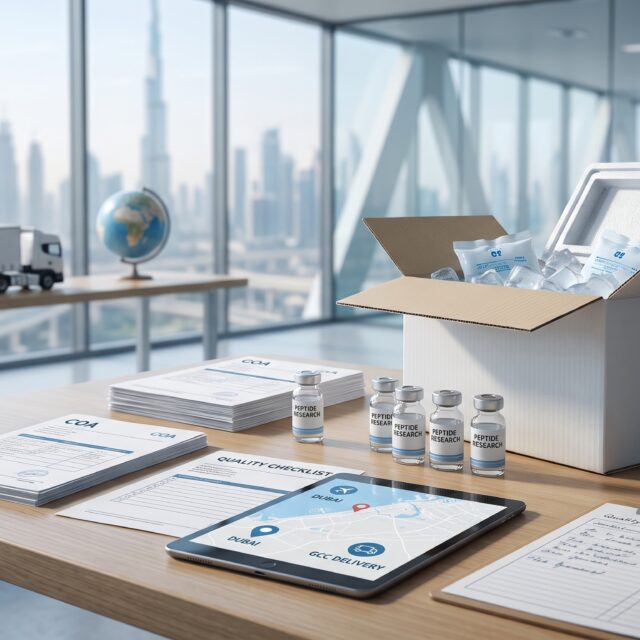
A comprehensive peptide storage temperature guide Abu Dhabi buyers rely on must thoroughly address logistics. The greatest threat to your research materials does not occur inside your climate-controlled laboratory; it happens on the airport tarmac and during customs processing.
Many overseas suppliers ship products using standard international courier networks. A package originating in North America, Europe, or Asia may spend several days in transit. During the GCC summer, a parcel held at an international logistics hub or delayed in Abu Dhabi customs processing can easily be exposed to ambient temperatures exceeding 45°C. Prolonged heat exposure causes the complex amino acid chains to denature, rendering the compound completely useless by the time it reaches your laboratory bench.
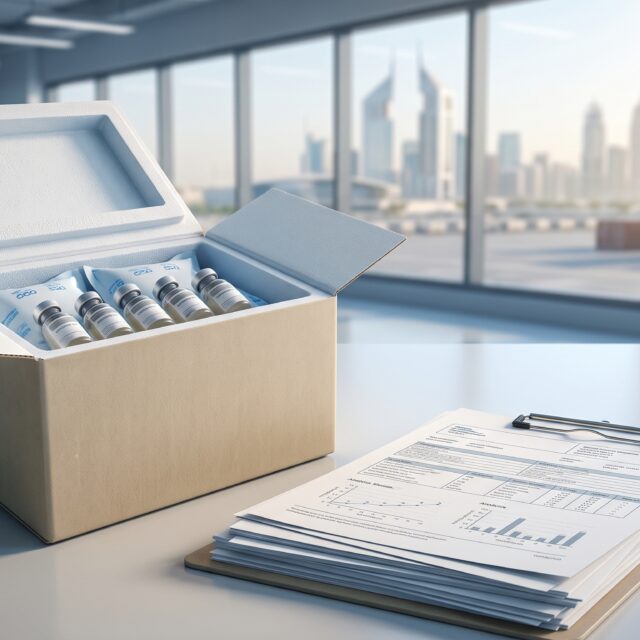
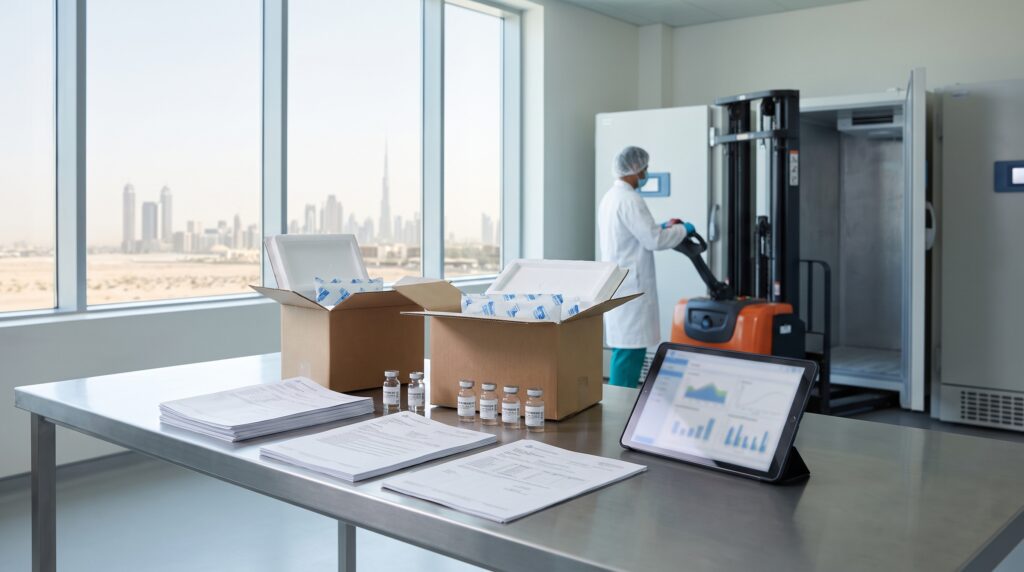
This is why sourcing locally is a non-negotiable requirement for serious researchers. By utilizing centralized UAE-based fulfillment, the transit time is drastically reduced. Reliable suppliers bypass international shipping friction entirely, ensuring that compounds spend minimal time outside of controlled environments. By utilizing dedicated UAE next-day delivery protocols, researchers can ensure their compounds bypass these thermal hazards entirely, arriving in a viable, research-ready state.
Evaluating Your UAE Supplier: What to Check Before Ordering
Preserving temperature integrity requires a supplier that intimately understands the operational realities of the GCC. When evaluating where to source your materials, look for strong indicators of commercial competence, rigorous testing standards, and local logistical expertise.
1. Independent Third-Party Testing (COA)
Temperature control means nothing if the underlying product is impure. Impurities, heavy metals, or leftover byproducts from the synthesis process can act as catalysts that accelerate thermal degradation. Always verify that the supplier provides a recent, batch-specific Certificate of Analysis (COA) utilizing High-Performance Liquid Chromatography (HPLC) and Mass Spectrometry (MS). The COA confirms the purity percentage (serious researchers should strictly look for >99%) and ensures a stable baseline for storage.
2. UAE Stock and Local Dispatch
Confirm that the supplier physically holds their stock within the UAE. A true local supplier will dispatch directly from a temperature-controlled regional hub. This eliminates the risk of international packages sitting on hot tarmacs and avoids complex customs delays altogether.
3. Accessible Support and Payment Flexibility
Trustworthy suppliers in the local market remove purchasing friction. Look for operations that provide direct, immediate support (such as WhatsApp) to handle specific queries regarding batch numbers, COA verification, or precise delivery windows. Additionally, the availability of regional payment gateways demonstrates a long-term commitment to the local buyer ecosystem.
To view a complete catalogue of compounds backed by verified HPLC documentation and stored securely under strict regional logistics protocols, explore the NOVA Labs shop here.
Practical Laboratory Checklist for Long-Term Viability
To minimize degradation once a local shipment arrives, integrate these standard operating procedures into your daily handling routines:
- Verify upon arrival: Immediately transfer new lyophilised deliveries to 2–8°C or -20°C storage upon receipt, minimizing bench time.
- Protect from UV light: Both ultraviolet radiation and direct sunlight aggressively accelerate molecular degradation. Always keep vials in dark environments, opaque containers, or covered storage boxes when not actively in use.
- Avoid mechanical stress: Never shake a reconstituted vial aggressively to force the lyophilised powder to dissolve. Gently swirl the vial and allow the solvent to naturally break down the powder to preserve the delicate molecular bonds.
- Single-use aliquots: If an experimental design requires long-term storage of a reconstituted solution, it must be flash-frozen into single-use aliquots using highly specialized laboratory protocols (never in a standard frost-free freezer, as the defrost cycles will cause repeated thermal shock).
Conclusion
Managing the correct peptide storage temperature in Abu Dhabi is a crucial scientific discipline that requires intense vigilance at every single step—from initial procurement and local delivery to bench-top preparation and long-term refrigeration. By prioritizing domestic UAE suppliers who eliminate international transit risks, demanding verified COA documentation for every batch, and adhering strictly to 2–8°C protocols for all reconstituted liquids, researchers can confidently ensure the maximum viability of their materials.
Always remember to respect the intense local climate, allow cold vials to properly acclimatise to avoid the destructive condensation trap, and source your sensitive materials exclusively from operators who prioritize the absolute integrity of the cold chain.
Disclaimer: The products and compounds mentioned in this article are strictly for in-vitro research purposes only and are not intended for human consumption, therapeutic use, or diagnostic applications.
References
- National Center for Biotechnology Information (NCBI): Guidelines on Stability of Lyophilized Peptides.
- Journal of Peptide Science: Thermal Degradation of Amino Acid Sequences in Humid Environments.
- Best Practices for Cold-Chain Storage of Biomolecules (Vital Healer Labs).
- Best Peptide Shop in GCC: How to Verify Suppliers & COAs (NOVA Labs).
- How To Read Peptide COA UAE: Verify Purity & Spot Fakes (NOVA Labs).
- Peptide Storage Temperature Sharjah: Practical Buyer Guide – NOVA Labs
- Peptide Storage Guide | UAE Core Peptides
- Peptide Storage Temperature Oman: Cold-Chain & Handling – NOVA Labs
- Peptide Storage Guide: How to Store Research Peptides Properly
- Peptide Storage Guidelines – Vital Healer Labs
- Best Peptide Shop in GCC: How to Verify Suppliers & COAs – NOVA Labs
- How To Read Peptide COA UAE: Verify Purity & Spot Fakes – NOVA Labs
Frequently asked questions
What is the optimal peptide storage temperature in Abu Dhabi?
Unopened lyophilised vials should be kept at 2–8°C for up to 36 months, while long-term reserves require -20°C. Once reconstituted, liquid peptides must remain strictly refrigerated at 2–8°C.
Can I freeze reconstituted liquid peptides?
No. Freezing reconstituted compounds in standard laboratory or household freezers causes ice crystals to form, which can permanently shear and destroy the delicate molecular chains.
How long do peptides last once reconstituted?
When mixed with bacteriostatic water and stored continuously at 2–8°C, they typically remain stable for 28 to 60 days. Using sterile water reduces this stability window to just 5 to 7 days.
What happens if research peptides are left at room temperature in the UAE?
Unopened lyophilised powder can survive brief periods at room temperature without rapid degradation, but prolonged exposure—especially to Abu Dhabi's extreme summer heat during transit—will quickly denature and destroy the compound.
How does humidity affect peptide storage?
Lyophilised peptides are hygroscopic. If a cold vial is opened immediately in a humid environment, condensation forms instantly, introducing moisture that rapidly degrades the vacuum-sealed powder.
Why is a COA important for peptide storage?
A Certificate of Analysis (COA) confirms the purity of the compound. Impurities or leftover synthesis byproducts can act as catalysts for accelerated degradation, making high-purity (>99%) peptides more stable under correct storage conditions.
Nova Labs buyer tools
Ready to verify stock, testing and delivery?
Use the product page and lab report section to check availability, documentation, delivery timing and support before placing an order.
- COA / test-report checks
- Abu Dhabi delivery context
- Cold-chain handling
- COD and card payment options
- WhatsApp support