
Conducting valid, reproducible in vitro research requires absolute certainty regarding the chemical integrity of your compounds. For laboratories operating in the Gulf, establishing a definitive peptide purity guide qatar researchers can rely on is about much more than just checking a percentage on a website. It requires a deep understanding of analytical testing, highly specific storage protocols to combat severe ambient heat, and strict adherence to rapidly evolving local regulations.
Whether you are a procurement specialist stocking a university laboratory or an independent researcher analyzing molecular structures, compromised reagents lead directly to false-positive data and wasted resources. This guide breaks down the precise metrics of peptide purity, the realities of Qatar’s regulatory environment, and the logistical challenges of importing and storing delicate biological compounds in Doha.
Quick Answer: Essential Checks for Qatar Researchers
A reliable peptide purity guide in Qatar must prioritize three vital factors: verifying batch-specific High-Performance Liquid Chromatography (HPLC) and Mass Spectrometry (MS) data to confirm 98%+ purity, complying meticulously with MoPH regulations for laboratory procurement, and ensuring unbroken cold-chain logistics to protect temperature-sensitive sequences from Doha’s extreme climate.
Navigating Qatar’s Regulatory Landscape (MoPH Circular PDC/2026/31)
Before evaluating technical purity data, laboratories must understand the legal parameters governing peptide procurement in the region. The regulatory environment in Qatar underwent a significant shift recently, heavily impacting how researchers source their materials.
On August 25, 2026, Qatar’s Ministry of Public Health (MoPH) issued Circular PDC/2026/31. This directive established a comprehensive ban on the handling, import, sale, and distribution of unlicensed peptide products outside of strictly approved scientific channels. The circular strictly regulates specialized research compounds, prohibiting their unauthorized trade and promotion for non-laboratory use.
Crucially for procurement teams, the MoPH directive explicitly notes that simply labeling a product as ‘for research purposes’ or ‘not for human use’ does not automatically exempt the compound from regulatory enforcement if it is subsequently diverted, promoted for, or utilized by humans.
For legitimate scientific and academic institutions in Doha, this means sourcing protocols must be rigorous. Suppliers must provide clear, batch-specific analytical documentation, and research facilities must maintain immaculate logs demonstrating that these compounds are utilized exclusively in controlled, in vitro environments. Following a recognized peptide purity guide Qatar laboratory directors trust is the first step in establishing bulletproof compliance protocols before finalizing any supplier contracts.
Decoding the COA: HPLC and MS Analysis Explained
When evaluating a supplier’s Certificate of Analysis (COA), researchers must look beyond the headline purity percentage. During the complex process of custom peptide synthesis, amino acids are linked sequentially. Errors in this process can create truncated sequences, deletion impurities, and incomplete deprotection byproducts.
To ensure scientific reproducibility, you must verify two primary analytical methods:
High-Performance Liquid Chromatography (HPLC)
HPLC is the gold standard for determining the chromatographic purity of the active peptide sequence. It measures the target peptide against all other synthesis-related impurities. For high-stakes in vitro biological assays, researchers typically require a chromatographic purity of >98%. If impurities are present, they can competitively bind to target receptors in your assay, drastically skewing the results.
Mass Spectrometry (MS)
While HPLC confirms that your sample is chromatographically pure, it does not confirm what the sample actually is. Mass Spectrometry is required to confirm the structural identity and precise molecular weight of the peptide. If the MS data matches the theoretical molecular weight of your desired sequence, you can confidently proceed with your assay.
Purity vs. Net Peptide Content (NPC)
Many procurement specialists misunderstand the difference between chromatographic purity and Net Peptide Content (NPC). Purity (verified by HPLC) relates solely to the peptide molecules present. NPC, however, accounts for the residual water, moisture, and counter-ions (such as Trifluoroacetic acid or TFA salts) inherently trapped in the lyophilized powder during the manufacturing process. A vial may boast 99% chromatographic purity but have an NPC of 75%, meaning 25% of the total powder weight consists of harmless salts and moisture. Knowing this distinction is critical when calculating precise molar concentrations for your experiments.
Surviving Doha’s Heat: Climate-Safe Logistics and Storage
Doha’s coastal humidity and summer temperatures, which regularly exceed 45°C, present severe risks to peptide integrity. Peptide bonds are highly susceptible to hydrolysis and thermal degradation.
Cold-Chain Logistics
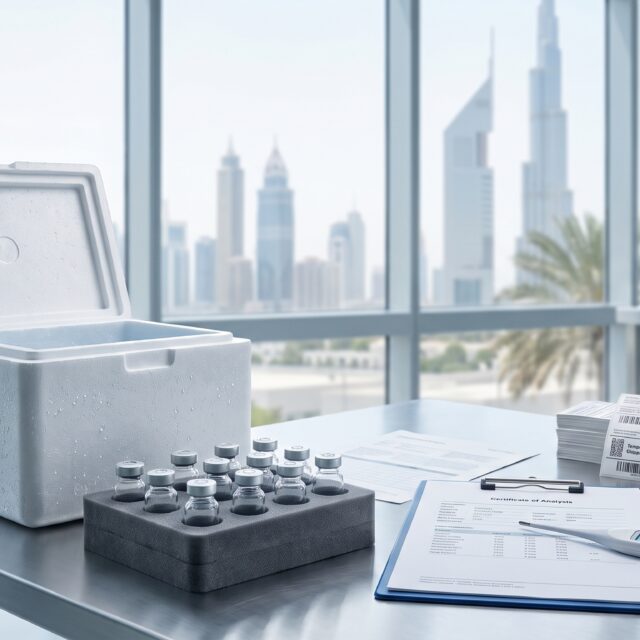
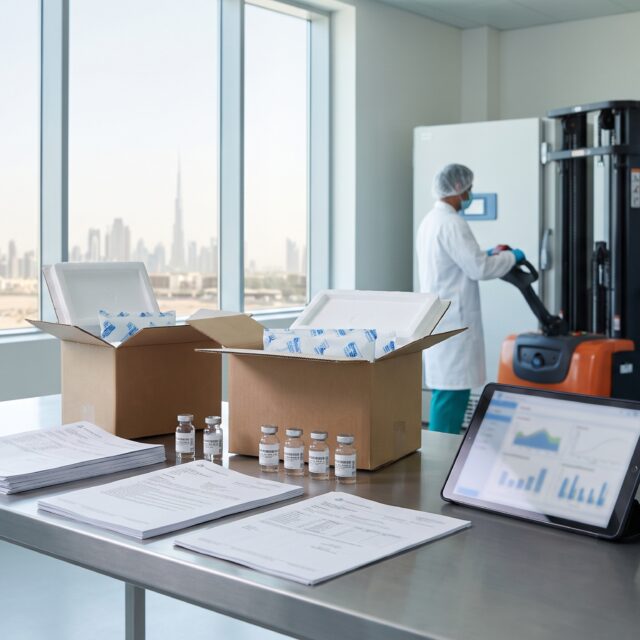
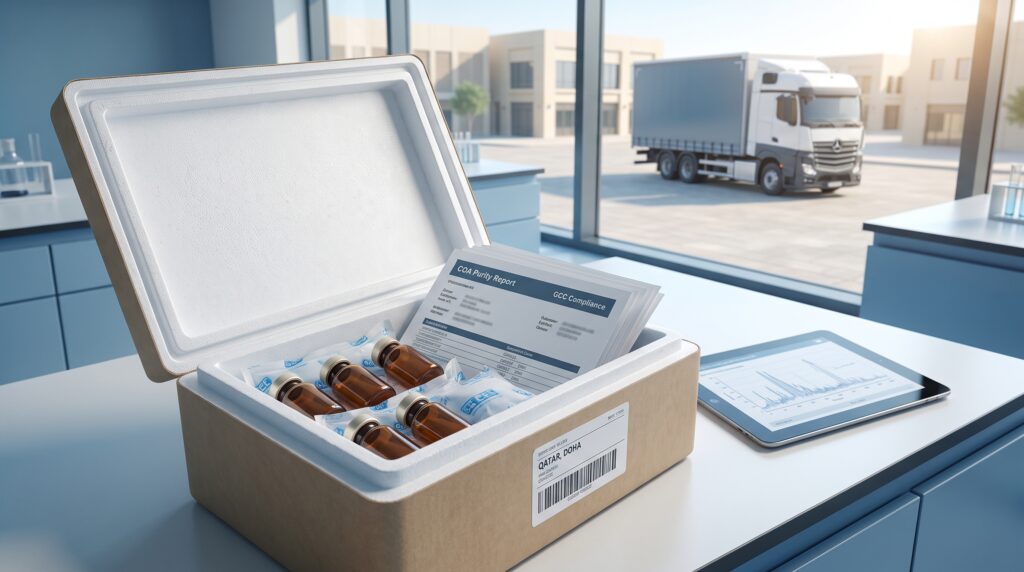
Passive cooling (such as standard ice packs) is often insufficient for standard parcel delivery if shipments are delayed in customs or left on loading docks. When sourcing compounds, regional proximity plays a major role in chemical survival. Procurement teams often prefer suppliers situated within the GCC to minimize transit times.
For those managing procurement across the Gulf, assessing regional shipping capabilities is vital. For example, researchers utilizing regional delivery networks operating from GCC hubs can bypass extended international transit times, ensuring that temperature-sensitive packages spend minimal time in uncontrolled environments before reaching Qatar.
Laboratory Storage Protocols (The Auto-Defrost Danger)
Once lyophilized peptides arrive safely at your facility, long-term storage protocols must be strictly enforced.
- Manual-Defrost Freezers Only: Lyophilized research peptides must be stored long-term at -20°C to -80°C. However, they must never be stored in a standard auto-defrost (frost-free) freezer. The continuous heating-cooling cycles designed to melt frost will repeatedly subject the delicate peptide bonds to thermal stress, rapidly degrading the compound.
- Handling Condensation: Doha’s high ambient humidity is the enemy of lyophilized powder. When a cold peptide vial is opened in a humid laboratory environment, moisture immediately condenses inside the vial, causing rapid hydrolysis. Vials must always be placed in a desiccator and allowed to slowly acclimate to room temperature before the seal is broken.
- Reconstituted Storage: Once reconstituted in bacteriostatic water or a specialized laboratory buffer, the liquid peptide becomes highly vulnerable to enzymatic degradation. It must be strictly refrigerated between 2°C and 8°C. For long-term use, the solution should be aliquoted into single-use portions and deep-frozen to avoid repeated freeze-thaw cycles.
Supplier Evaluation Checklist for Qatar Laboratories
When auditing potential suppliers to support your laboratory’s mandate, ensure they meet the following operational and technical criteria:
- Verifiable COAs: Does the supplier provide third-party, batch-specific HPLC and MS reports? Are the chromatogram peaks clearly visible and properly integrated?
- Compliance Understanding: Does the supplier respect regional regulations (like MoPH Circular PDC/2026/31) and clearly market their products strictly for laboratory research?
- Optimized Logistics: Do they utilize insulated packaging and offer expedited GCC shipping to outrun the extreme Gulf heat?
- Accessible Support: Can procurement teams easily verify stock or request technical documentation via direct channels like WhatsApp or local support desks?
For laboratories prioritizing stringent quality control and regional logistics, reviewing suppliers that emphasize transparency is non-negotiable. Institutions frequently utilize established regional hubs to fulfill their chemical needs; you can explore advanced in vitro compounds via our specialized research catalog to review corresponding analytical data.
The Bottom Line
Maintaining a rigorous peptide purity guide in Qatar is not simply a matter of preference; it is a scientific and regulatory necessity. By understanding the distinct roles of HPLC and MS, adhering to the strict mandates of local regulations, and implementing uncompromising cold-chain and storage protocols, laboratories can safeguard their research integrity against both regulatory friction and Doha’s unforgiving climate. Always demand transparent documentation and prioritize logistics that respect the fragility of these advanced compounds.
Disclaimer: The products mentioned in this article are for in vitro laboratory research purposes only and are strictly not intended for human consumption or clinical use.
References
- Qatar Ministry of Public Health (MoPH) Circular PDC/2026/31 (August 25, 2026).
- Journal of Chromatography A. “High-performance liquid chromatography and mass spectrometry in peptide synthesis and quality control.”
- International Journal of Pharmaceutics. “Impact of moisture and thermal stress on the stability of lyophilized peptides.”
- Qatar Health Ministry Prohibits Trade and Promotion of Unlicensed Peptide Products – QBS RADIO
- MoPH bans sale and use of unlicensed peptide products – Qatar Living
- Your Peptides Cleared TSA. That Doesn’t Mean They Can Clear Customs. – Jetsetter Guide
- Peptide Storage Temperature Qatar: Laboratory Handling & Cold Chain Guide – NOVA Labs
- Peptide Purity Analysis Methods: A Technical Overview For Researchers
- How to Read a Peptide Purity Test: HPLC, Mass Spectrometry and COA Interpretation for UK Researchers (2026)
Frequently asked questions
Why is HPLC testing important for research peptides in Qatar?
HPLC (High-Performance Liquid Chromatography) testing verifies the precise chromatographic purity of a peptide by separating the active sequence from synthesis impurities. In Qatar laboratories, ensuring 98%+ purity prevents truncated sequences from skewing in vitro biological assay results.
What is the difference between peptide purity and Net Peptide Content (NPC)?
Peptide purity measures the percentage of the target peptide sequence relative to other peptide impurities. Net Peptide Content (NPC) measures the percentage of actual peptide material versus the residual moisture and counter-ions (like TFA salts) trapped in the lyophilized powder.
How should lyophilized peptides be stored in Doha's climate?
Lyophilized peptides must be stored long-term at -20°C to -80°C in a manual-defrost freezer. To prevent humidity-induced hydrolysis in Doha's climate, vials must be acclimated to room temperature inside a desiccator before opening.
Does labeling a peptide 'for research purposes' exempt it from Qatar MoPH regulations?
No. According to MoPH guidelines, labeling unlicensed peptide products as 'for research purposes' does not exempt them from regulatory enforcement if they are subsequently diverted, promoted for, or used by humans.
Nova Labs buyer tools
Ready to verify stock, testing and delivery?
Use the product page and lab report section to check availability, documentation, delivery timing and support before placing an order.
- COA / test-report checks
- Qatar delivery context
- Cold-chain handling
- COD and card payment options
- WhatsApp support