




Why Cold Chain Peptide Delivery GCC is Non-Negotiable
Quick Answer: Cold chain peptide delivery in the GCC is essential because extreme ambient temperatures rapidly degrade fragile amino acid bonds. Secure logistics utilizing insulated packaging, phase-change materials, and local fulfillment prevent thermal degradation, ensuring lyophilized research compounds arrive structurally intact for accurate laboratory analysis.
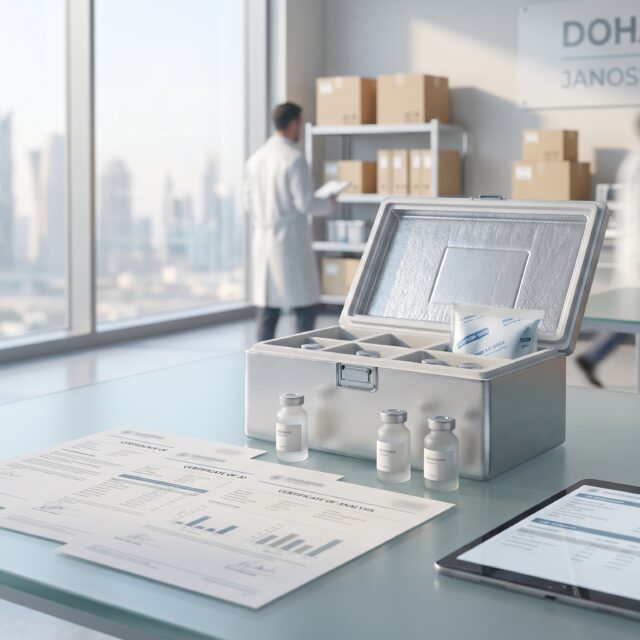
In a region where summer ambient temperatures routinely exceed 45°C, the logistics network responsible for moving your order from warehouse to receiving bench is just as critical as the chemical synthesis itself. Sourcing high-purity peptides in the Middle East demands more than just verifying a Certificate of Analysis (COA). While third-party High-Performance Liquid Chromatography (HPLC) testing confirms the quality of a batch at the time of synthesis, it guarantees nothing about the compound’s journey to your laboratory.
For research buyers, procurement staff, and informed laboratory managers evaluating peptide suppliers, transit temperature control is a non-negotiable part of the purchasing process. A supplier may highlight 99% purity on paper, but if they rely on standard uninsulated shipping methods, the biological integrity of those compounds is highly compromised by the time the package arrives, skewing all downstream experimental data.
The Science: How 45°C Heat Impacts Peptide Stability
Peptides are complex chains of amino acids held together by delicate peptide bonds. Unlike robust synthetic chemicals, these biological molecules are highly sensitive to environmental stressors, particularly thermal excursions. When cold chain protocols fail, elevated temperatures trigger several accelerated degradation pathways that immediately invalidate COA purity claims.
Hydrolysis and Oxidation
Heat acts as a powerful catalyst for hydrolysis, a process where water molecules cleave the peptide bonds, breaking the chain into smaller, unusable fragments. Simultaneously, exposure to high temperatures accelerates oxidation, particularly in peptides containing sensitive amino acid residues like methionine, tryptophan, or cysteine. This alters the molecular weight and structure, effectively ruining the compound for precise in-vitro testing and returning inaccurate mass spectrometry readings.
Aggregation and Misfolding
When exposed to the intense heat of a GCC summer delivery van, peptides can undergo severe physical instability, leading to aggregation. Proteins misfold and clump together. If you notice your reconstituted solution appears cloudy or contains microscopic floating particulates, thermal damage and aggregation have likely occurred. At this stage, the vial is rendered useless for rigorous laboratory protocols.
Lyophilized vs. Reconstituted Stability
Understanding the difference between lyophilized (freeze-dried) powder and reconstituted solutions is vital for proper handling. Reputable suppliers ship peptides in a lyophilized state because removing moisture significantly increases thermal stability. However, “more stable” does not mean invincible. While a freeze-dried powder might survive short periods at a controlled room temperature (20°C to 25°C), the extreme 45°C+ heat of a Dubai or Riyadh afternoon causes rapid structural breakdown. Once a peptide is reconstituted in bacteriostatic water, its fragility multiplies exponentially, requiring strict refrigeration (2°C to 8°C) at all times and careful handling to avoid agitation.
The Customs Risk: Why International Shipping Struggles in the Gulf
One of the most significant risks for researchers relying on overseas suppliers is the unpredictability of international borders. Achieving reliable cold chain peptide delivery for research peptides GCC is exceptionally difficult when shipments cross international lines.
The Limits of Passive Insulation
The vast majority of temperature-controlled pharmaceutical shipping relies on passive insulation—typically expanded polystyrene (EPS) foam coolers packed with water-based gel packs or advanced Phase Change Materials (PCMs). These engineered packaging solutions are highly effective, but they operate within a strict, finite thermal window. Depending on the density of the insulation and the volume of the cooling agent, passive cold-chain packaging can only maintain an internal temperature of 2°C to 8°C for approximately 48 to 72 hours.
Customs Holds and Cold-Chain Failure
When importing research compounds into the UAE or broader GCC from the US, UK, or China, packages must clear regional customs authorities. While analytical-grade, “Research Use Only” peptides are distinct from clinical therapeutics, customs inspections routinely cause unpredictable delays. A package held for an extra 48 hours in a non-climate-controlled customs warehouse inevitably exceeds the lifespan of its internal cooling agents. Once the insulation fails, the internal temperature rapidly equalizes with the ambient environment, destroying the compounds before they ever reach the final delivery courier.
Buyer Checklist: Evaluating GCC Logistics and Quality
To ensure your research investment is protected, evaluate potential suppliers based on their operational transparency, testing rigor, and local logistical capabilities.
- Verify Local Dispatch: Does the supplier fulfill orders from a local GCC warehouse, or are they dropshipping? Local fulfillment bypasses the international customs trap entirely.
- Check the Packaging Protocol: Confirm that the supplier utilizes thermal packaging. A standard padded envelope is insufficient for peptide delivery in the Middle East. Look for explicit mentions of insulated shippers and cooling agents.
- Demand Batch-Specific COAs: Always ensure the supplier provides verifiable third-party testing (HPLC and Mass Spectrometry) for the specific batch you are purchasing, proving purity before transit.
- Assess Delivery Timelines: The faster the transit, the less stress on the cold chain. Vendors offering same-day or next-day domestic courier services minimize the risk of a package sitting in a hot delivery van.
- Evaluate Local Support and Payment: Can you reach the supplier immediately via WhatsApp or local phone if there is a logistical issue? Do they offer secure, localized payment gateways or cash-on-delivery options?
From Delivery to Laboratory: Receiving and Storing Your Order
Securing cold chain delivery is only half the battle; how you handle the shipment upon arrival dictates the long-term viability of your research compounds.
- Immediate Unboxing: Do not leave the package sitting on a loading dock, reception desk, or mailroom. Unbox the insulated shipper immediately upon receipt.
- Inspect the Vials: Ensure the vials are intact, the lyophilized puck is solidly formed at the bottom of the glass, and there are no signs of moisture ingress or cracking.
- Long-Term Storage (-20°C): If you are not utilizing the compounds immediately, transfer the unmixed, freeze-dried vials to a dedicated laboratory freezer set to -20°C or below. Under deep-freeze conditions, lyophilized peptides can remain stable for up to 24 months.
- Short-Term Storage (2°C to 8°C): If the compounds will be reconstituted and utilized within the next few weeks, storing them in a standard, temperature-monitored laboratory refrigerator is appropriate.
- Avoid Freeze-Thaw Cycles: Never repeatedly freeze and thaw a vial. Temperature fluctuations cause condensation and severely damage the molecular structure. Aliquot your solutions into separate sterile vials if multiple uses are required over time.
Local Fulfillment vs. Overseas Importing
Navigating the complexities of thermal degradation, customs delays, and international transit windows is a significant burden for researchers in the Middle East. Localized operations provide a measurable advantage by directly eliminating border friction.
At NOVA Labs, our logistics network is engineered specifically to combat the challenges of the GCC climate. By maintaining stock locally, we eliminate the 72-hour international customs bottleneck. We utilize specialized insulated packaging combined with premium phase-change cooling agents to ensure the thermal window is maintained from our storage facilities directly to your laboratory bench.
This accelerated domestic routing ensures your compounds spend the absolute minimum amount of time in transit, preserving the 99%+ analytical purity verified in our batch-specific COAs. Furthermore, local fulfillment allows us to offer reliable peptide next-day delivery across the UAE, paired with flexible, secure local payment options, removing the friction typically associated with overseas sourcing.
Conclusion: Secure Your Research Supply
Protecting the structural integrity of your research compounds requires more than just high-quality manufacturing; it demands a robust, climate-resilient logistics network. The intense heat of the Middle East combined with the unpredictable nature of international customs makes importing peptides a high-risk endeavor. By prioritizing cold chain handling through local fulfillment, researchers can bypass these logistical hazards entirely.
Ensure your laboratory receives analytically pure, structurally intact materials for every protocol. To view our range of rigorously tested, locally dispatched compounds, explore our complete catalogue.
References
- Manning, M. C., Chou, D. K., Murphy, B. M., Payne, R. W., & Tardiff, D. F. (2010). Stability of Protein Pharmaceuticals: An Update. Pharmaceutical Research, 27(4), 544–575.
- World Health Organization (WHO). (2015). Guidelines on the international packaging and shipping of vaccines and temperature-sensitive health products.
- D’Authenay, A., et al. (2018). Impact of thermal excursions on the quality and stability of lyophilized peptide formulations. Journal of Pharmaceutical Sciences, 107(3), 856-865.
Disclaimer: The products mentioned in this article are intended strictly for in-vitro research and laboratory applications only. They are not approved for human consumption, diagnostic, or therapeutic use.
Disclaimer: The products mentioned in this article are for research purposes only and are not intended for human consumption.
- Cold-Chain Peptide Delivery and Stability in the UAE
- PepcoLab | Research-Grade Peptides & Laboratory Compounds — UAE & UK
- Shipping & Delivery – DXB Peptides
- FAQ – Answers About Peptides & Dn Research
- Cold Chain Logistics in GCC: 10 Proven Steps to Improve Management
Frequently asked questions
Why is cold chain delivery important for peptides?
Extreme heat acts as a catalyst for hydrolysis and oxidation, rapidly degrading the fragile amino acid structures of peptides. Cold chain delivery ensures the compounds are kept between 2°C and 8°C, preserving their analytical purity and structural integrity during transit.
How long can peptides survive in transit without cooling in the GCC?
While lyophilized (freeze-dried) peptides are more stable than liquids, exposing them to GCC summer temperatures exceeding 40°C can trigger rapid molecular breakdown within 48 to 72 hours if proper thermal packaging and cooling agents are not utilized.
What happens if a peptide shipment is delayed at UAE customs?
Extended customs delays frequently outlast the 72-hour thermal limit of passive insulated packaging. Once the gel packs fail, the internal temperature spikes, resulting in cold-chain failure and a highly degraded, unusable research compound.
How should I store my peptides once delivered?
Immediately transfer unmixed, lyophilized vials to a freezer at -20°C for long-term preservation (up to 24 months), or a refrigerator at 2°C to 8°C if they will be reconstituted and utilized in the near term. Always avoid repeated freeze-thaw cycles.
Does NOVA Labs provide local cold-chain delivery in the UAE?
Yes, NOVA Labs utilizes specialized insulated packaging and a rapid domestic courier network to provide secure, next-day delivery within the UAE, completely bypassing the risks of international customs delays.
Nova Labs buyer tools
Ready to verify stock, testing and delivery?
Use the product page and lab report section to check availability, documentation, delivery timing and support before placing an order.
- COA / test-report checks
- GCC delivery context
- Cold-chain handling
- COD and card payment options
- WhatsApp support