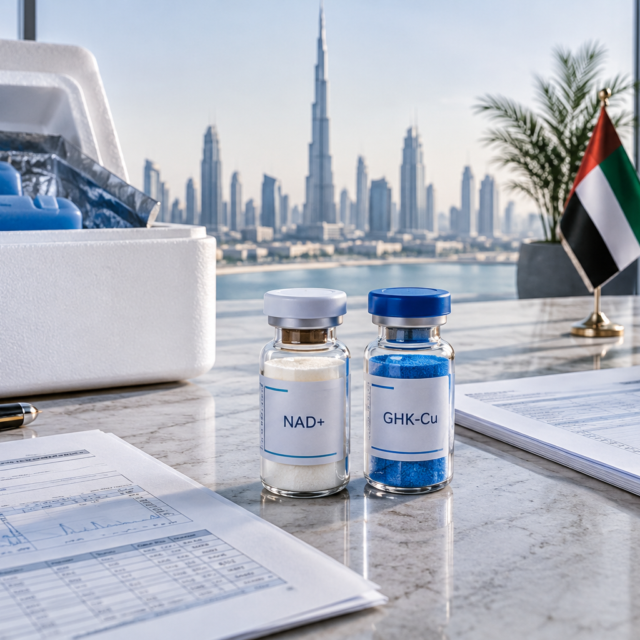





NAD+ vs MOTS-c: what is the difference?
NAD+ vs MOTS-c compares different molecular classes, not two interchangeable peptides. NAD+ is a dinucleotide coenzyme involved in redox reactions and cellular signalling; MOTS-c is a mitochondrial-derived peptide investigated mainly in experimental models. Published findings do not establish which is better for a person. UAE research buyers should compare study designs and current-batch documentation.
At a glance
| Question | NAD+ | MOTS-c |
| — | — | — |
| What is it? | A dinucleotide coenzyme | A reported 16-amino-acid, mitochondrial-derived peptide |
| What does the cited research cover? | Established biochemistry and a wider, sometimes conflated literature on NAD-related compounds | Cellular and animal experiments, plus studies measuring naturally occurring MOTS-c in humans |
| What should a buyer verify? | Identity evidence for NAD+ and documentation for the lot supplied | Peptide identity evidence and documentation for the lot supplied |
Neither a shared discussion of cellular metabolism nor a product-page purity percentage makes these materials substitutes. The practical question for a UAE laboratory is which documented material fits its defined research question and procurement requirements.
Is NAD+ a peptide like MOTS-c?
No. NAD+—nicotinamide adenine dinucleotide—is a coenzyme, not an amino-acid chain. It carries electrons in redox reactions and serves as a substrate for enzymes involved in cellular signalling. Research on NAD metabolism also covers precursors and related biomarkers. A finding about one of those subjects should not automatically be presented as a finding about supplied NAD+ itself. A review of NAD+ metabolism explains these distinct roles.
MOTS-c is a peptide reported to contain 16 amino acids and to originate from a short reading frame in the mitochondrial 12S rRNA region. The original MOTS-c paper examined cellular pathways and animal models. Those experiments help define research questions; they do not, by themselves, demonstrate a clinical effect in people.
The structural distinction matters at purchase. A chromatographic purity result is not automatically proof that a vial contains the molecule named on its label. Ask what identity method supports the assignment and whether the report identifies the batch that will be dispatched. Purity, identity and measured content are separate questions.
What does the published research say about each?
NAD+ has an extensive biochemical literature. Human studies discussed alongside it may instead investigate NAD-related precursors or changes in measured biomarkers. To assess a claim, check the methods section for what researchers actually studied and which endpoint they measured. A change in a biomarker is not the same as a demonstrated functional or clinical outcome.
MOTS-c research includes cellular and animal experiments. Researchers have also measured naturally occurring MOTS-c in people, including in an exercise-related study published in Nature Communications. Read that paper’s human measurements separately from its experimental findings: measuring an endogenous peptide is not equivalent to testing a supplied MOTS-c product in a human intervention trial.
The sources cited here do not provide a direct, head-to-head comparison of supplied NAD+ and supplied MOTS-c on a common endpoint. That describes this article’s sources, not every study that may exist. There is consequently no evidence-based winner to infer from these papers.
When comparing any two studies, check:
- Material: NAD+ itself, an NAD-related precursor, supplied MOTS-c or naturally occurring MOTS-c?
- Design: cell experiment, animal experiment, human observation or human intervention?
- Measurement: what did the assay detect, and what limitations did the authors report?
- Endpoint: a pathway signal, a measured concentration or another outcome?
This also prevents a procurement mistake: a published paper about a named molecule does not verify the identity or condition of a supplier’s current stock.
What should a UAE buyer check before ordering?
Start with the lot that would actually be shipped. NOVA Labs lists NAD+ and MOTS-c research products and provides a lab-results index. Check the current listing and request the report for the specific available batch; an older result may refer to different stock. A website category name is not a substitute for identifying the molecule correctly: NAD+ is not a peptide.
For either material, ask for:
- A certificate of analysis (COA) whose product name and lot number match the item to be dispatched.
- The identity method and result, alongside the stated purity method and result. Ask about mass-spectrometry evidence where applicable rather than treating an HPLC purity percentage as complete identification.
- The stated content, test date and testing laboratory, including whether testing was performed by the supplier or an independent laboratory.
- Any additional test results required by your institution’s specification. Do not assume that a purity COA also covers sterility, endotoxin or heavy metals.
Handling and delivery require separate confirmation. Ask for the storage instructions for the particular product and format, the planned packaging, dispatch timing and what happens if delivery is delayed. In UAE heat, a claim that a parcel is cooled does not establish continuous temperature control; ask what shipping records, if any, support the claim.
Before payment, confirm live stock, accepted payment methods and delivery coverage for your address. For another GCC destination, obtain a destination-specific shipping answer and check the recipient’s applicable import, customs and courier requirements. A COA or “research use only” label does not, on its own, establish regulatory authorization or guarantee customs clearance. Where classification or import requirements are uncertain, consult the relevant authority or qualified compliance adviser rather than relying on a product listing.
References
- Covarrubias et al., “NAD+ metabolism and its roles in cellular processes during ageing,” Nature Reviews Molecular Cell Biology — NAD+ biochemistry and the distinction between NAD+ and related metabolic research.
- Lee et al., original MOTS-c research, Cell Metabolism, via PubMed Central — peptide identification and experimental findings.
- “Exercise induces mitochondrial-derived peptide MOTS-c expression in humans and enhances physical performance in mice,” Nature Communications — human measurement and animal findings that should be interpreted separately.
- MOTS-c is an exercise-induced mitochondrial-encoded regulator of age-dependent physical decline and muscle homeostasis | Nature Communications
- Regulatory Instructions for Handling Peptide Products and Molecules | Emirates Drug Establishment
Bottom line for a research purchase
NAD+ is a coenzyme; MOTS-c is a peptide. Their cited studies address different questions, so choose a material by research design—not a claimed ranking of personal effects. Before ordering, verify the current lot’s identity evidence, purity method, handling instructions and destination-specific delivery terms.
If either material fits your procurement brief, review its linked product page and lab results, then ask NOVA Labs to confirm the available batch and shipping details in writing.
Research use only. The products discussed are not intended for human consumption. This article provides no treatment, administration or dosage guidance.
Disclaimer: The products mentioned in this article are for research purposes only and are not intended for human consumption.
Frequently asked questions
Is NAD+ a peptide?
No. NAD+ is a dinucleotide coenzyme. MOTS-c is a reported 16-amino-acid mitochondrial-derived peptide.
Are NAD+ and MOTS-c the same thing?
No. They differ in molecular structure and in the research questions addressed by the cited studies. Evidence about one should not automatically be applied to the other.
Have NAD+ and MOTS-c been compared in a head-to-head study?
The studies and review cited in this article do not compare supplied NAD+ and supplied MOTS-c directly on a common endpoint. That is a description of these sources, not a comprehensive claim about all published research.
Does human MOTS-c research mean a MOTS-c product has been tested in people?
Not necessarily. Studies measuring MOTS-c naturally present in people are different from human intervention trials testing a supplied peptide product. Check each paper’s methods.
Is an HPLC purity result enough to verify NAD+ or MOTS-c?
No. Request batch-matched evidence of molecular identity, the stated purity method and result, and documentation of content and testing. A purity percentage alone does not establish every quality attribute.
What should a UAE or GCC buyer confirm before ordering NAD+ or MOTS-c?
Confirm the current lot and its documents, product-specific storage instructions, packaging, stock, payment terms and delivery coverage. For GCC shipments, also check destination-specific import, customs and courier requirements; a research-use label does not guarantee clearance.
Nova Labs buyer tools
Ready to verify stock, testing and delivery?
Use the product page and lab report section to check availability, documentation, delivery timing and support before placing an order.
- COA / test-report checks
- UAE delivery context
- Cold-chain handling
- COD and card payment options
- WhatsApp support