
Transitioning from raw lyophilized powder to a precise, ready-to-measure liquid solution requires exact arithmetic. For laboratory technicians and independent investigators in the UAE, managing peptide preparation is not just about mathematical accuracy; it requires a strict understanding of environmental preservation, aseptic technique, and equipment standardization.
Without a firm grasp of the relationship between milligrams (mg) and micrograms (mcg), research data is easily compromised. Furthermore, the unique climate of the GCC, coupled with local regulatory frameworks and logistical hurdles, means that calculating a concentration is only half the process. If a sensitive compound degrades in extreme summer heat before it reaches the laboratory bench, the mathematical calculations are entirely void.
Key Takeaways for Laboratory Preparation
- Baseline Conversions: 1 milligram (mg) equals 1,000 micrograms (mcg). All calculations must start by converting the vial’s total milligram mass into micrograms.
- Syringe Standardization: The standard U-100 laboratory syringe contains 100 units per 1 milliliter (1 mL), meaning 1 unit equals exactly 0.01 mL of liquid.
- Thermal Protection: Reconstituted solutions must be kept refrigerated (2°C to 8°C) and used within 28 days. In the GCC, leveraging local cold-chain delivery is critical to prevent thermal degradation prior to mixing.
- Quality First: Mathematical formulas rely entirely on the accuracy of the raw material. Always verify the net active mass via third-party Certificates of Analysis (COAs) before calculating concentrations.
Mastering Peptide Dosage: Core Mathematical Principles
Mastering peptide dosage requires converting the vial’s total mass in milligrams (mg) to micrograms (mcg) by multiplying by 1,000. Researchers then divide this total by the volume of bacteriostatic water added to calculate the exact concentration per milliliter, enabling precise liquid measurements using standard U-100 laboratory syringes.
Lyophilized (freeze-dried) research compounds are universally sold by mass, which is typically measured in milligrams (mg). However, standard in-vitro applications dictate measurements in micrograms (mcg). This discrepancy is the foundation of all reconstitution mathematics. To establish a baseline, one milligram (1 mg) is equal to one thousand micrograms (1,000 mcg). Therefore, a standard 5mg vial contains 5,000mcg of the active compound, while a 10mg vial holds 10,000mcg.
When calculating concentration, it is crucial to remember that the mass of the lyophilized powder remains static, but the volume of the diluent—most commonly bacteriostatic water (BAC)—can vary depending on the specific protocol requirements. Adding 1mL of BAC water to a 5mg vial yields a high-concentration solution, whereas adding 2mL of BAC water to that exact same vial yields a lower-concentration solution. A lower concentration often makes it easier to measure minute microgram volumes on a standard laboratory syringe, reducing the margin of error during extraction.
The Standard U-100 Syringe: Converting Concentration to Units
In standard scientific settings, the U-100 syringe is the primary instrument for drawing aqueous solutions. The “100” indicates that 100 units make up 1 milliliter (1 mL) of liquid. Therefore, 1 unit equates to precisely 0.01 mL.
To consistently achieve accurate measurements without relying on guesswork, researchers utilize a strict three-step mathematical formula:
Step 1: Calculate Total Micrograms (mcg)
Convert the vial’s stated milligram mass into micrograms by multiplying by 1,000.
Formula: Vial Mass (mg) × 1,000 = Total mcg.
(Example: A 5mg vial equals 5,000mcg.)
Step 2: Determine Concentration (mcg/mL)
Divide the total micrograms by the total volume of bacteriostatic water added to the vial.
Formula: Total mcg ÷ Volume of BAC water (mL) = Concentration in mcg per 1 mL.
(Example: 5,000mcg ÷ 2mL BAC water = 2,500mcg per 1mL.)
Step 3: Calculate Syringe Units (Draw Volume)
To find out how many units on the U-100 syringe correspond to a specific microgram target for your assay, use the final draw formula.
Formula: [Target Application (mcg) ÷ Concentration per 1mL (mcg)] × 100 = Syringe Units.
(Example: If the in-vitro protocol calls for a 250mcg application: [250 ÷ 2,500] × 100 = 10 units.)
Aseptic Preparation: Laboratory Protocols for Reconstitution
Calculating the math accurately is futile if the compound’s structural integrity is compromised during the physical mixing phase. Lyophilized powders consist of delicate, precisely folded amino acid chains that are highly susceptible to mechanical shear, extreme pH shifts, and bacterial contamination.
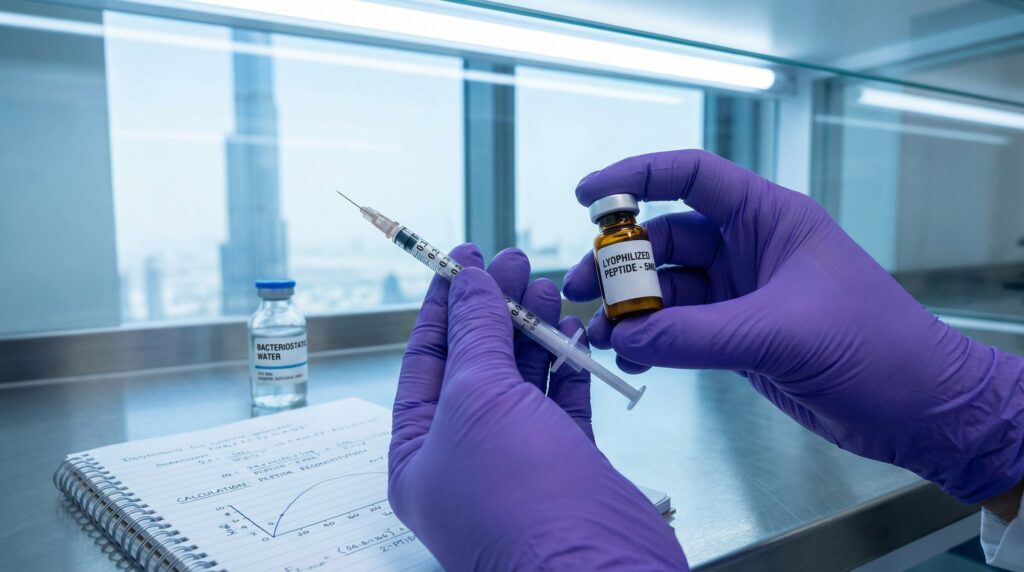
A strict aseptic preparation protocol is mandatory. It begins by wiping both the peptide vial septum and the bacteriostatic water vial septum with 70% isopropyl alcohol. When piercing the peptide vial, researchers must aim the needle at a 45-degree angle toward the inner glass wall.
The diluent should flow gently down the side of the glass rather than being sprayed directly onto the fragile powder puck. Because many high-quality lyophilized vials contain a strong vacuum seal to preserve the contents, the bacteriostatic water may be pulled into the vial rapidly. Researchers must firmly control the syringe plunger to ensure a slow, steady flow, preventing aggressive turbulence inside the vial.
The vial must never be aggressively shaken. Instead, researchers should gently swirl the vial in a slow, circular motion until the solution is entirely clear and free of any visible particulates.
Combating GCC Climate Risks: Cold-Chain and Thermal Stability
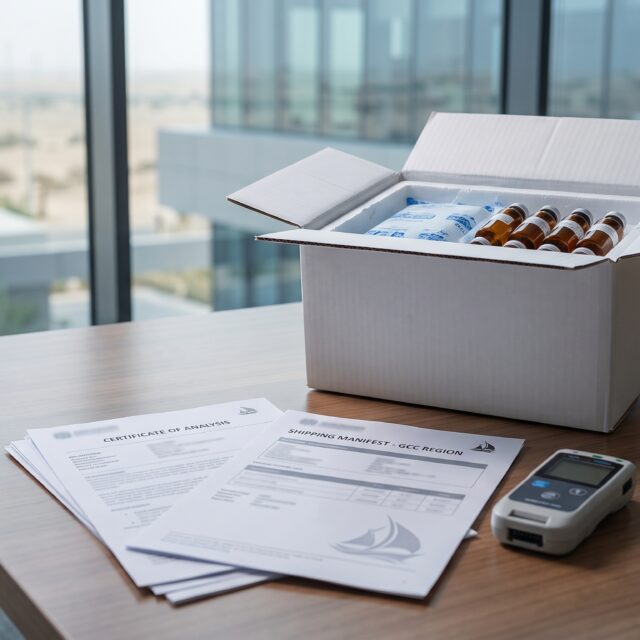
In the UAE and greater GCC region, research preparation extends far beyond mathematics into severe environmental logistics. During the summer months, ambient temperatures regularly exceed 40°C, and surface temperatures in standard delivery vehicles can climb much higher. Extended exposure to high heat and intense UV radiation causes lyophilized peptides to degrade rapidly, breaking the fragile amino acid bonds and rendering the compound structurally altered.
A researcher cannot rely on meticulous concentration calculations if the primary compound has already lost active purity due to thermal damage in transit. Cold-chain logistics are a non-negotiable requirement for regional procurement.
To safeguard research validity, buyers should only partner with suppliers capable of navigating extreme local temperatures through heavily insulated packaging and temperature-stable routing. For laboratories aiming to avoid thermal degradation risks entirely, utilizing a localized UAE next-day delivery network ensures that sensitive compounds minimize their exposure to the elements and arrive structurally intact.
Once reconstituted with bacteriostatic water, storage protocols become even stricter. Aqueous peptide solutions are far more fragile than their dry powder counterparts. These solutions must be stored consistently in a laboratory refrigerator at 2°C to 8°C. Best practices dictate that reconstituted vials should be utilized within 28 days to maintain maximum efficacy and prevent bacterial proliferation.
Verifying Compound Integrity: COAs and HPLC Reports
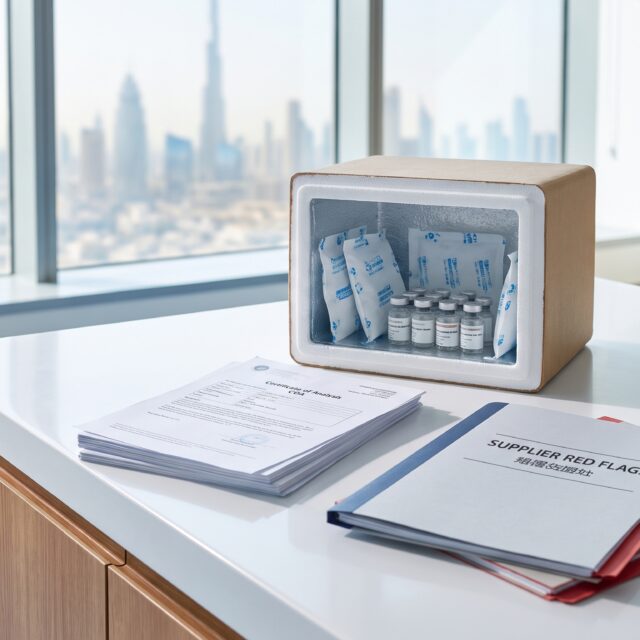
Mathematical accuracy relies entirely on baseline material quality. If a vial is labelled as 5mg but only contains 3.5mg of active compound due to poor manufacturing standards, the entire concentration formula becomes inherently flawed.
Many inferior suppliers use excess fillers, such as mannitol, to bulk up the powder puck. While mannitol is a harmless stabilizing agent, it can obscure the true weight of the active peptide. Verifiable Certificates of Analysis (COAs) and High-Performance Liquid Chromatography (HPLC) reports are mandatory procurement signals. A valid, batch-specific COA confirms the exact net weight of the active compound (excluding fillers) and its purity percentage (typically >99%). Before engaging in any calculations, researchers must demand this testing documentation to ensure their baseline math is grounded in reality.
Navigating the UAE Procurement Landscape
Procuring high-purity research compounds in Dubai and the wider UAE requires strict adherence to local regulations. In recent enforcement campaigns, the Emirates Drug Establishment (EDE) targeted unauthorized sources and referred social media influencers to the National Media Office for promoting unapproved, non-clinical products.
Under current UAE frameworks, peptides intended for human clinical therapy are strictly controlled, requiring EDE registration and administration through licensed medical facilities. Commercial suppliers catering to independent investigators and scientific facilities must operate under local Department of Economy and Tourism (DET) registered trade licenses that designate these compounds exclusively as “not for human consumption.”
Procurement staff must also navigate ongoing financial hurdles. Global payment networks, including Wise, Stripe, and PayPal, enforce strict Acceptable Use Policies (AUP) that heavily restrict the processing of transactions related to research compounds. Consequently, international orders frequently face unexpected cancellations, frozen funds, or prolonged customs delays.
Experienced GCC researchers prioritize suppliers offering localized infrastructure. Cash-on-Delivery (COD) options, integrated local merchant gateways, and responsive local support channels (such as WhatsApp) provide a secure, seamless transaction pathway that avoids international gateway flags.
Standardizing Your Laboratory Protocols
Achieving accuracy in the lab requires a functional working knowledge of mass-to-volume conversions, a deep understanding of U-100 syringe tracking, and an unwavering commitment to sterile, aseptic reconstitution practices. For UAE-based researchers, these technical skills must be paired with acute situational awareness regarding environmental heat, cold-chain logistics, and local regulatory compliance.
By executing precise mathematics, verifying raw material purity via third-party COAs, and utilizing secure local delivery channels, investigators can ensure their data remains valid and uncompromised. When you are ready to source premium, batch-tested materials for your next study, you can explore our full catalog of research compounds to experience a supply chain built specifically for the demands of the UAE scientific community.
Disclaimer: The products and information mentioned in this article are strictly for laboratory research and in-vitro applications only. They are not intended for human consumption, clinical administration, or therapeutic use.
References
- Gulf News (2024). UAE Cracks Down on Unapproved Peptide Weight-Loss Drugs: 71 Sources and 14 Influencers Face Action.
- Emirates Drug Establishment (EDE). Regulatory Frameworks on Clinical vs. Commercial Supply in the UAE.
- National Center for Biotechnology Information (NCBI). Laboratory Best Practices for the Handling and Reconstitution of Lyophilized Research Proteins.
- Journal of Pharmaceutical Sciences. Thermal Degradation and Stability of Lyophilized Peptides in Extreme Environments.
Disclaimer: The products mentioned in this article are for research purposes only and are not intended for human consumption.
- UAE Cracks Down on Unapproved Peptide Weight-Loss Drugs: 71 Sources and 14 Influencers Face Action – Gulf News
- Peptide Calculator: Reconstitution & Syringe Units – Vitadel
- Are Peptides Legal in UAE – FIBAV
- Peptide Therapy in Dubai & Abu Dhabi | DNA Health and Wellness
- Peptide Storage & Stability Guide
- Peptide Calculator — Free Dosage & Draw Volume Tool
Frequently asked questions
How do you convert mg to mcg for research peptides?
To convert milligrams (mg) to micrograms (mcg), you multiply the total milligram amount by 1,000. For example, a standard 5mg vial contains exactly 5,000mcg of the research compound, establishing the baseline for your concentration calculations.
How much liquid is one unit on a U-100 laboratory syringe?
On a standard U-100 laboratory syringe, 100 units equal exactly 1 milliliter (1 mL) of volume. Therefore, one single unit on the syringe corresponds to precisely 0.01 mL of liquid.
How long do reconstituted peptides last in UAE temperatures?
Unreconstituted lyophilized powder degrades rapidly in ambient GCC heat and should be kept away from direct sunlight. Once mixed with bacteriostatic water, the liquid solution must be stored in a refrigerator at 2°C to 8°C and utilized within 28 days to maintain maximum stability and sterility.
Why should you never shake a peptide vial during reconstitution?
Research peptides consist of delicate amino acid chains. Shaking the vial vigorously causes mechanical shear and introduces aggressive turbulence, which can damage the molecular structure and invalidate the compound. Researchers should only gently swirl the vial until the liquid becomes perfectly clear.
What is the role of bacteriostatic water in peptide calculations?
Bacteriostatic water acts as the sterile diluent. While the mass of the peptide (mg) remains constant, the volume of bacteriostatic water added dictates the final concentration of the solution, allowing researchers to scale the mcg-per-mL ratio to suit their specific syringe measurements.
Nova Labs buyer tools
Ready to verify stock, testing and delivery?
Use the product page and lab report section to check availability, documentation, delivery timing and support before placing an order.
- COA / test-report checks
- UAE delivery context
- Cold-chain handling
- COD and card payment options
- WhatsApp support