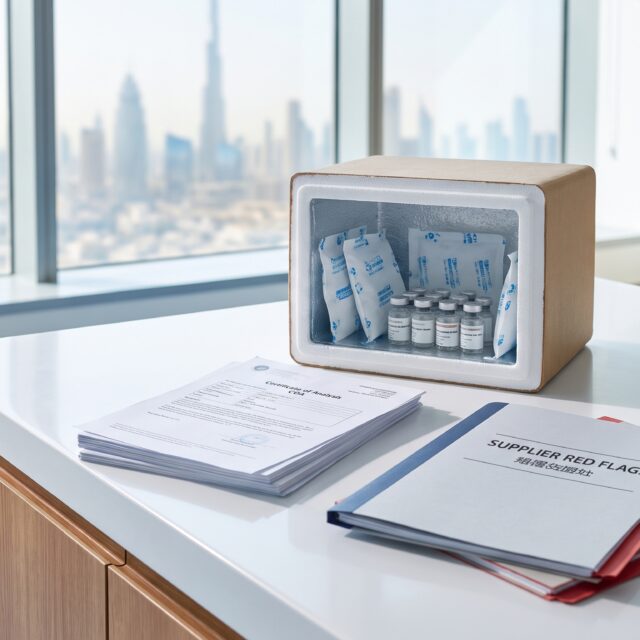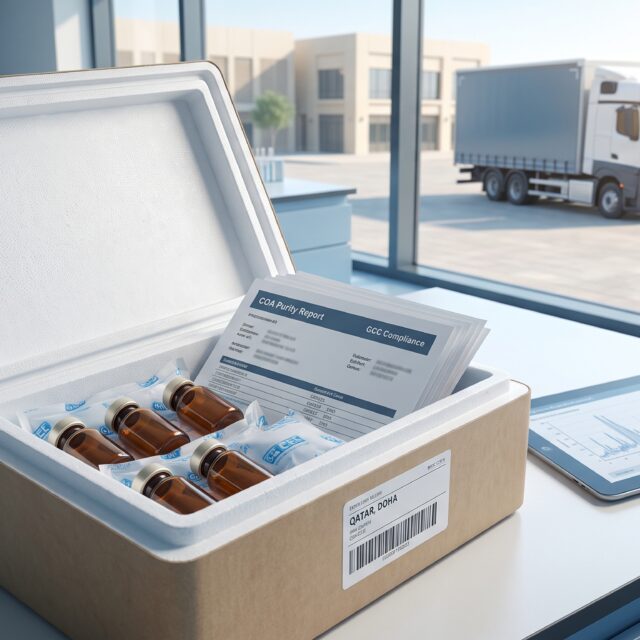


For laboratory professionals and independent researchers in the UAE, knowing how to spot fake peptides sharjah is the first line of defense against compromised studies, skewed assay data, and wasted procurement budgets. The regional market for biological materials has shifted dramatically in recent years. Purchasing high-purity compounds now requires a rigorous, systematic evaluation of testing documentation, local cold-chain logistics, and vendor transparency.
This comprehensive guide explains exactly what procurement staff and independent researchers must check before placing an order in the Emirates to ensure structural integrity and compound authenticity.
Quick Answer: How to Spot Fake Peptides Sharjah
To spot fake peptides in Sharjah, buyers must verify batch-specific third-party Certificates of Analysis (COAs) from accredited labs, confirm insulated cold-chain shipping logistics that survive extreme GCC heat, and avoid vendors relying solely on untraceable cryptocurrency payments. Legitimate UAE-based suppliers prioritize verifiable HPLC testing, transparent support, and secure delivery.
The Regulatory Reality: Why the Market is Changing
To understand why counterfeit or compromised peptides are circulating, one must look at recent regulatory shifts in the UAE. Historically, the grey market for research compounds allowed various international and local entities to ship products with little oversight, leading to a flood of under-dosed or entirely fabricated compounds.
However, under Federal Decree-Law No. 38 of 2024, the Emirates Drug Establishment (EDE) assumed sole federal authority over pharmaceuticals and biological compounds. The EDE’s subsequent crackdown on unapproved health and research products has heavily penalized illegitimate social media promotions and unregistered local suppliers.
What does this mean for researchers in Sharjah?
- Scrutiny is high: Research peptides are strictly permitted for in-vitro laboratory studies and analytical research.
- Fly-by-night vendors are adapting: As authorities shut down illegitimate operations, fraudulent suppliers often rebrand rapidly. They frequently attempt to sell counterfeit or highly degraded compounds to quickly liquidate inventory before disappearing from the market altogether.
Knowing standard guiding principles for spotting fake peptides is your best defense against these shifting underground operators and ensures your laboratory data remains reliable.
The 4-Step COA Audit: Unmasking Forged Lab Reports
The most common method fraudulent vendors use to sell fake peptides is fabricating a Certificate of Analysis (COA). A legitimate COA is a technical document provided by an independent analytical laboratory detailing the purity and identity of a specific compound batch.
Here is how to effectively audit a supplier’s testing claims to separate the real from the fabricated:
1. Look for Independent, Accredited Laboratories
An authentic COA must be generated by a recognized third-party analytical laboratory. If the vendor’s COA features their own company logo at the top without a distinct third-party laboratory letterhead, it is merely an internal document. Internal testing is easily manipulated, subject to extreme bias, and holds no objective weight in verifying authenticity.
2. Verify HPLC and Mass Spectrometry Data
A valid test report must include both High-Performance Liquid Chromatography (HPLC) and Mass Spectrometry (MS) data.
- HPLC: This determines the purity percentage (e.g., 99.2% purity). On the chromatogram graph, you should see one massive, sharp peak indicating the primary compound. Multiple smaller peaks suggest contamination, manufacturing byproducts, or severe degradation.
- Mass Spectrometry (MS): This confirms the molecular weight (m/z ratio), proving the compound is actually the specific peptide it claims to be. Without both graphs, the report is incomplete and cannot verify identity.
3. Check for Batch-Specific Documentation
Counterfeiters often purchase one high-quality batch, have it legitimately tested, and then use that exact same COA for years across thousands of vials. Check the date and the batch number on the COA. Does it match the batch number printed on the physical vial you receive? If a supplier cannot provide a recent, batch-matched COA for their current inventory, reconsider the purchase immediately.
4. Contact the Testing Lab
The easiest way to spot a fake PDF that has been edited in Photoshop is to look for a verification key or serial number on the document. Legitimate testing labs provide a unique alphanumeric code on their reports. You can enter the code on their website or email the laboratory directly to verify that the report has not been altered by the vendor.
Heat Degradation: When Good Peptides Go Bad
One unique factor researchers face when learning how to spot fake peptides in Sharjah is the extreme local environment. Even if a peptide leaves a manufacturing facility at 99% purity, it can be entirely degraded by the time it reaches your laboratory bench if shipped improperly.
Lyophilized (freeze-dried) biological compounds are highly sensitive to thermal stress and UV light. Standard courier transit in the UAE, where ambient temperatures regularly exceed 40°C in the summer, is disastrous for peptide stability.
Why Cold-Chain Shipping is Non-Negotiable
Valid local suppliers must utilize insulated cold-chain packaging designed to maintain internal temperatures between 2°C and 8°C. This involves:
- EPS (Expanded Polystyrene) insulated shipping boxes.
- Industrial ice packs or dry ice.
- Temperature indicator monitoring during fulfillment.
Because time in transit is the biggest enemy of temperature-sensitive research compounds, utilizing services that offer next-day peptide delivery in the UAE is crucial for securing viable materials. If a vendor ships delicate biological compounds via a standard courier poly-mailer without insulation, the compound will rapidly degrade. While this doesn’t necessarily mean the peptide was a “fake” from the start, it renders the compound chemically useless, yielding the same disastrous result for your research.
Payment and Procurement Red Flags
Beyond scientific testing and logistics, commercial behavior offers massive clues into a supplier’s legitimacy.
The Crypto-Only Warning Sign
One of the most glaring red flags in the GCC market is a vendor that only accepts cryptocurrency (Bitcoin, USDT). While crypto is a legitimate technology, exclusive reliance on it by a peptide vendor often signals an unwillingness to comply with standard banking, merchant services, and local KYC (Know Your Customer) laws. Crypto payments strip the buyer of chargeback protections. If the vendor fails to deliver or ships fake products, the buyer has zero financial recourse.
Lack of Local Support and Transparency
Legitimate suppliers operating in the UAE have accessible, transparent support channels. If a vendor hides behind a generic contact form without offering a WhatsApp support line, a clear return policy, or standard secure credit card processing, they are operating in the shadows. Transparency in business operations is almost always a direct reflection of transparency in compound manufacturing.
Visual Inspection: The Lyophilized Cake
While visual inspection alone cannot mathematically confirm purity, it can help spot glaring quality control issues. When you receive a vial, inspect the lyophilized “cake” (the solid puck of powder at the bottom) and the vial’s physical integrity.
- Vacuum Seal: When you remove the flip-off cap and pierce the rubber stopper with a syringe to reconstitute the peptide, there should be a noticeable vacuum drawing the bacteriostatic water into the vial. A lack of vacuum suggests a compromised vial, which can lead to bacterial contamination and rapid oxidation.
- Legitimate Appearance: A uniform, solid white puck or a fine, evenly distributed powder.
- Red Flags: Discoloration (yellow or brown tints), excessive moisture, or a gummy appearance. These are signs of poor manufacturing, incomplete freeze-drying, or moisture contamination.
Furthermore, when you reconstitute the compound with bacteriostatic water, the solution should generally mix completely clear. If the solution remains cloudy, viscous, or contains floating particulate matter after proper mixing, do not use it in your assays as it is likely compromised.
Sourcing Authentic Research Materials
Securing high-quality compounds requires partnering with a supplier that understands local compliance, environmental challenges, and the non-negotiable necessity of independent analytical testing.
NOVA Labs prioritizes the needs of the GCC research community by addressing these procurement pain points directly. By combining transparent, batch-specific COA availability with secure credit card processing, local customer support, and rigorous cold-chain delivery systems across the UAE, researchers can procure materials with absolute confidence.
When evaluating where to source your materials, ensure your supplier checks every box on this guide. To explore verifiable, high-purity compounds for your upcoming laboratory studies, you can shop for research compounds through NOVA Labs’ secure local portal.
Conclusion
Learning how to spot fake peptides sharjah comes down to prioritizing empirical evidence over marketing claims. In a landscape shaped by evolving EDE regulations and extreme local temperatures, buyers must demand third-party HPLC/MS testing, insist on temperature-controlled cold-chain logistics, and avoid vendors operating exclusively via untraceable payment methods. By auditing COAs carefully and partnering with transparent, locally optimized suppliers, procurement teams can permanently safeguard their research data.
Ready to elevate your laboratory procurement standards and avoid counterfeit risks? Browse NOVA Labs today to secure third-party tested, cold-chain protected research compounds delivered straight to your facility.
Disclaimer: The products mentioned in this article are strictly for laboratory research purposes only and are not intended for human consumption, therapeutic use, or medical treatment.
*
References
- Federal Decree-Law No. 38 of 2024, Emirates Drug Establishment (EDE) Compliance Framework.
- UAE Ministry Crackdowns on Unapproved Health and Research Products, Regional Regulatory Enforcement Reports (2024).
- Why Cold-Chain Matters for Peptide Stability in Extreme Heat, Laboratory Logistics Technical Review.
- Buying Research Peptides in the UAE: Import Documentation and Compliance, Industry Whitepaper.
- UAE Cracks Down on Unapproved Peptide Weight-Loss Drugs: 71 Sources and 14 Influencers Face Action – Gulf News
- Are Research Peptides Legal in the UAE? Complete Compliance – NOVA Labs
- Buying Research Peptides in the UAE: Import Documentation and Compliance
- Why Cold-Chain Matters for Peptide Stability, Especially in UAE Heat – Swiss Pharma
- Peptide Storage in UAE Labs: Best Practices
Frequently asked questions
How do I know if my peptide COA is fake?
A fake COA often lacks a traceable batch number, is missing mass spectrometry (m/z) data, or uses a generic company letterhead instead of an accredited third-party laboratory. Always check for a unique verification code that can be verified directly on the independent testing laboratory's website.
Why is cold shipping required for peptides in Sharjah?
Lyophilized biological compounds are highly sensitive to heat and will rapidly degrade in ambient UAE temperatures, which regularly exceed 40°C in summer. Cold-chain shipping using insulated packaging (2°C to 8°C) is mandatory to maintain the molecular stability and structural purity of the research compound during transit.
Are crypto-only peptide suppliers safe to use in the UAE?
Suppliers that solely accept cryptocurrency are highly risky, as they offer no chargeback protections or buyer recourse if counterfeit or degraded materials are delivered. Reputable local vendors will always offer secure credit card gateways or transparent merchant processing.
Are research peptides legal to buy in Sharjah?
Yes, research peptides are legal to purchase in Sharjah strictly for in-vitro laboratory research and analytical studies. However, under EDE regulations, they are not authorized for human consumption, and they cannot be legally sold, marketed, or used as therapeutic medical treatments.
Nova Labs buyer tools
Ready to verify stock, testing and delivery?
Use the product page and lab report section to check availability, documentation, delivery timing and support before placing an order.
- COA / test-report checks
- Sharjah delivery context
- Cold-chain handling
- COD and card payment options
- WhatsApp support