
The research market in the Middle East is expanding rapidly, but this growth has unfortunately attracted an influx of counterfeit, mislabelled, and heavily diluted compounds. For laboratory researchers, academic institutions, and procurement staff, knowing exactly how to spot fake peptides gcc suppliers might try to sell is the only reliable way to safeguard the integrity of your analytical studies. In a region characterised by unique thermal logistics challenges and tightening regulatory oversight, relying on a vendor’s unverified claims is a major liability.
From sophisticated Canva-forged laboratory reports to products that rapidly degrade under the intense regional sun, buyers face a gauntlet of hurdles. This comprehensive guide breaks down everything you need to know—from verifying chemical purity through High-Performance Liquid Chromatography (HPLC) to navigating the complex logistical realities of cold-chain transport in the Middle East.
Quick Answer: How to Spot Fake Peptides GCC
To spot fake peptides in the GCC, buyers must independently verify batch-specific third-party Certificates of Analysis (COA) containing HPLC and Mass Spectrometry data. Avoid suppliers relying solely on anonymous cryptocurrency payments and ensure products ship as lyophilised powder from local hubs to prevent severe thermal degradation.
The GCC Market Shift: Regulatory Actions and Grey Market Risks
The landscape for peptide procurement in the region has shifted dramatically over the past two years. Recently, regional health authorities—including the Emirates Drug Establishment (EDE) and the Ministry of Health and Prevention (MoHAP)—have launched significant regulatory crackdowns. They have taken strict enforcement actions against dozens of unverified grey-market sources and local social media influencers who were illegally marketing unapproved, untested, and non-compliant peptide products directly to consumers.
This robust regulatory action highlights a critical reality for legitimate researchers: the secondary market is saturated with sub-standard products. Fraudulent operations rarely sell completely “blank” vials, as this raises immediate suspicion. Instead, they rely on the most pervasive scam in the chemical supply industry: severe underdosing.
By diluting the active compound—for instance, providing only 1mg or 2mg of active peptide in a vial labelled as 10mg—disreputable suppliers massively inflate their profit margins. This allows them to evade immediate detection by buyers who might notice a minor chemical response in their assays but fail to realise their research is fundamentally compromised by skewed concentrations. Operating safely in this environment requires treating every procurement cycle as a strict audit.
Decoding the COA: Separating Real Analytics from Forgeries
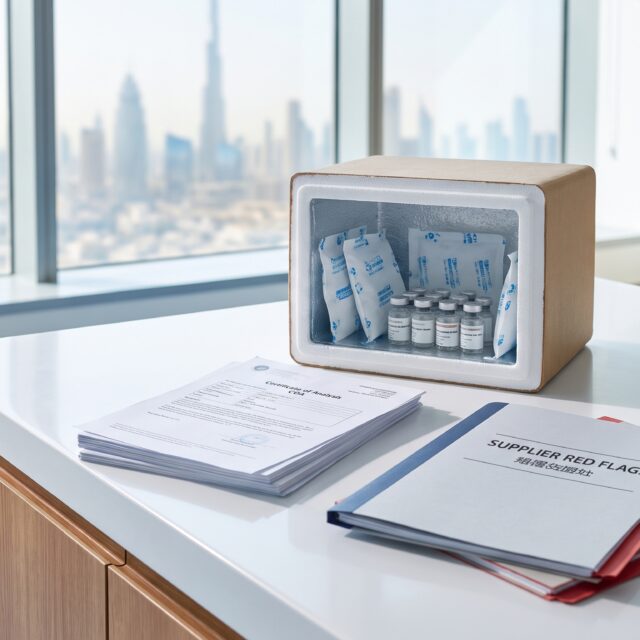
The absolute cornerstone of determining how to spot fake peptides in gcc markets is mastering the Certificate of Analysis (COA). A legitimate COA is a highly technical document, not a marketing flyer. Unfortunately, fraudulent suppliers have become adept at using software to modify generic templates, steal COAs from reputable sellers, or even use AI to generate fake HPLC chromatograms.
The Essentials of a Legitimate COA
- Third-Party Independence: A COA issued by a vendor’s own “in-house” laboratory carries zero analytical weight. Authentic validation requires testing from an independent, recognised third-party laboratory (such as Janoshik Analytical or MZ Biolabs).
- High-Performance Liquid Chromatography (HPLC): The HPLC report measures the purity of the compound by separating its components. For high-calibre research, the HPLC should demonstrate a purity level of at least 98 percent, visualised by a singular, sharp, dominant peak on the chromatogram (the Area Under the Curve, or AUC), devoid of significant “noise” representing impurities or heavy metals.
- Mass Spectrometry (MS): While HPLC shows how pure a powder is, Mass Spectrometry confirms the exact molecular identity of the compound. It proves that the powder in the vial is actually the specific peptide you ordered by matching its established molecular weight to the exact decimal.
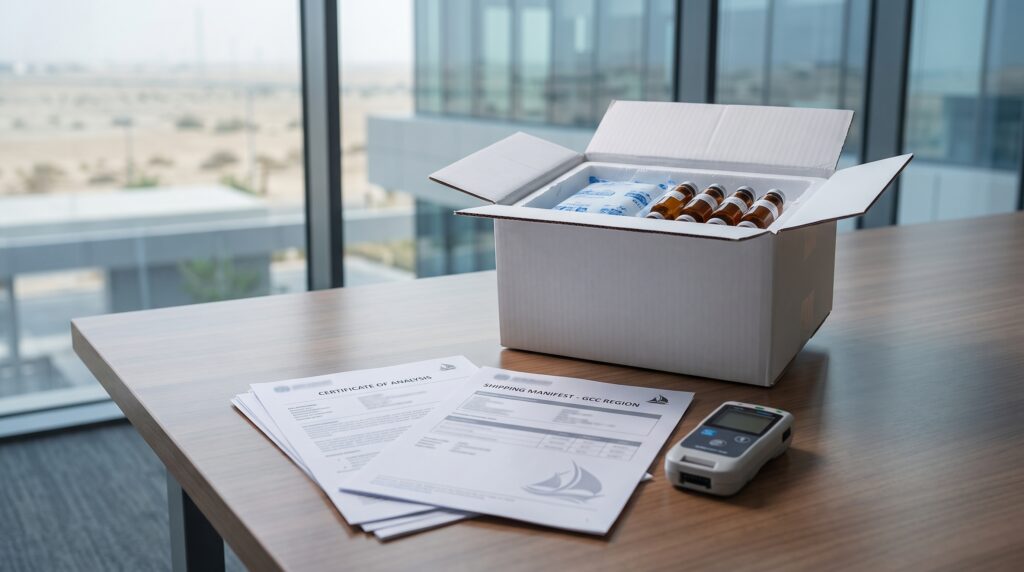
- Batch Specificity: A COA is useless if it is three years old. Legitimate vendors test every single batch they produce. The batch number printed on your physical vial must precisely match the batch number listed on the independent lab report.
- Verification Links or Codes: Premier analytical labs provide a verification key or QR code on their documents. Buyers should always enter this code directly on the testing facility’s official website. If a vendor only provides a flat PDF with no verifiable link, you should immediately assume the document has been altered.
Thermal Degradation: The Middle East Heat Threat
Even a 99.9 percent pure peptide can become entirely degraded before it reaches your laboratory if it is handled incorrectly. In the GCC, ambient temperatures routinely surpass 45 degrees Celsius during the summer months. This extreme heat rapidly breaks down sensitive peptide amino acid chains via a process known as hydrolysis, effectively rendering the compound useless and destroying your research investment.
When evaluating a supplier, their logistical setup is just as important as their lab reports. Buying from international suppliers who use standard postal services to ship to the GCC is a massive red flag. A package sitting on a sun-baked tarmac at an international customs facility in Dubai or Riyadh for 48 hours will experience catastrophic thermal degradation.
The Importance of Lyophilisation and Local Hubs
Peptides must always be shipped as a lyophilised (freeze-dried) powder. In this state, the compound is relatively stable and can withstand brief temperature fluctuations. Liquid peptides—those pre-mixed with bacteriostatic water or other solvents—are highly fragile. Their molecular bonds will degrade almost immediately during standard transit in the Middle East heat.
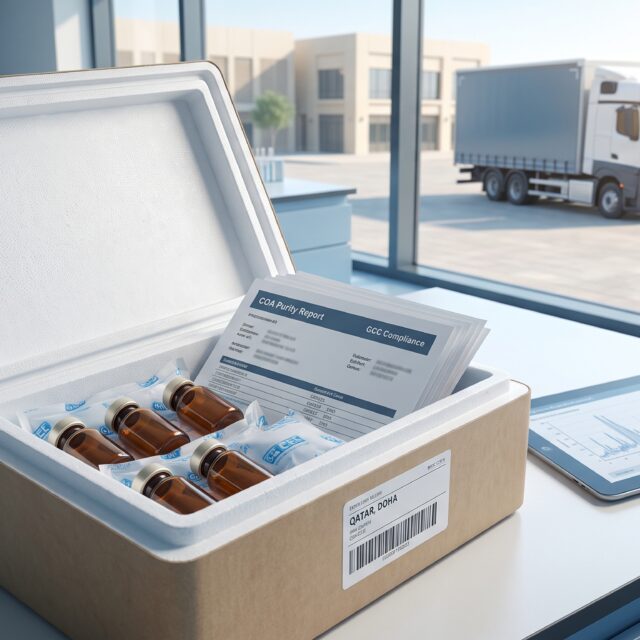
However, even lyophilised powders require protection. This is why sourcing from a localised hub that utilises climate-controlled logistics is mandatory for GCC buyers. For researchers in the region, securing peptides via UAE next-day delivery is not just a convenience; it is a critical scientific requirement. Local dispatch ensures the product moves rapidly from a cold-storage facility directly to your laboratory bench, bypassing the thermal trauma and prolonged exposure associated with international customs delays.
The Payment Gateway Litmus Test
One of the most effective, non-technical methods for spotting a fraudulent supplier is analysing their checkout process.
Legitimate, legally registered businesses operating transparently must undergo intense audits by high-risk merchant banks in order to process standard credit cards. These banking institutions review business licenses, physical operating addresses, compliance frameworks, and return policies before granting a merchant payment gateway.
Conversely, scam operations and fly-by-night vendors often rely exclusively on anonymous payment methods. If a supplier only accepts cryptocurrency, Peer-to-Peer (P2P) app transfers, or obscure third-party cash apps, it is a critical warning sign. These methods strip the buyer of all chargeback rights and consumer protections. If the product never arrives, or if independent testing proves the vial is severely underdosed, a crypto-only transaction leaves the buyer with zero financial recourse.
A trusted supplier will offer secure, traditional payment methods—including Cash on Delivery (COD) where locally feasible—demonstrating their confidence in their product, their adherence to KYC (Know Your Customer) regulations, and their commitment to regional logistics.
Sourcing Safely for Your Research
Understanding how to spot fake peptides gcc vendors might attempt to offload is ultimately a matter of rigorous diligence. It requires cross-referencing independent HPLC and MS data, ensuring the supplier operates a climate-controlled local supply chain, and verifying standard corporate payment security.
At NOVA Labs, we eliminate these friction points for researchers and academic institutions across the Middle East. Every compound we supply is backed by batch-specific, verifiable third-party testing to ensure maximum chemical integrity and accurate dosing. Furthermore, our operations are localised in the UAE, allowing us to deploy strict cold-chain handling and swift delivery protocols that protect delicate amino acid structures from the intense GCC climate.
We provide seamless local support via WhatsApp and secure payment frameworks, giving procurement teams complete peace of mind from initial order placement to final laboratory application. Ready to source verifiable, high-purity compounds for your next project? You can safely browse our tested peptide catalogue to view our current local stock and review comprehensive batch analytics.
Disclaimer: The products mentioned in this article are strictly for in-vitro laboratory research purposes only and are not intended for human consumption, clinical treatment, or diagnostic use. NOVA Labs prohibits the use of its products outside of validated research environments.
References
- Gulf News (2024). UAE Cracks Down on Unapproved Peptide Weight-Loss Drugs: Influencers Face Action.
- PSPeptides (2025). How to Avoid Peptide Scams: Quality Control Guide.
- Peptify UK (2023). How to Spot a Fake Peptide COA: 5 Red Flags.
- Janoshik Analytical. Understanding HPLC and Mass Spectrometry in Peptide Validation.
- Los Angeles Times (2024). Buying Peptides Online? Here’s How to Spot Fake and Dangerous Products.
- UAE Cracks Down on Unapproved Peptide Weight-Loss Drugs: 71 Sources and 14 Influencers Face Action – Gulf News
- How to Avoid Peptide Scams: Best Guide 2026 – PSPeptides
- Wholesale Peptides Saudi Arabia: Bulk Sourcing & ZATCA – NOVA Labs
- How to Spot a Fake Peptide COA: 5 Red Flags | Peptify UK
- Buying Peptides Online? Here’s How to Spot Fake and Dangerous Products – LA Times
Frequently asked questions
How do I verify a peptide Certificate of Analysis (COA)?
You can verify a COA by checking for a unique verification code or QR code on the document and entering it directly on the independent testing laboratory's official website. Never rely solely on a PDF sent by a supplier without cross-referencing it with the original issuing lab.
Why are liquid peptides a red flag in the UAE?
Pre-mixed liquid peptides degrade rapidly when exposed to the high temperatures common in the UAE and wider GCC. Legitimate suppliers only ship peptides as lyophilised (freeze-dried) powder to maintain chemical stability during transit.
What does HPLC and Mass Spectrometry show for peptides?
HPLC (High-Performance Liquid Chromatography) measures the purity percentage of the peptide by separating its components. Mass Spectrometry (MS) confirms the exact molecular weight and identity, ensuring the compound is exactly what the label claims.
Can heat ruin peptides during shipping to the GCC?
Yes, extreme heat exceeding 45 degrees Celsius can break down peptide amino acid chains through a process called hydrolysis. This is why ordering from local UAE hubs with next-day, climate-controlled delivery is crucial for maintaining product integrity.
Why should I avoid crypto-only peptide vendors?
Vendors that only accept cryptocurrency or anonymous P2P transfers strip buyers of their chargeback rights and consumer protections. Legitimate, registered businesses undergo banking audits to provide standard credit card processing or local Cash on Delivery (COD).
Nova Labs buyer tools
Ready to verify stock, testing and delivery?
Use the product page and lab report section to check availability, documentation, delivery timing and support before placing an order.
- COA / test-report checks
- GCC delivery context
- Cold-chain handling
- COD and card payment options
- WhatsApp support