
Procuring high-purity research compounds is only the first step in ensuring accurate, reproducible laboratory results. Understanding exactly how to reconstitute peptides correctly is what separates a stable, viable compound from one that degrades before it can be effectively studied. For researchers, procurement teams, and laboratory managers in the UAE, standard global handling protocols often fall short. Extreme local climate factors, coupled with complex supply chain logistics, must be carefully managed to maintain compound integrity.
In standard environments, the science of preparing lyophilised (freeze-dried) compounds is relatively straightforward. However, Dubai’s summer climate—characterised by dry-bulb temperatures of 40 to 48 degrees Celsius and relative humidity routinely exceeding 70 percent—creates unique transit and handling friction. Without proper temperature equilibration, stringent cold-chain delivery, and strict aseptic techniques, covalent degradation pathways accelerate rapidly, rendering premium research materials useless.
Quick Answer: How to Reconstitute Peptides
To reconstitute peptides correctly, mix the lyophilised powder with a sterile diluent like bacteriostatic water using strict aseptic techniques. Let refrigerated vials reach room temperature first. Inject the diluent slowly against the glass wall at a 45-degree angle, then gently swirl the vial to prevent structural degradation.
The Core Challenge: Handling Peptides in the UAE Climate
To understand why proper reconstitution techniques matter so deeply in the GCC, it is necessary to examine how peptides are shipped, stored, and physically structured. High-quality research peptides arrive in a lyophilised state. Freeze-drying removes the water content through sublimation, creating a stable dry “cake” or powder at the base of the vial that is highly resistant to chemical degradation.
However, once this sterile seal is breached, or if severe temperature fluctuations occur, the compound’s vulnerability increases exponentially.
The Danger of Atmospheric Condensation
A common mistake researchers make when learning how to reconstitute peptides is rushing the initial preparation process. When a vial is removed from cold storage (whether refrigerated at 2 to 8 degrees Celsius or frozen at -20 degrees Celsius), its temperature is drastically lower than the ambient laboratory environment.
If a cold vial is opened or punctured immediately, Dubai’s high ambient humidity will cause atmospheric moisture to condense directly onto the dry cake inside the vial. This immediate introduction of unmeasured, unsterilised moisture initiates rapid hydrolytic degradation before the proper diluent is even introduced. To combat this, standard operating procedures dictate that vials must equilibrate to room temperature for 15 to 30 minutes before any seals are wiped or reconstitution begins.
Essential Supplies for Aseptic Reconstitution
Before initiating the reconstitution workflow, researchers must gather the appropriate clinical-grade supplies. Preparing your workspace ensures that the peptide remains sterile, structurally intact, and free from cross-contamination.
- Bacteriostatic Water (BAC): This is the industry-standard diluent for long-term lab viability. Bacteriostatic water contains 0.9 percent benzyl alcohol, which actively inhibits bacterial growth. This allows a reconstituted vial to be stored safely under refrigeration for up to 28 to 30 days without spoiling.
- Sterile Laboratory Syringes: Typically, 1ml sterile syringes are used for precise, volumetric measurement of the diluent.
- Alcohol Prep Pads: 70% isopropyl alcohol pads are used for sterilising the rubber stoppers of both the diluent and the peptide vial prior to needle insertion.
Using plain sterile water (which lacks benzyl alcohol) means the compound will have no antibacterial protection and must typically be utilized or discarded within 24 to 48 hours to prevent contamination.
Step-by-Step Guide: How to Reconstitute Peptides Safely
Translating theory into bench-side practice requires patience and mechanical precision. Follow this procedural workflow to maintain the purity and molecular integrity of your research materials.
Step 1: Temperature Equilibration
Remove both your lyophilised peptide vial and your bacteriostatic water from the refrigerator. Place them on a clean, sterilised bench and allow them to sit undisturbed for 15 to 30 minutes. This allows the internal temperature of the glass to match ambient room conditions, nullifying the risk of internal condensation.
Step 2: Aseptic Preparation
Wash your hands thoroughly and don standard laboratory gloves. Take an alcohol swab and vigorously wipe the rubber stoppers of both the bacteriostatic water and the peptide vial. Allow the alcohol to air-dry completely (usually 30 to 60 seconds). Do not blow on the stoppers to speed up drying, as this introduces airborne pathogens directly into the sterile field.
Step 3: Measuring the Diluent
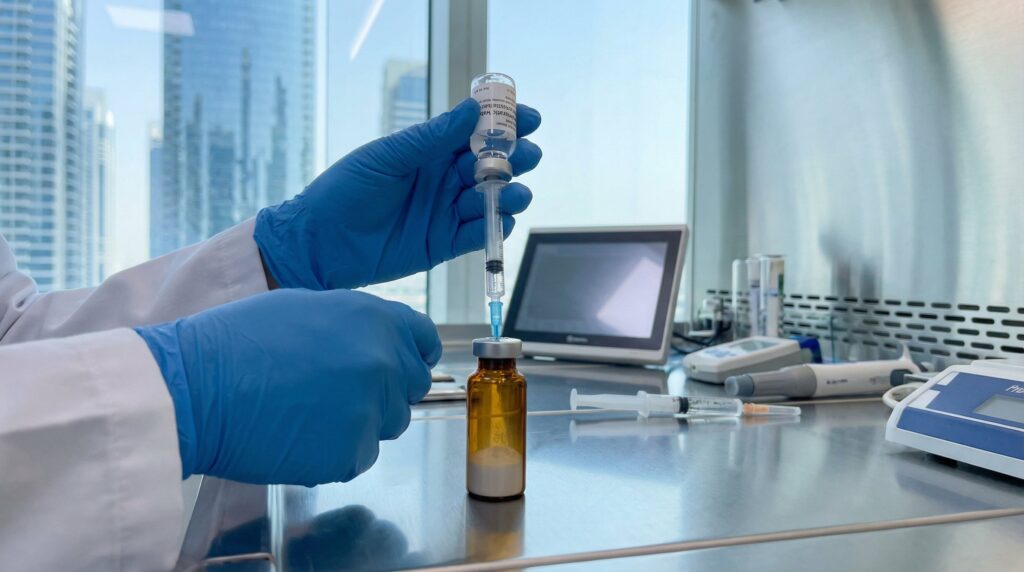
Draw air into your syringe equal to the volume of bacteriostatic water you intend to use. Inject this air into the bacteriostatic water vial to equalise the negative pressure, then draw out the precise required volume of liquid. Accurate reconstitution requires calculating the correct liquid-to-powder ratio based on the total milligram content of the lyophilised vial and the specific requirements of your research protocol.
Step 4: The 45-Degree Rule
This is perhaps the most critical mechanical step in understanding how to reconstitute peptides safely. Insert the needle into the peptide vial. Do not spray the liquid directly down onto the lyophilised powder. The mechanical force of a direct stream can cause aggressive foaming, shearing forces, and structural degradation of the fragile molecular bonds.
Instead, angle the needle at 45 degrees so the bevel faces the glass wall of the vial. Inject the bacteriostatic water slowly so that it trickles down the glass side and pools gently at the bottom, naturally enveloping the dry cake.
Step 5: Gentle Mixing (Never Shake)
Once the liquid has been transferred, carefully remove the syringe. You will likely see the dry cake begin to dissolve almost immediately.
Under no circumstances should you shake, agitate, or vortex the vial. Violent agitation causes surface denaturation, peptide aggregation, and foaming, which severely degrades the compound’s efficacy and alters its behavior in assays. Instead, hold the vial between your thumb and forefinger and roll it gently, or swirl it in a slow, circular motion on the benchtop until the liquid is entirely clear and no visible particulates remain.
Cold Chain Logistics and Longevity in Dubai
The physical state of a peptide dictates its ongoing storage requirements. However, laboratory storage is only half the battle in the GCC.
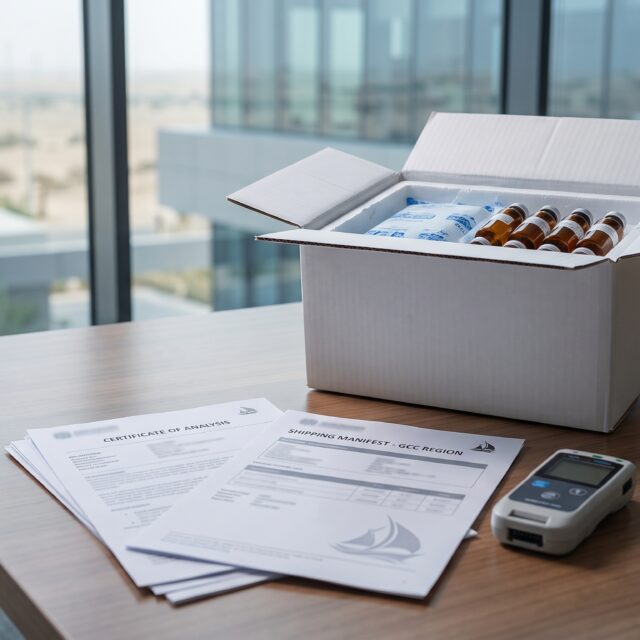
Because maintaining the cold chain is paramount to stability, local procurement teams must factor in transit times. Purchasing from international suppliers often means delicate vials sit in un-air-conditioned customs warehouses during the peak of Dubai summer. A few hours at 45 degrees Celsius is enough to permanently degrade premium compounds.
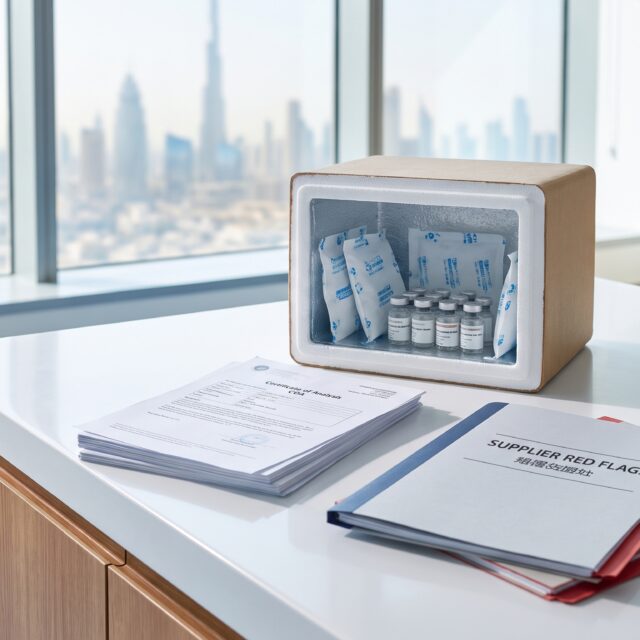
Working with a local supplier who manages the initial cold-chain logistics is highly advantageous. For seamless lab operations, researchers should rely on local logistics networks that ensure compounds are never out of optimal temperature zones. Utilizing Dubai same-day peptide delivery guarantees that your lyophilised inventory moves from climate-controlled storage directly to your laboratory without the perilous delays associated with international shipping.
Lyophilised (Dry) Peptides:
- Short-term storage (weeks to months): Refrigerate at 2 to 8 degrees Celsius.
- Long-term storage (up to two years): Freeze at -20 degrees Celsius. Ensure vials are sealed tightly and stored away from frost-free freezer cycles, which constantly fluctuate in temperature and cause freeze-thaw damage.
Reconstituted (Liquid) Peptides:
- Must be stored immediately in a refrigerator at 2 to 8 degrees Celsius.
- Keep vials away from direct UV light.
- With the use of bacteriostatic water, the solution remains stable for approximately 28 to 30 days.
- Never freeze a reconstituted peptide. The expansion of water crystals will mechanically destroy the peptide structures.
Evaluating Your Supplier’s Standards
Perfect reconstitution technique means nothing if the underlying compound is compromised before it reaches your workbench. Discerning buyers and laboratory managers must rigorously evaluate their suppliers for operational transparency and scientific integrity.
Always verify that your vendor provides public, batch-specific Certificates of Analysis (COAs) alongside High-Performance Liquid Chromatography (HPLC) and Mass Spectrometry (MS) testing. These documents confirm that the compound meets stringent purity benchmarks (usually exceeding 99 percent) and contains the precise molecular mass of the stated peptide.
Furthermore, consider the operational support of the supplier. A credible supplier catering to the UAE market will understand local friction points. They should offer secure local stock, cash on delivery (COD) options for procurement flexibility, and responsive WhatsApp or direct customer support to coordinate rapid, temperature-controlled transit schedules.
Conclusion
Mastering how to reconstitute peptides is a foundational skill for ensuring your research yields accurate, uncompromised results. By prioritizing temperature equilibration, adopting strict aseptic protocols, respecting the physical fragility of the compound through the 45-degree injection rule, and understanding local UAE storage requirements, laboratories can maximize the viability and longevity of their inventory.
Start by securing the highest purity compounds backed by transparent, third-party testing. Verify the logistics of your supplier to ensure your materials survive the Gulf climate, and apply these careful handling guidelines every time a vial is transferred from cold storage to the workbench. If you are equipping your UAE laboratory and require rigorously tested compounds backed by local cold-chain infrastructure, shop for verified research peptides at NOVA Labs.
Disclaimer: The products and compounds mentioned in this article are strictly for laboratory research purposes only and are not intended for human consumption, diagnostic, therapeutic, or clinical use.
References
- National Center for Biotechnology Information (NCBI) – Guidelines on Peptide Stability, Handling, and Storage
- Journal of Peptide Science – Environmental Impacts on Lyophilised Compounds and Hydrolytic Degradation Pathways
- Good Laboratory Practice (GLP) – Aseptic Technique Standards for Reconstitution
- VaultLabs Technical Whitepaper – Thermal Stability of Lyophilized Peptides in the Gulf Climate
- NOVA Labs UAE – Internal Cold Chain Logistics and Handling Protocols
- Thermal Stability of Lyophilized Peptides in the Gulf Climate | VaultLabs Technical Whitepaper
- Peptide Calculator | Free Reconstitution & Syringe Tool UAE | VaultLabs
- Lyophilised vs reconstituted research peptides – UAEPEP
- Custom Hair Compounds Provided by CureCell Pharmacy Dubai
- Peptide Reconstitution & Storage Guide 2026 – Nexyra Lab
- Peptide Reconstitution: Dosing, Mixing and Storage Guidelines – Jay Campbell
Frequently asked questions
What liquid do you use to reconstitute peptides?
Bacteriostatic water is the standard diluent for reconstituting research peptides. It contains 0.9 percent benzyl alcohol, which inhibits bacterial growth and allows the solution to remain viable under laboratory refrigeration for up to 30 days.
Can I shake a peptide vial to mix it faster?
No, you should never shake or vortex a peptide vial. Violent agitation causes foaming, surface denaturation, and structural degradation of the peptide bonds. Always swirl or roll the vial gently on the benchtop until the solution is clear.
How long do reconstituted peptides last in the fridge?
When reconstituted with bacteriostatic water and stored properly in a laboratory refrigerator at 2 to 8 degrees Celsius away from direct light, most research peptides remain stable for 28 to 30 days.
Why do I need to let cold vials sit at room temperature before mixing?
Allowing a cold vial to equilibrate to room temperature for 15 to 30 minutes prevents atmospheric moisture from instantly condensing on the dry lyophilised powder. Immediate condensation causes rapid hydrolytic degradation upon opening the sterile seal.
Nova Labs buyer tools
Ready to verify stock, testing and delivery?
Use the product page and lab report section to check availability, documentation, delivery timing and support before placing an order.
- COA / test-report checks
- Dubai delivery context
- Cold-chain handling
- COD and card payment options
- WhatsApp support