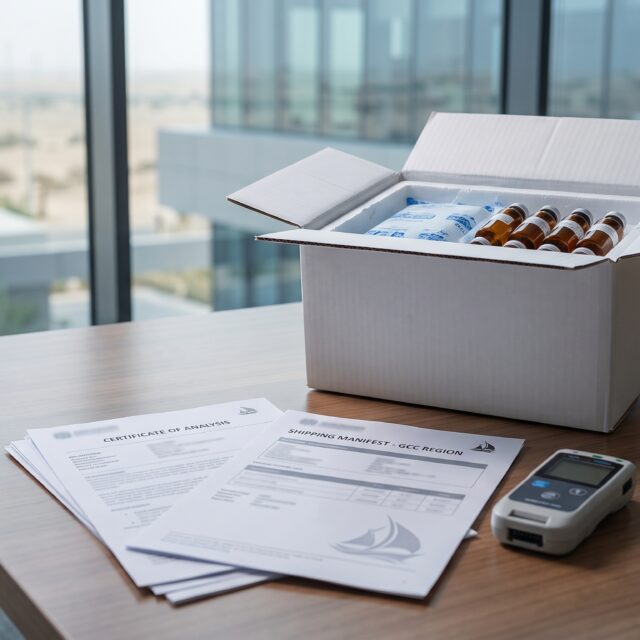

Procuring reliable research materials in the UAE requires more than just finding a supplier with a professional website. For procurement staff and informed researchers, verifying the analytical testing of a compound is the single most important step before making a purchase. When learning how to read peptide COA Dubai standards demand, understanding the raw data on a Certificate of Analysis (COA) is what separates successful laboratory studies from compromised research.
A true COA goes far beyond a simple “99% pure” badge on a product page. It requires specific, independent analytical readouts that prove both the quality and the exact chemical identity of the compound inside the vial. In this guide, we break down exactly how to interpret these documents, how to spot outdated or manipulated reports, and why cold-chain logistics in the GCC matter just as much as the initial laboratory test.
Decoding the Data: How to Read Peptide COA Dubai
To effectively know how to read peptide COA Dubai testing standards demand, buyers must verify two main components: a High-Performance Liquid Chromatography (HPLC) report confirming purity above 98%, and a Mass Spectrometry (MS) scan verifying exact molecular identity. Always verify batch numbers and independent laboratory QR codes.
Quick Buyer Checklist: Verifying Laboratory Reports
Before authorizing a procurement order for your laboratory, ensure the supplier’s documentation passes this rapid assessment:
- HPLC Purity Check: Is the main chromatogram peak clearly defined, and does the numerical purity report exceed 98% for in-vitro applications?
- MS Identity Verification: Does the measured mass-to-charge (m/z) ratio match the theoretical molecular weight of the target peptide sequence?
- Third-Party Authenticity: Is the testing performed by an independent, recognized analytical laboratory rather than handled exclusively in-house?
- Live Verification Link: Does the document feature a verifiable task ID or QR code that directs to the testing laboratory’s official database?
- Current Batch Alignment: Does the lot number on the COA perfectly match the lot number on the physical vial being delivered to your facility?
Understanding High-Performance Liquid Chromatography (HPLC)
The HPLC section of a COA is designed to separate, identify, and quantify each component in a complex mixture. On a valid test report, you will look at a graph called the chromatogram. The X-axis represents “Retention Time” (how long it takes for a substance to pass through the testing column), and the Y-axis measures absorbance (typically in milli-Absorbance Units, or mAU).
You should see a single, massive, dominant peak. This peak represents the primary research compound. Any smaller peaks appearing alongside it represent impurities, such as synthesis byproducts, truncated peptide chains missing an amino acid, or residual solvents.
The analytical report will provide a percentage breakdown based on the total area under the curve. For high-level in-vitro research, a purity standard of 98% or higher is generally expected. However, it is vital to remember a critical caveat: an HPLC test only confirms that whatever is in the vial is highly pure. It does not definitively prove what the substance actually is. A vial of 99% pure mannitol (a common buffer) will show an excellent HPLC chart, which is why purity alone is never enough.
Mass Spectrometry (MS) for Precise Identity Verification
This is where Mass Spectrometry becomes a non-negotiable requirement for research procurement. An MS report measures the mass-to-charge ratio of ionized particles to determine the precise molecular weight of the substance in the vial.
Every peptide has a theoretical molecular weight based strictly on its specific amino acid sequence. If a supplier provides an HPLC report showing 99.5% purity but omits the MS report, your laboratory is exposed to significant experimental variables. Any reliable guide covering how to read peptide coa in dubai will always insist on matching the MS test result against the peptide’s established theoretical mass.
When examining the MS graph, you will typically look for a dominant peak that corresponds to the intact molecule, often shown with various charge states (e.g., [M+H]+ for a single positive charge). If the measured mass aligns with the theoretical mass within a very tight decimal margin, the identity of the chemical compound is successfully verified.
Net Peptide Content (NPC) vs. Total Vial Mass
Another critical factor frequently overlooked by buyers is understanding Net Peptide Content (NPC) versus total lyophilized mass. A standard research vial might be labeled as containing 10mg of a specific compound. However, the white freeze-dried “puck” inside the vial is rarely composed entirely of the active peptide.
During Solid Phase Peptide Synthesis (SPPS) and the subsequent cleavage and lyophilization processes, counter-ions (such as Trifluoroacetic acid or acetate salts) remain securely attached to the peptide molecules. Additionally, buffer salts like mannitol or glycine are frequently added to stabilize the delicate peptide structure during the intense freeze-drying phase. Therefore, the total weight of the powder in the vial might actually be 15mg or 20mg to yield 10mg of active material.
Advanced third-party testing evaluates the Net Peptide Content to ensure that the actual active ingredient accurately hits the 10mg target. Lower-tier suppliers often underfill the active compound and make up the visual difference with excess bulking agents, which drastically skews laboratory concentration calculations during reconstitution.
Spotting Forged or Manipulated Testing Reports in the UAE Market
The UAE research and biotechnology market has grown rapidly, bringing a mix of reputable, rigorous laboratories and lower-tier, opportunistic vendors. Evaluating the authenticity of the COA itself is just as important as reading the technical data.
When reviewing a supplier’s documentation, view any discrepancies with extreme caution:
- Check for Live Verification: Reputable independent analytical laboratories (such as Janoshik, frequently utilized in the GCC and global markets) include unique task ID numbers and QR codes on their COAs. Scanning this QR code should direct you immediately to the testing laboratory’s official domain, proving the report has not been manipulated in Photoshop.
- Verify the Batch/Lot Number: The lot number on the COA must match the lot number printed on the vial you receive. If a supplier uses a single generic COA from three years ago for all current inventory, the documentation is effectively useless for your current experiment.
- Look at the Testing Date: Lyophilized peptides degrade over time, particularly if stored improperly. A COA that is several years old does not accurately reflect the current chemical state of the supplier’s stock.
- Check for Hidden Information: If a supplier claims “COAs available upon request” but makes it difficult to actually obtain them, or routinely redacts critical tracking information from the document, view it as a major warning sign regarding their supply chain transparency.
Preserving Purity: Cold-Chain Logistics for GCC Heat
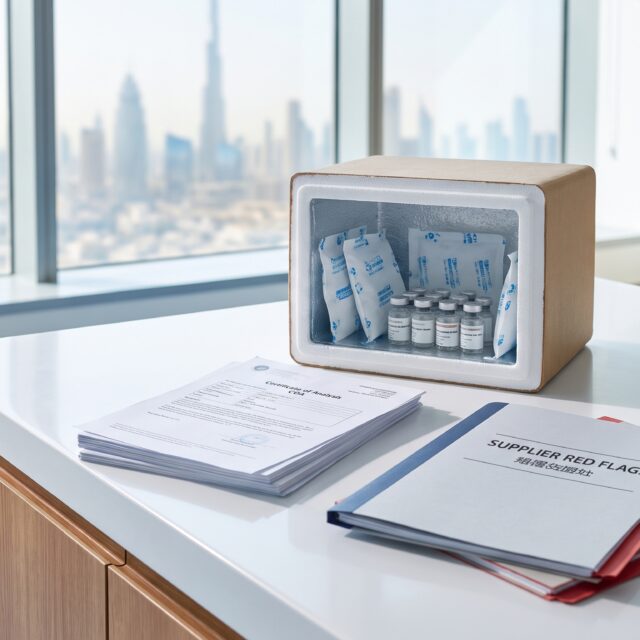
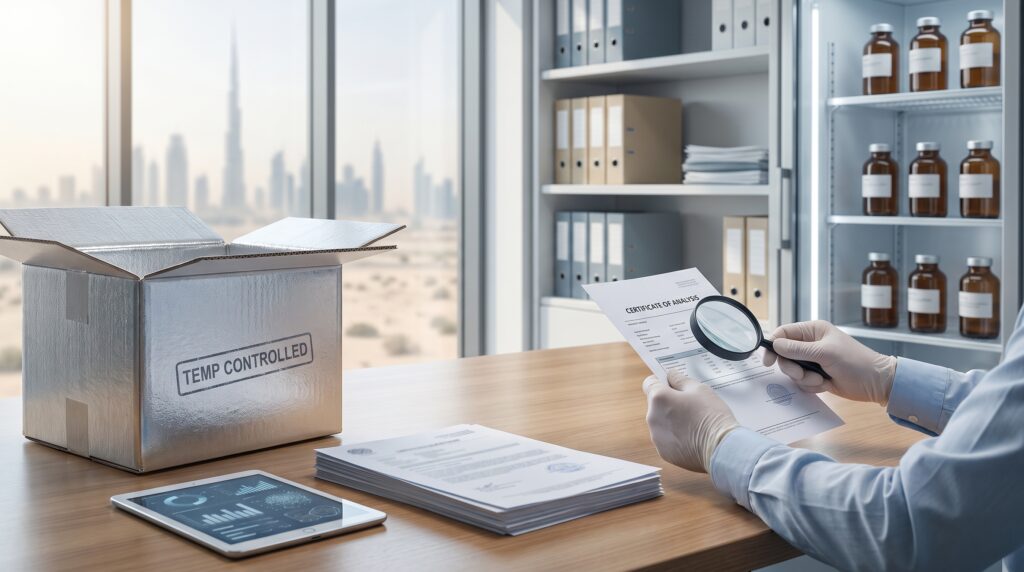
Verifying a pristine, authentic COA is only the first half of the procurement equation. The second half is ensuring that the verified purity survives the physical transit to your laboratory. The extreme climate of Dubai and the broader GCC presents a unique challenge for peptide molecular stability.
Lyophilized peptides in powder form are generally stable at ambient room temperatures for short durations. However, if a package is left in the back of a standard courier van during a Dubai summer where temperatures routinely exceed 45°C (113°F), the delicate amino acid bonds can undergo rapid degradation and aggregation. A compound that tested at 99% purity in an analytical laboratory can quickly degrade before it ever reaches your facility if it is improperly handled in transit.
Premium local suppliers actively manage this logistical risk through specialized cold-chain logistics. This includes storing bulk inventory in deep-freeze climate-controlled environments and utilizing insulated packaging during local transit. If your lab prioritizes structural integrity, utilizing secure same-day peptide delivery in Dubai ensures that your materials spend the absolute minimum amount of time in transit, perfectly preserving the integrity documented on the COA.
Seamless Local Sourcing with NOVA Labs
At NOVA Labs, we understand that UAE researchers require uncompromising analytical transparency combined with localized logistical expertise. We ensure that our procurement standards prioritize independent third-party testing, complete batch visibility, and correct thermal handling procedures from the synthesis laboratory straight to your door.
Rather than navigating the costly uncertainties of international customs delays or opaque, outdated testing documentation, regional researchers can rely on our streamlined local supply chain. We prioritize verifiable quality control, providing accessible COAs for our inventory, and utilize optimized delivery networks tailored specifically for the severe UAE climate. To explore our rigorously handled inventory and review the data supporting our compounds, view our complete research catalog.
Our procurement team is also directly available via WhatsApp to answer specific stock inquiries, provide current batch documentation, and assist with UAE-friendly COD (Cash on Delivery) or secure digital payment options, ensuring a frictionless purchasing experience.
Conclusion
Mastering how to read peptide COA Dubai standards require is an essential operational skill for any serious research buyer or laboratory manager. By strictly demanding both HPLC purity and MS identity data, verifying independent lab links via QR codes, and cross-referencing batch numbers, you protect the integrity of your experimental data. Furthermore, by factoring in the harsh reality of UAE heat and exclusively selecting suppliers who prioritize cold-chain preservation and rapid fulfillment, you ensure that the purity printed on the COA perfectly matches the purity actually utilized in your laboratory.
Disclaimer: The products mentioned in this article are strictly for laboratory research and in-vitro applications only. They are not intended for human consumption, diagnostic, or therapeutic use. Handle all research compounds in accordance with standard laboratory safety protocols.
References
- ICH Q2(R1) Validation of Analytical Procedures: Text and Methodology. International Council for Harmonisation of Technical Requirements for Pharmaceuticals for Human Use.
- Snyder, L. R., Kirkland, J. J., & Dolan, J. W. (2011). Introduction to Modern Liquid Chromatography. John Wiley & Sons.
- USP <1047> Biotechnology-Derived Articles – Peptide Therapeutics. United States Pharmacopeia.
- Janoshik Analytical. Independent Third-Party Testing Methodologies for Research Compounds.
- D’Hondt, M., et al. (2014). Related impurities in peptide medicines. Journal of Pharmaceutical and Biomedical Analysis, 101, 2-30.
Disclaimer: The products mentioned in this article are for research purposes only and are not intended for human consumption.
- DXB Peptides — Research Peptides UAE | ≥99% Purity + COA
- How to Read a Peptide COA (Real vs Fake)
- How to read a peptide Certificate of Analysis (COA) | BioHack London
- Best Peptide Therapy in Dubai | EDEN AESTHETICS
- How to Read a Peptide COA (Certificate of Analysis) – Underground Biohacking
- About Body Labs UAE | Research Peptide Supply Lab in Dubai
Frequently asked questions
What does HPLC mean on a peptide COA?
High-Performance Liquid Chromatography (HPLC) is an analytical technique used to measure the purity percentage of a compound. It identifies the primary peptide peak on a chromatogram and highlights any remaining impurities, such as truncated sequences or synthesis byproducts.
Why is Mass Spectrometry (MS) necessary for peptides?
Mass Spectrometry (MS) verifies the exact molecular weight of the compound. Without an MS scan, a product may show high purity on an HPLC test but actually be a completely different chemical substance than what is listed on the label.
How can I verify a peptide COA in the UAE?
Reputable suppliers in the UAE provide certificates containing scannable QR codes or independent lab task IDs. This allows buyers to confirm the report's authenticity directly with the testing facility's live database, preventing the use of forged or outdated documents.
Does 99% peptide purity mean the vial is 99% active ingredient?
No, purity only indicates the quality of the raw peptide material itself. The total powder in the vial often includes necessary buffer salts (like mannitol) and counter-ions from synthesis. Net peptide content testing is required to ensure the correct milligram amount of active compound is present.
How does Dubai heat affect peptide stability during delivery?
Extreme heat can rapidly degrade fragile amino acid bonds. Even if a COA proves 99% purity at the lab, prolonged exposure to high temperatures in standard transit vans can ruin the compound, making localized cold-chain storage and rapid delivery essential in the GCC.
Nova Labs buyer tools
Ready to verify stock, testing and delivery?
Use the product page and lab report section to check availability, documentation, delivery timing and support before placing an order.
- COA / test-report checks
- Dubai delivery context
- Cold-chain handling
- COD and card payment options
- WhatsApp support