
GHK-Cu vs TB-500: what should UAE research buyers compare?
GHK-Cu vs TB-500 is a comparison of different research materials, not two names for the same peptide. GHK-Cu is a copper complex of a tripeptide; TB-500 commonly denotes an acetylated seven-residue fragment of thymosin-β4. UAE laboratories should compare the exact chemical identity, relevant publications and documentation for the lot offered.
Quick answer — check these before ordering:
- Name the material precisely. A paper on free GHK is not necessarily about GHK-Cu; a paper on intact thymosin-β4 is not necessarily about TB-500.
- Match the paperwork to the shipment. Request a certificate of analysis (COA) for the available lot, not a sample report for another batch.
- Confirm the transaction. Ask about product-specific shipping conditions, delivery to your UAE address, payment terms and any institutional procurement requirements.
| Comparison point | GHK-Cu | TB-500 |
| — | — | — |
| Declared identity to check | Copper complex of glycine–histidine–lysine | Commonly the acetylated thymosin-β4 fragment Ac-LKKTETQ |
| Literature mix-up | Substituting findings on free GHK for findings on its copper complex | Substituting findings on intact, 43-residue thymosin-β4 for fragment-specific findings |
| Lot-document question | How were peptide identity and copper content assessed? | Does testing support the declared sequence, acetylation and chemical form? |
These checks help identify a material and assess its documentation; they do not establish that either product fits a particular experiment.
How do the molecules differ?
GHK is the three-residue peptide glycine–histidine–lysine. GHK-Cu names its copper complex. When comparing a catalogue listing with a publication, look for the form used in each: free peptide and copper complex should not be treated as interchangeable. A supplier’s stated mass or purity may also require clarification if it is unclear whether the figure refers to peptide, complex or another reporting basis.
TB-500 is commonly associated with Ac-LKKTETQ, an N-terminally acetylated seven-residue fragment corresponding to residues 17–23 of thymosin-β4. The cited analytical paper identified that fragment in material described as TB-500. Intact thymosin-β4 has 43 amino acids. Because names on product pages can be abbreviated, ask for the sequence, terminal modification and declared chemical form rather than relying on “TB-500” or “thymosin beta-4” alone.
The distinction affects practical decisions. A laboratory seeking a particular sequence for an assay needs documentation for that sequence, not a broadly related name. Likewise, published handling information for free GHK, GHK-Cu, the short fragment and intact thymosin-β4 should not be transferred between materials without checking the formulation and the laboratory’s approved procedure.
Which published findings can inform a purchase?
Start with the methods section of a paper. Record the substance tested, its chemical form, the experimental model and the measured endpoint. A review of GHK-Cu research can help locate primary studies, but it cannot verify a supplier’s current lot. The TB-500 analytical paper is useful for identifying the fragment associated with that name; it is not proof that results reported for intact thymosin-β4 also apply to the fragment.
Before treating two publications as comparable, ask whether they tested the same material and preparation. A cell-culture experiment and an experiment in another model may address different questions even when both mention the same molecule. Where a paper does not specify whether GHK was copper-complexed, or whether thymosin-β4 was intact, record that uncertainty instead of filling the gap from a product description.
Comparison method: This guide compares reported molecular identities and the scope of the cited literature, then applies those distinctions to procurement documents. It does not compare clinical effects or independently assess any supplier’s lots. As of publication, no live UAE prices, inventory levels or delivery times have been verified for this comparison; confirm those details when requesting a quote.
What should a lot-matched COA actually show?
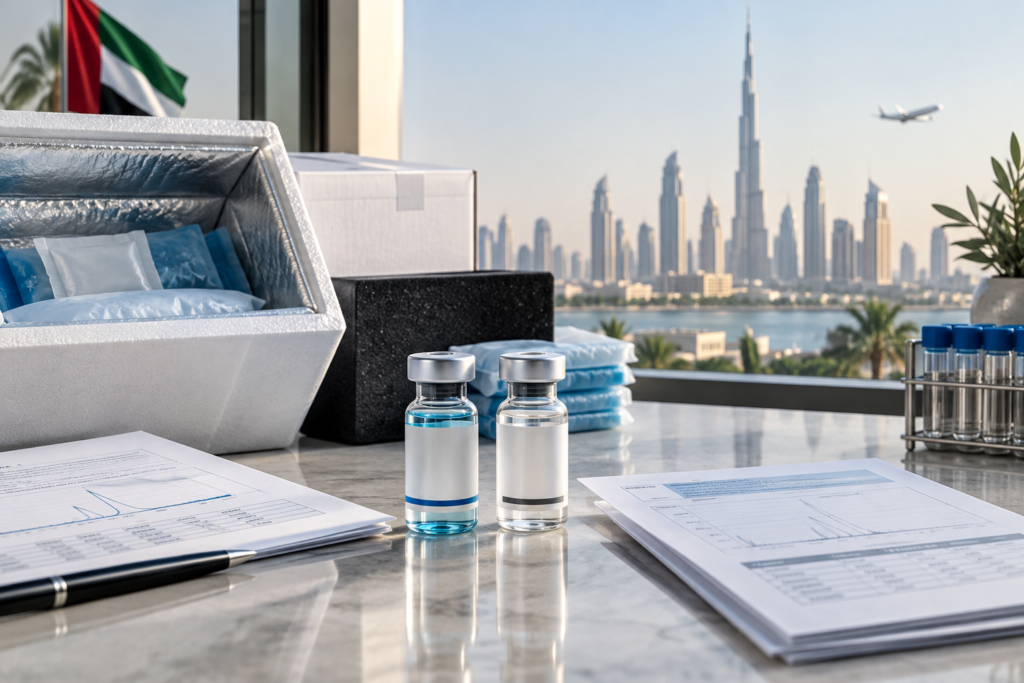
A COA is most useful when its lot or batch identifier matches the vial that will ship. Ask how the sample tested was linked to that lot, who issued the report, when testing occurred and which methods produced the results. If a seller provides a report for a different lot, it can illustrate a testing approach but cannot establish the results for your shipment.
Read the reported measurements separately:
- Identity: Does the evidence support the declared molecule? A mass measurement may support a peptide assignment, but the report should make clear what was analysed and how the conclusion was reached.
- Chromatographic purity: An HPLC percentage describes peaks observed under a stated method. Check whether the chromatogram, detection method and interpretation are available; the percentage is not automatically the mass fraction of the intended material in a vial.
- Content: Ask whether the quantity of the declared material was determined separately from HPLC purity, and on what basis it is reported.
- Project-specific tests: If your protocol requires additional attributes, request evidence that those tests were performed on the relevant lot. Do not infer an unreported result from a general marketing statement.
For GHK-Cu, the buyer’s specific question is how the supplier characterised the copper complex and assessed copper content, rather than relying on a peptide-only purity figure. For TB-500, compare the stated sequence and acetylation with the identity testing, and clarify any declared salt or counterion. An HPLC purity number alone does not establish sterility, transport stability or suitability for administration.
If reviewing NOVA Labs listings, use the GHK-Cu product page and TB-500 product page to identify which material is being offered. Check the lab-results page for available documentation, then confirm with support that any report you rely on matches the lot actually available for your order. A listing or posted report should not be assumed to describe every future batch.
What changes for delivery to Dubai or elsewhere in the GCC?
For a Dubai receiving laboratory, a workable purchase depends on more than the catalogue name. Request the offered product’s storage and shipping specifications and ask how the proposed delivery service meets them. Confirm the delivery address, receiving hours and process for a missed delivery, especially if a shipment may sit at a building reception desk over a weekend. Do not assume all peptide vials need the same service or that instructions for an unopened vial apply to a prepared laboratory solution.
Before payment, check available stock and lot, dispatch origin, estimated delivery window, shipping charges and who handles a shipment issue. Ask which payment methods are available for your organisation, whether an invoice or purchase-order process is supported, and how to reach support if the lot or delivery plan changes. If a laboratory procedure depends on particular transport conditions, get those conditions confirmed for the offered product rather than relying on a general delivery estimate.
A research-use-only label does not itself establish that an import, sale or institutional use is authorised. The receiving organisation should verify current requirements for its material, purpose and transaction with the relevant UAE authority. For delivery to another GCC country, check that destination’s requirements separately; UAE arrangements should not be assumed to apply throughout the region.
Which material fits the research question?
Choose by the molecule specified in the approved research plan, not by a shared theme in search results. If the protocol calls for a copper complex of GHK, confirm that the offered form and its analytical evidence match. If it calls for the acetylated seven-residue fragment, verify that sequence rather than substituting intact thymosin-β4. Where the study specifies neither form clearly, resolve the ambiguity internally before comparing listings or prices.
For an institutional research enquiry, ask NOVA Labs support to confirm the available lot, its matching analytical report, applicable payment options and delivery terms before placing an order. Both materials discussed here are for research purposes only and are not intended for human consumption. This article provides no treatment, administration or dosage guidance.
References
- Pickart L, Margolina A. “Regenerative and Protective Actions of the GHK-Cu Peptide in the Light of the New Gene Data.” International Journal of Molecular Sciences (2018). A review of published GHK-Cu research, not a lot-specific assessment.
- “Synthesis and characterization of the N-terminal acetylated 17–23 fragment of thymosin beta 4 identified in TB-500.” PubMed record. Analytical identification of the fragment associated with TB-500.
- Emirates Drug Establishment. Official starting point for checking current UAE regulatory information; requirements must be verified for the specific transaction.
- EDE Circular No. 46/2026 — Guideline for Handling Peptide Products and Molecules
- Copper tripeptide — PubChem
- GHK-Cu as a Bioactive Metallopeptide and Drug-Delivery Cargo: Coordination Chemistry, Formulation Science, Therapeutic Evidence, and a Translational Roadmap
- services.dha.gov.ae
Frequently asked questions
What is the difference between GHK-Cu and TB-500?
GHK-Cu is a copper complex of the three-residue peptide glycine–histidine–lysine. TB-500 commonly denotes an acetylated seven-residue fragment of thymosin-β4. They are different research materials, so check the exact identity specified by your protocol and supplier.
Is TB-500 the same as thymosin-β4?
No. TB-500 is commonly associated with an acetylated seven-residue fragment; intact thymosin-β4 has 43 amino acids. Findings for the intact peptide are not automatically findings for the fragment.
What should I check on a GHK-Cu or TB-500 certificate of analysis?
Match the COA lot number to the offered shipment, then review sample identification, test methods, identity evidence and how purity and content are reported. For GHK-Cu, clarify copper assessment; for TB-500, check the declared sequence and acetylation.
Does a research-use-only label authorise a peptide order in the UAE?
No. The receiving organisation should verify current requirements for the specific material, research purpose and transaction with the relevant UAE authority. The label alone does not establish authorisation.
What should a Dubai laboratory confirm before ordering a research peptide?
Confirm the exact material and available lot, matching analytical documentation, product-specific shipping conditions, delivery arrangements, payment options and a support contact. Check applicable institutional and UAE procurement requirements before ordering.
Nova Labs buyer tools
Ready to verify stock, testing and delivery?
Use the product page and lab report section to check availability, documentation, delivery timing and support before placing an order.
- COA / test-report checks
- UAE delivery context
- Cold-chain handling
- COD and card payment options
- WhatsApp support