



Cold Chain Peptide Delivery Dubai: Overcoming Regional Logistics
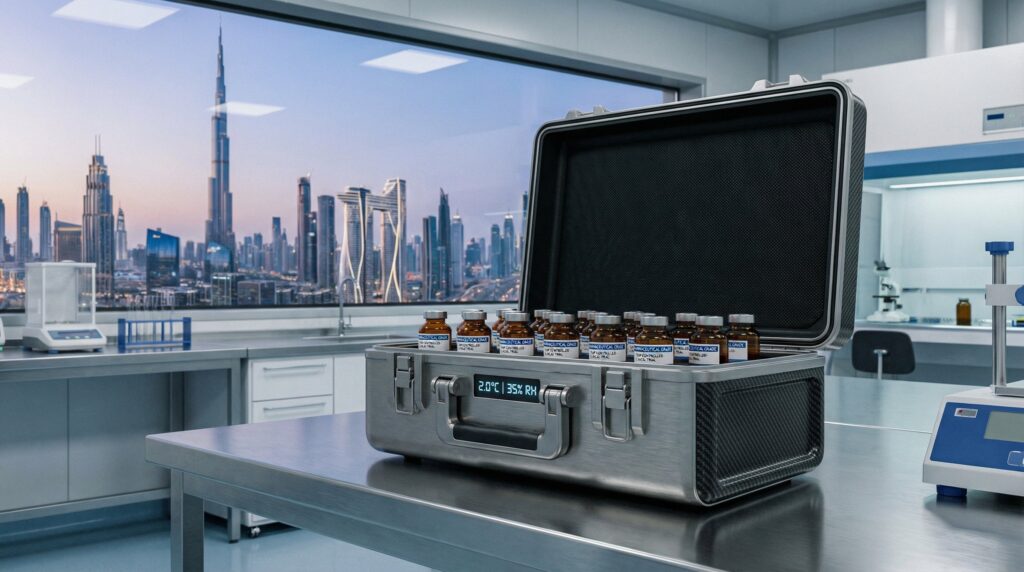
Cold chain peptide delivery in Dubai utilizes insulated foil packaging, medical-grade gel packs, and rapid local dispatch to protect fragile research compounds from severe UAE heat. Bypassing international customs delays with same-day local fulfillment ensures lyophilized materials maintain structural viability from warehouse to laboratory.
Key Takeaways for UAE Laboratory Buyers:
- Heat Vulnerability: Ambient UAE temperatures rapidly degrade covalent peptide bonds. Maintaining a 2°C to 8°C transit environment is crucial for empirical accuracy.
- Customs Delays: International imports risk prolonged heat exposure at DXB customs holding facilities as temporary cooling agents expire during clearance.
- The Local Advantage: Same-day fulfillment within Dubai ensures the cooling agent remains active during transit, keeping the cold chain completely unbroken.
- Quality Assurance: Logistics must be paired with rigorous HPLC/MS testing and Certificates of Analysis (COAs) to verify compound purity both before and after transit.
For researchers, lab managers, and procurement staff in the UAE, sourcing high-purity laboratory materials is only half the battle. The other half is ensuring those delicate materials survive the journey to your facility. Lyophilized (freeze-dried) peptides possess complex amino acid chains that are highly susceptible to molecular breakdown when exposed to sustained thermal stress, moisture, or severe mechanical agitation.
When UAE ambient temperatures push past 45°C during peak summer, procurement logistics become a race against the clock. Securing third-party tested, 99% pure compounds means nothing if the logistics chain fails before arrival. Mastering cold chain peptide delivery in Dubai helps laboratory buyers distinguish reliable local partners from high-risk offshore suppliers, guaranteeing that every batch maintains its structural integrity from the moment of dispatch to the moment it enters your -20°C freezer.
The Science of Degradation: How Thermal Stress Impacts Peptides
To understand why temperature control is non-negotiable, one must look at the biochemical fragility of these compounds. Peptides degrade through multiple pathways, primarily hydrolysis, deamidation, and oxidation.
While freeze-drying removes the water necessary for rapid hydrolysis, thermal agitation can still induce conformational changes in the lyophilized “cake” or “puck.” Sustained exposure to high heat causes the structural bonds holding the amino acids together to fracture. When a researcher attempts to reconstitute a thermally degraded compound, the resulting solution will contain fragments of the original peptide, rendering it completely useless for precise empirical study.
Even minor temperature excursions can compromise the concentration of the active compound. If an experiment requires an exact molarity, utilizing a vial that has lost 15% of its structural viability due to transit heat will thoroughly invalidate the research data.
The UAE Summer Hazard: Why Standard Courier Shipping Fails
The fundamental challenge of laboratory distribution in the Gulf Cooperation Council (GCC) is ambient temperature. Official UAE Ministry of Health and Prevention (MOHAP) and Dubai Health Authority (DHA) guidelines strictly govern pharmaceutical cold chains, and premium research suppliers voluntarily adopt these same 2°C to 8°C standards to protect sensitive non-clinical compounds.
Standard, uninsulated courier shipping poses a severe hazard in this environment. An un-airconditioned delivery van in Dubai or Abu Dhabi during July can easily reach internal temperatures exceeding 60°C (140°F). If a standard cardboard box sits in these conditions during a multi-stop delivery route, thermal energy quickly penetrates the packaging.
Reputable logistics providers mitigate these hazards using specialized equipment. Commercial cold-chain transport leverages advanced phase change materials (PCMs) to prevent temperature excursions. For individual buyers and smaller research facilities, this means categorically avoiding suppliers who rely on standard post or budget courier tiers that lack insulated, temperature-monitored last-mile handling.
The Customs Waiting Game: Local Fulfillment vs. International Imports
Many researchers initially look to international suppliers in the EU, the UK, or the US, assuming access to better pricing or a broader inventory. However, international procurement introduces a critical, often fatal vulnerability into the logistics chain: customs clearance delays.
Dubai International Airport (DXB) operates one of the most efficient cargo logistics hubs in the world. Yet, the importation of research chemicals inevitably requires inspection, documentation review, and clearance protocols. A package may travel from London to Dubai in just seven hours, but it can easily sit in a customs holding facility at the cargo village for 48 to 72 hours while paperwork is processed.
During this waiting game, any active gel packs or dry ice included by the international shipper will melt or sublimate. Once the cooling agent is exhausted, the package is entirely at the mercy of the holding facility’s ambient temperature. By the time it finally clears customs and is handed over to a local courier for final delivery, the internal temperature has likely fluctuated wildly.
Sourcing from a locally warehoused supplier completely eliminates this friction point. Local fulfillment bypasses international air-freight holding times, ensuring the cold chain remains perfectly unbroken.
Verifying Supplier Quality: HPLC, MS, and COAs
Cold chain logistics are only valuable if the product being protected is of exceptional quality to begin with. Reliable peptide delivery must be preceded by rigorous analytical testing.
Before initiating an order, procurement officers must verify that the local supplier provides batch-specific testing. High-Performance Liquid Chromatography (HPLC) is the gold standard for verifying the purity percentage of a synthesized peptide. Mass Spectrometry (MS) is equally vital, confirming that the molecular weight of the compound exactly matches the target sequence.
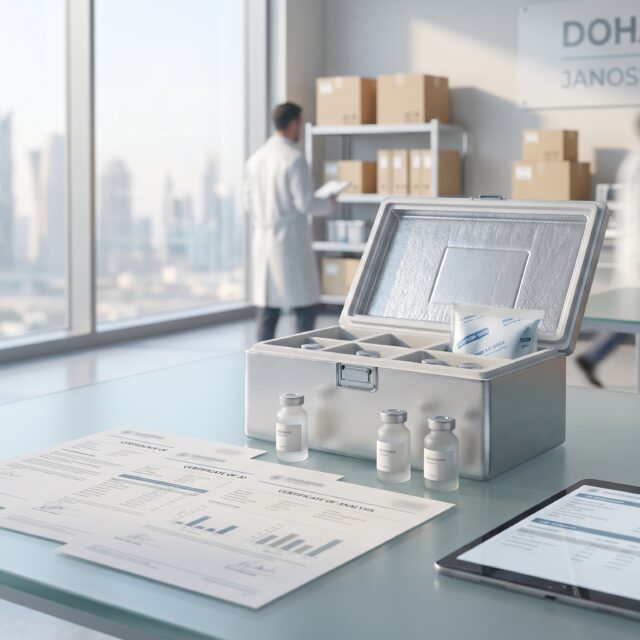
A reputable supplier will provide a Certificate of Analysis (COA) summarizing these tests. Logistics merely preserve the purity that the COA guarantees; if a supplier cannot produce valid, transparent testing documentation, their delivery methods are irrelevant.
Payment and Logistics Support for UAE Procurement
Frictionless procurement is vital for fast-paced laboratories. Specialized suppliers catering to the UAE market understand the need for localized payment and communication structures.
Rather than navigating complex international wire transfers, modern UAE laboratories benefit from suppliers offering Cash on Delivery (COD), secure local bank transfers, or cryptocurrency options for privacy. Furthermore, because timing is everything with temperature-controlled deliveries, responsive communication is essential. Suppliers offering direct WhatsApp support allow procurement staff to coordinate exact delivery windows, ensuring a technician is present to receive the package and immediately transfer it to a laboratory freezer.
Securing Cold Chain Delivery for Research Peptides in Dubai
When evaluating a local supplier, buyers should demand specific, verifiable logistics protocols. Effective cold chain peptide delivery relies on a multi-layered approach to packaging and dispatch.
Here are the critical standards you should expect:
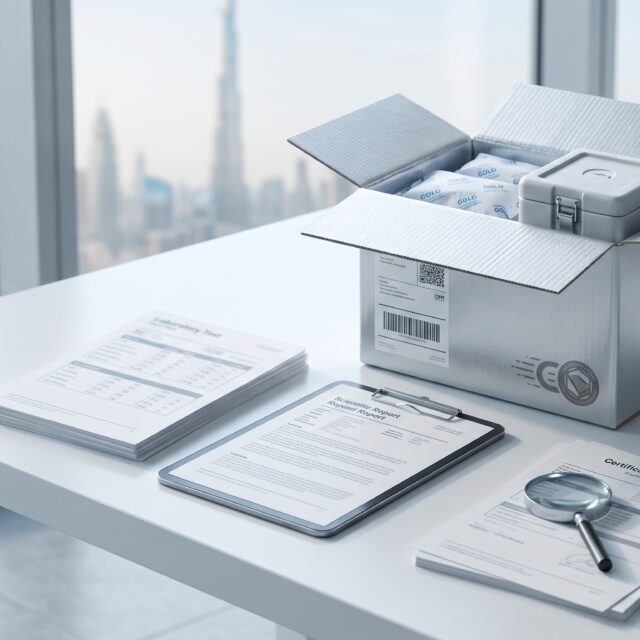
1. Insulated Packaging: Materials should never be shipped in standard cardboard or thin plastic mailers. Professional suppliers utilize thick, insulated foil envelopes or specialized thermal boxes designed to reflect external heat and trap cold air.
2. Active Cooling Agents: Heavy-duty, medical-grade cold gel packs must be included. These packs should be thoroughly frozen prior to dispatch and positioned to cool the vials without causing direct freezing damage to the lyophilized powder.
3. Rapid Dispatch and Last-Mile Speed: The window for cold chain viability using gel packs is typically 24 to 48 hours. Therefore, next-day or same-day delivery within Dubai is a chemical necessity. Suppliers must employ strict cut-off times to ensure packages are never left sitting in courier depots overnight.
4. Transparent Tracking: Buyers require immediate access to tracking information and direct support channels to monitor their delivery window. Being present to receive the package is the final, vital step in the cold chain.
The Arrival Checklist: 4 Things to Inspect Upon Delivery
Even with robust logistics, it remains the buyer’s responsibility to verify shipments upon arrival. Perform this quick inspection before transferring materials to long-term storage:
1. Assess the Cooling Agent: Open the insulated mailer immediately. The gel pack does not need to be rock solid—some thawing is expected—but it should feel noticeably cool. If the pack is hot, the package may have experienced prolonged ambient heat exposure.
2. Inspect the Vials: Examine the glass vials for cracks, structural damage, or compromised crimp tops. The vacuum seal must be intact to prevent moisture ingress.
3. Check the Lyophilized ‘Puck’: Observe the freeze-dried powder inside. It should appear as a solid, uniform puck or a fine, dry powder. If it appears gummy, heavily discolored, or clustered with moisture droplets, it may indicate thermal degradation or compromised seals.
4. Review the Documentation: Ensure the batch numbers on the vials match the provided COA documentation.
Post-Delivery Handling: Storage Protocols for UAE Labs
Once received, the compounds must be handled meticulously. For un-reconstituted, lyophilized powders, immediately transfer the vials to a freezer set to -20°C. At this temperature, freeze-dried peptides can remain stable for up to 24 months. Keep the vials shielded from direct UV light and sealed in their original protective packaging.
When preparing for an experiment, allow the vial to reach room temperature before breaking the seal. This prevents ambient room condensation from forming inside the cold vial. For research applications requiring liquid solutions, reconstitution should be performed using sterile bacteriostatic water, and the resulting solution must be kept refrigerated at 2°C to 8°C and used within a short timeframe to minimize bacterial growth and structural breakdown. Never subject reconstituted solutions to repeated freeze-thaw cycles.
NOVA Labs: Protecting Your Research with Local Logistics
At NOVA Labs, we understand that securing highly pure, verifiable compounds is only the first step; delivering them safely is equally critical. We engineered our fulfillment operations specifically around the environmental realities of the UAE, ensuring your research materials are completely shielded from extreme thermal stress.
Our local inventory model completely bypasses the risks of international customs delays. We warehouse our rigorously tested, HPLC/MS-verified batches locally in climate-controlled environments. When an order is placed, it is packed utilizing high-grade insulated foil mailers and heavy-duty gel packs designed for regional heat.
To ensure the shortest possible transit time, we prioritize rapid local fulfillment. Researchers in the emirate can utilize our specialized logistics network, leveraging dedicated same-day delivery options for maximum stability. We also offer flexible solutions including local payment options and responsive WhatsApp support, giving procurement staff total visibility and confidence in their supply chain.
Ready to secure verifiable, properly handled compounds for your facility? Browse our complete inventory and experience the reliability of temperature-controlled fulfillment by visiting our research shop today.
Disclaimer: The products and compounds mentioned in this article are strictly for laboratory research purposes only and are not intended for human consumption, diagnostic, or therapeutic use.
*
References
- UAE Ministry of Health and Prevention (MOHAP). Guidelines on Good Storage and Distribution Practices for Pharmaceuticals.
- Dubai Health Authority (DHA). Cold Chain Management Best Practices (Reference framework for research storage).
- D’Hondt, M., et al. (2014). “Related impurities in peptide medicines.” Journal of Pharmaceutical and Biomedical Analysis.
- Supply Chain Logistics Middle East (2023). “Navigating Temperature-Controlled Transit in the GCC.”
- Shipping & Returns – Peptides DXB
- Performance Peptides for Serious Athletes – PeptideAE
- Pharmaceutical Transport Standards UAE | GDP Compliance Guide | Drive Cool
- Best Cold Chain Logistics for Pharmaceuticals Dubai for 2026
- Ultimate Guide to Cold Storage in UAE — 8 Industries Covered – Chiller Room
Frequently asked questions
How long do cooling agents last during local peptide delivery in Dubai?
High-grade medical gel packs inside insulated foil mailers typically maintain a cold environment for 24 to 48 hours. Because of this limited window, next-day or same-day local dispatch is critical to ensure packages arrive before cooling agents deplete.
Why is international shipping risky for research materials imported to the UAE?
International shipments frequently encounter unpredictable customs holds at DXB. During these 48-to-72-hour delays, temporary cooling agents expire, exposing sensitive research compounds to ambient heat that rapidly degrades their molecular integrity.
What transit temperatures are required for lyophilized research peptides?
Although freeze-dried (lyophilized) powders are more stable than reconstituted liquids, best practices for cold chain transit dictate maintaining temperatures between 2°C and 8°C to completely shield them from the UAE's harsh summer climate.
How should UAE researchers store compounds immediately upon delivery?
Immediately transfer delivered vials to a laboratory freezer, optimally at -20°C, for long-term preservation. Always keep the vials sealed in their original packaging, shielded from light and moisture, until reconstitution.
Does NOVA Labs offer temperature-controlled same-day delivery in Dubai?
Yes, NOVA Labs utilizes a localized UAE fulfillment network to mitigate thermal risk. Researchers who place orders before the daily cut-off time can secure same-day or next-day temperature-controlled delivery directly to their facility.
Nova Labs buyer tools
Ready to verify stock, testing and delivery?
Use the product page and lab report section to check availability, documentation, delivery timing and support before placing an order.
- COA / test-report checks
- Dubai delivery context
- Cold-chain handling
- COD and card payment options
- WhatsApp support