




The Logistical Reality of Procuring MOTS-c in Saudi Arabia
When attempting to buy MOTS-c in Saudi Arabia, procurement officers, principal investigators, and independent researchers encounter a distinct set of logistical hurdles. The Middle East presents extreme environmental conditions alongside highly rigorous regulatory frameworks. Procuring delicate research compounds requires partnering with a supplier who deeply understands the intersection of thermal stability, cross-border customs protocols, and verifiable analytical chemistry.
Historically, buyers in Riyadh, Jeddah, and Dammam relied on overseas suppliers located in North America or Europe. However, extended international transit times, summer temperatures that regularly exceed 45 degrees Celsius, and complex clearance procedures via the Saudi Food and Drug Authority (SFDA) and ZATCA often lead to compromised shipments. To ensure laboratory continuity and preserve valuable research budgets, modern investigators must evaluate suppliers based on regional infrastructure, lyophilisation standards, and absolute third-party testing transparency.
Buyer Checklist for Saudi Arabia:
- Format: Only purchase lyophilised (freeze-dried) powder. Liquid peptides degrade rapidly in GCC transit.
- Logistics: Utilise regional hubs (like the UAE) to bypass lengthy ZATCA international customs holds.
- Verification: Demand a third-party Certificate of Analysis (COA) showing >99% HPLC purity.
- Storage: Ensure you have -20°C freezer capacity ready for long-term storage upon delivery.
Navigating ZATCA, SABER, and Cross-Border Customs Delays
One of the most significant friction points for anyone looking to source research compounds in the Kingdom of Saudi Arabia is the customs clearance process. The Kingdom maintains strict oversight over imported chemicals and biological materials, with regulatory entities requiring detailed documentation through regional clearance platforms like SABER and FASAH.
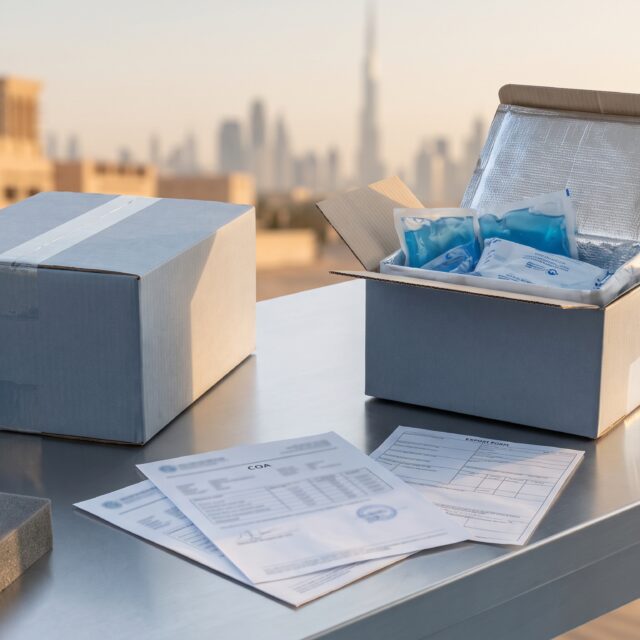
When ordering directly from Western suppliers, packages can sit in holding facilities for weeks while awaiting classification and inspection. During these administrative delays, even well-packaged parcels are subjected to ambient warehouse temperatures. Prolonged heat exposure can destroy delicate peptide bonds, leaving researchers with degraded, useless compounds before their experiments even begin.
Utilising a regional Middle Eastern supply corridor drastically streamlines this process. Regional suppliers operating out of the United Arab Emirates are inherently familiar with GCC harmonised system (HS) codes, research-only documentation, and integrated local courier networks. For instance, leveraging a regional hub that offers peptides UAE next day delivery means the materials reach the staging point for the Saudi border rapidly, significantly reducing transit friction and avoiding the prolonged processing patterns associated with intercontinental shipments.
The Heat-Shield Strategy: Why Lyophilised Powder is Non-Negotiable
The ambient climate of Saudi Arabia dictates strict handling protocols for all biological and synthetic compounds. A critical mistake many first-time buyers make is purchasing pre-mixed, liquid peptide solutions. In an aqueous state, peptide bonds are highly susceptible to thermal agitation, hydrolysis, and enzymatic degradation. When subjected to the severe heat of a regional summer transit, liquid MOTS-c will rapidly denature.
To safeguard compound integrity, informed researchers must exclusively source lyophilised (freeze-dried) MOTS-c. Lyophilisation removes the water content under a vacuum, locking the peptide into a highly stable powder matrix. In this state, the peptide can comfortably withstand standard room temperatures and the inevitable thermal fluctuations of regional shipment without compromising its molecular structure.
Once the lyophilised MOTS-c peptide arrives at your facility in Saudi Arabia, it should be immediately transferred to a temperature-controlled environment. The compound should only be reconstituted with clinical-grade sterile water or bacteriostatic water immediately prior to the commencement of the in vitro research protocol.
Verification: Decoding the Certificate of Analysis (COA)
Not all peptide suppliers operate with the same standard of transparency. Because the industry serves a wide spectrum of research entities, separating premium analytical-grade suppliers from substandard operations requires a strict evaluation checklist. The cornerstone of this evaluation is the Certificate of Analysis (COA).
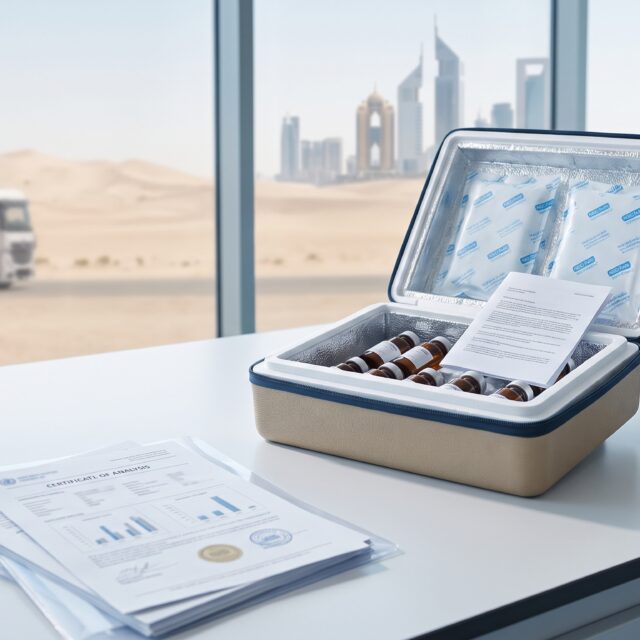
A reputable supplier operating in the GCC will never ask a buyer to rely on blind trust or outdated, in-house testing. They will provide a recent, batch-specific COA conducted by an independent, third-party analytical laboratory (such as Janoshik Analytical). When reviewing a COA for MOTS-c, procurement teams must look for two critical metrics:
1. High-Performance Liquid Chromatography (HPLC)
HPLC measures the purity of the compound by separating the components of the sample. For rigorous scientific research, the MOTS-c peptide should register a purity level of 99% or higher. This indicates that synthesis byproducts, such as truncated peptide sequences or residual trifluoroacetic acid (TFA) salts, have been effectively removed during the purification phase.
2. Mass Spectrometry (MS)
Mass Spectrometry confirms the exact molecular weight of the compound, ensuring that the substance in the vial is definitively MOTS-c and not a cheaper substitute or a fragmented chain. By verifying the mass-to-charge (m/z) ratio against the known molecular weight of MOTS-c, researchers can confirm compound identity with absolute certainty.
Crucial Step: Always ensure that the COA features a unique validation key or QR code. Elite independent laboratories provide these keys so buyers can directly verify the results on the laboratory’s own server, effectively eliminating the risk of manipulated PDF documents.
Laboratory Storage and Handling Protocols
Proper handling upon delivery is just as critical as the procurement process itself. When your MOTS-c arrives, adherence to strict storage protocols ensures the longevity of the compound:
- Short-Term Storage (Unreconstituted): Vials can be stored in a standard laboratory refrigerator at 4°C for up to several months.
- Long-Term Storage (Unreconstituted): For preservation spanning a year or more, vials should be placed in a deep freezer at -20°C.
- Post-Reconstitution Handling: Once mixed with bacteriostatic water, the peptide is in a fragile aqueous state. It must be kept refrigerated at 2°C to 8°C and should generally be utilised within 14 to 20 days to ensure maximum efficacy in research models.
- Avoid Freeze-Thaw Cycles: Never repeatedly freeze and thaw reconstituted peptides, as the formation of ice crystals will shred the delicate peptide chains.
The Scientific Profile: Understanding MOTS-c in Vitro
Understanding the precise nature of the compound is essential for setting appropriate laboratory parameters. MOTS-c (Mitochondrial Open Reading Frame of the 12S rRNA-c) is a highly unique, 16-amino acid peptide that is encoded not in the cell’s nucleus, but within the mitochondrial genome itself.
In controlled laboratory settings, MOTS-c is extensively studied for its role in cellular metabolism and energy regulation. Current scientific literature observes its capacity to activate AMP-activated protein kinase (AMPK)—a primary cellular energy sensor—and its interaction with the folate cycle. Research models primarily investigate how mitochondrial-derived peptides signal to the nucleus to regulate metabolic homeostasis, influence cellular respiration, and mediate stress responses under varying physiological conditions.
It is vital to reiterate that these observations belong strictly to controlled in vitro and animal model studies. The parameters of these studies focus on target-tissue glucose utilisation and metabolic signaling pathways to map underlying cellular mechanisms.
Structuring Your Procurement Strategy with NOVA Labs
Securing high-purity research compounds in a challenging logistical environment requires a supplier built specifically for the region’s demands. For buyers mapping out where to buy MOTS-c in Saudi Arabia, NOVA Labs provides a streamlined, highly transparent procurement solution tailored to the realities of the GCC.
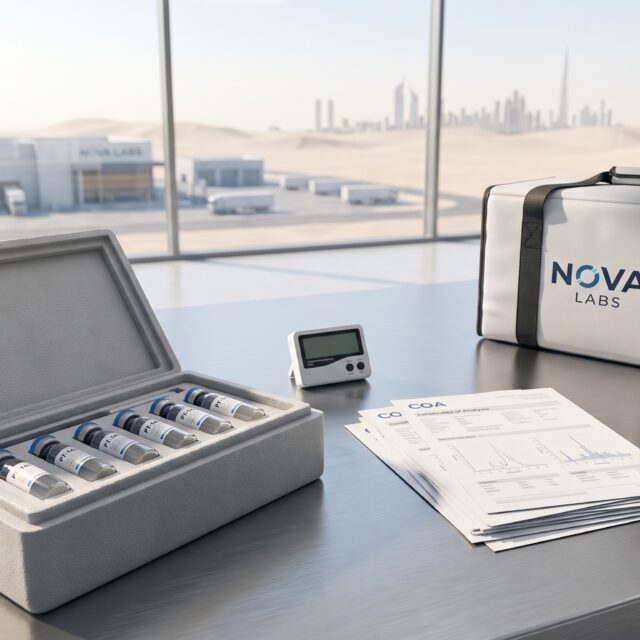
By operating out of a centralised regional hub, NOVA Labs drastically cuts down the transit times and customs friction that plague international orders. Every batch of lyophilised powder is rigorously validated through independent HPLC and MS testing, with transparent COAs readily available to verify purity standards >99%. Combined with secure packaging protocols, responsive local support, and regional payment flexibility, researchers can focus entirely on their data rather than worrying about degraded materials or administrative bottlenecks.
To review the latest analytical testing data, confirm regional stock availability, and secure your batch for upcoming studies, you can directly access and order MOTS-c for your laboratory here.
*
Disclaimer: NOVA Labs products are sold strictly for in vitro laboratory research purposes only. They are not intended for human consumption, therapeutic use, diagnostic purposes, or any form of clinical application. Purchasers must ensure compliance with all local and institutional regulations regarding the handling of synthetic peptides.
*
References
- Lee, C., et al. (2015). The mitochondrial-derived peptide MOTS-c promotes metabolic homeostasis and reduces diet-induced obesity. Cell Metabolism.
- Zhai, D., et al. (2020). MOTS-c: A promising mitochondrial-derived peptide for therapeutic exploitation. Frontiers in Endocrinology.
- Saudi Food and Drug Authority (SFDA). Importation Guidelines for Chemical and Biological Research Materials. Riyadh, Saudi Arabia.
- Kim, S. J., et al. (2018). The mitochondrial-derived peptide MOTS-c promotes metabolic homeostasis. Aging Cell.
- Buy MOTS-c Saudi Arabia: Purity, COA & Delivery Guide – NOVA Labs
- Wholesale Peptides Saudi Arabia: B2B Supplier & Procurement – NOVA Labs
- MOTS-c: A promising mitochondrial-derived peptide for therapeutic exploitation – PMC – NIH
- Mitochondria-derived peptide MOTS-c restores mitochondrial respiration in type 2 diabetic heart – Frontiers
Frequently asked questions
Is it legal to buy MOTS-c in Saudi Arabia?
Yes, it is permitted to import and purchase MOTS-c in Saudi Arabia strictly for laboratory and research purposes. Buyers must ensure they adhere to ZATCA and SFDA guidelines for importing scientific compounds and maintain proper research-only documentation.
How long does shipping research peptides to Saudi Arabia usually take?
When ordering from a regional GCC supplier, shipments to Saudi Arabia typically bypass lengthy international customs holds and arrive within a few business days. Ordering directly from Western countries can result in customs delays lasting several weeks.
Why must MOTS-c be shipped as a lyophilised powder?
Lyophilised (freeze-dried) powder protects the peptide's molecular bonds from the extreme heat of the GCC region. Pre-mixed liquid peptides degrade rapidly at high temperatures, whereas lyophilised powder remains highly stable during transit.
How can I verify the purity of MOTS-c before buying?
You should always request a third-party Certificate of Analysis (COA) from the supplier. The COA must include High-Performance Liquid Chromatography (HPLC) to confirm purity (ideally >99%) and Mass Spectrometry (MS) to verify the correct molecular weight. Always check for a scannable verification code on the document.
How should MOTS-c be stored after delivery in Saudi Arabia?
Upon arrival, unreconstituted lyophilised MOTS-c should be kept away from direct sunlight and stored in a refrigerator at 4°C for medium-term storage, or in a deep freezer at -20°C for long-term preservation spanning over a year.
Nova Labs buyer tools
Ready to verify stock, testing and delivery?
Use the product page and lab report section to check availability, documentation, delivery timing and support before placing an order.
- COA / test-report checks
- Saudi Arabia delivery context
- Cold-chain handling
- COD and card payment options
- WhatsApp support