




Procuring research compounds in the United Arab Emirates requires careful attention to logistics. For buyers and procurement staff in the capital, the extreme local climate poses a distinct challenge to maintaining the structural integrity of delicate amino acid sequences. Ambient temperatures frequently exceed 45°C during the summer months, and the inside of an unmitigated delivery van can climb significantly higher. Without stringent logistical controls, temperature-sensitive research materials can degrade rapidly before they ever reach the laboratory bench.
Evaluating how your supplier handles transit, packaging, and last-mile delivery is just as critical as checking their Certificates of Analysis (COAs). In this guide, we break down what researchers and informed buyers must know about cold chain peptide delivery in Abu Dhabi, exploring how proper thermal packaging, domestic fulfilment, and rapid local couriers protect your investment.
Quick Answer: What Secures Your Delivery?
For researchers and buyers, securing cold chain peptide delivery in Abu Dhabi requires insulated packaging, thermal gel packs, and rapid local courier dispatch to prevent structural degradation in extreme heat. Bypassing international customs through domestic fulfilment ensures that temperature-sensitive compounds remain stable, viable, and fully intact upon arrival at your facility.
The Science of Heat Degradation in Peptides
Peptides are precisely sequenced chains of amino acids held together by fragile peptide bonds. While they are highly resilient in a carefully controlled environment, they are remarkably sensitive to thermal stress.
When exposed to prolonged, unmitigated heat, these compounds undergo accelerated structural degradation. High temperatures can cause the delicate bonds to break or alter, leading to a loss of the compound’s original molecular structure. Furthermore, excessive heat accelerates oxidation—a chemical reaction that compromises the integrity of the peptide, rendering it ineffective for precise research protocols.
In Abu Dhabi, surface temperatures and vehicle cargo holds routinely reach levels that far exceed the safe storage thresholds for biological materials. If a supplier simply drops a vial into a standard padded envelope and relies on traditional postal networks, the transit conditions practically guarantee some level of degradation. This is why standard logistics are insufficient for research peptides in the UAE.
Lyophilization: Protective, but Not Invincible
Most premium research peptides are shipped in a lyophilized (freeze-dried) state. Lyophilization removes moisture, transforming the compound into a stable powder.
While lyophilized peptides are considerably more stable at room temperature than reconstituted (liquid) peptides—often remaining viable for up to 72 hours under moderate clinical travel conditions—they are not immune to the extreme environmental realities of the GCC. Lyophilization provides a buffer, but it cannot fully protect the compound against the punishing 45°C+ heat of an Abu Dhabi summer if the package is left sitting in a hot warehouse or an un-airconditioned sorting facility.
To ensure complete preservation, even lyophilized powders require continuous thermal mitigation during transit. This underscores the necessity of dedicated cold chain logistics for laboratory materials in the Emirates.
Domestic Fulfilment vs. International Customs Friction
One of the most significant logistical hurdles for UAE researchers is the international customs process. Ordering peptides from overseas suppliers introduces a layer of unpredictability that is fundamentally incompatible with temperature-sensitive materials.
The Risks of Importing
International shipments arriving in the UAE face rigorous inspection protocols. Industry data suggests a 2% to 3% risk of customs holds for scientific compounds arriving from abroad. While this percentage may seem small, the consequences of a hold are severe. A package detained at customs is often stored in ambient-temperature holding areas for days or even weeks while documentation is verified. During this time, any cooling elements (such as dry ice or gel packs) will thaw and expire, leaving the peptides entirely exposed to the local climate.
The Local Logistics Advantage
Local fulfilment completely bypasses international customs friction. By sourcing from a supplier that warehouses and dispatches from within the UAE, researchers eliminate the risk of border delays. A robust domestic network allows for same-day or next-day turnaround, drastically reducing the time the product spends in transit.
Partnering with specialised local couriers—logistics providers who understand the requirements of temperature-controlled freight—ensures the package moves swiftly from a climate-controlled facility directly to your location. For more information on our rapid dispatch capabilities, learn about how we ensure reliable peptides UAE next-day delivery across the Emirates.
Packaging Standards: What to Look For
The efficacy of a cold chain logistics network relies entirely on the quality of the last-mile packaging. When you require cold chain peptide delivery in Abu Dhabi, the physical unboxing experience should immediately confirm the integrity of the supplier’s handling protocols.
Expect the following standards from a credible local supplier:
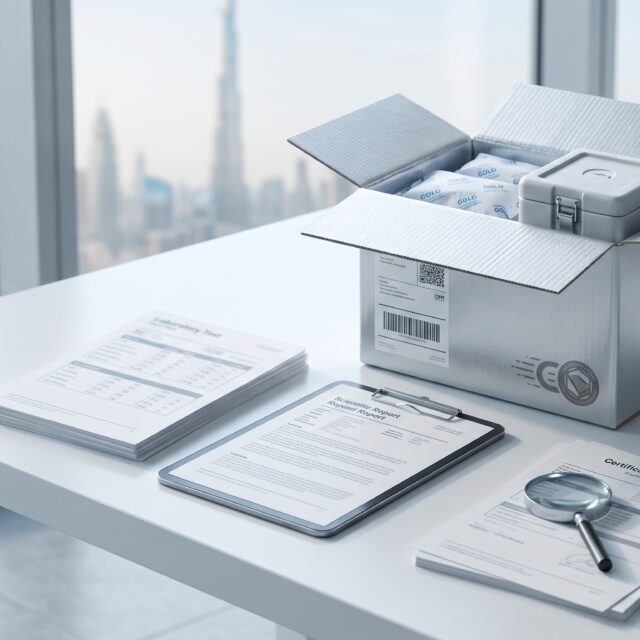
- Insulated Mailers and Thermal Boxes: Standard cardboard offers zero thermal resistance. Premium suppliers utilise specialised insulated enclosures designed to reflect external heat and trap internal cold.
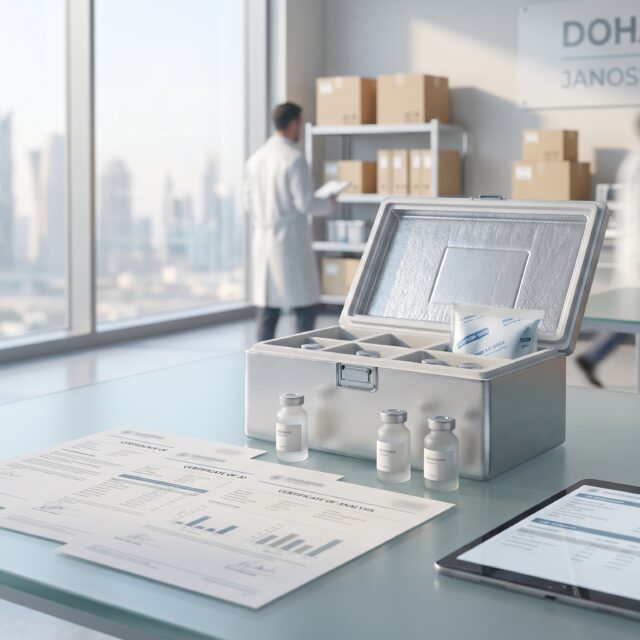
- Thermal Gel Packs: Active cooling elements are non-negotiable. High-quality thermal gel packs should be included within the insulated enclosure. Even if the gel packs have begun to thaw by the time of delivery, they should still be cool to the touch, proving they actively absorbed heat during transit.
- Vial Protection: Beyond temperature, physical shock is a risk. Vials must be securely cushioned to prevent the fragile lyophilized puck from shattering into dust during courier handling.
- Clear Batch Documentation: Upon opening the package, buyers should find easy access to or scannable links for the batch-specific Certificate of Analysis (COA) matching the exact vials received.
A Buyer’s Checklist: Verifying Delivery Integrity
When your order arrives, take immediate steps to verify its logistical integrity before logging the compounds into your laboratory inventory.
- Inspect the Packaging: Did it arrive in an insulated box or just a standard plastic shipping bag? The presence of thermal protection is your first indicator of a serious supplier.
- Check the Internal Temperature: Open the package immediately. The interior space and the thermal gel packs should still feel distinctly cooler than the ambient room temperature.
- Examine the Vials: The lyophilized powder inside the vial should ideally appear as a solid, uniform puck (though some transit shifting is normal). Discoloration or a melted, gummy appearance strongly indicates severe heat exposure and moisture ingress.
- Verify the COA: Ensure the lot number on your vials matches the third-party High-Performance Liquid Chromatography (HPLC) and Mass Spectrometry (MS) documentation provided by the supplier.
- Transfer to Storage: Immediately transfer the lyophilized vials to a freezer (optimally -20°C) for long-term storage, keeping them entirely out of direct light.
Payment and Support Preferences in the UAE
Beyond just the physical transit of goods, the procurement experience in Abu Dhabi carries specific consumer expectations. Flexibility and communication are key markers of a reliable supplier.
Many local researchers and informed buyers prefer the security of Cash on Delivery (COD) options, allowing them to visually inspect the condition of the package before finalising payment. Additionally, responsive customer support is critical. Suppliers offering direct WhatsApp communication channels demonstrate operational transparency, allowing buyers to check stock availability, confirm COA details, and track local delivery dispatch in real time.
The NOVA Labs Commitment to Secure Logistics
At NOVA Labs, we understand that providing access to rigorously tested research compounds is only half the equation; the other half is ensuring those compounds survive the journey. We have engineered our logistics network specifically to meet the unique challenges of the GCC climate.
Our operations are locally based, allowing us to completely eliminate international customs delays for our UAE clients. Every order is prepared in a climate-controlled environment, packed with specialized thermal insulation and cooling elements, and handed over to dedicated local couriers for rapid last-mile delivery across Abu Dhabi and Dubai. We combine this uncompromising approach to transit stability with transparent third-party testing, ensuring you have total confidence in your research materials from the moment you click order to the moment you open the box.
To explore our full range of rigorously tested, locally stocked research compounds, visit the NOVA Labs shop.
Disclaimer: The products mentioned in this article are for research purposes only and are not intended for human consumption.
References
- Jeebly Logistics Insights: Benefits of Temperature Controlled Logistics in UAE.
- General principles of peptide stability and lyophilization dynamics in extreme ambient environments.
- UAE Customs regulations regarding the importation of laboratory and scientific research compounds.
- About PepcoLab — Research-Grade Peptide Supplier, UAE
- Peptide Therapy in Dubai & Abu Dhabi | DNA Health and Wellness
- From Manufacturer to End Customer: How AlGenome International Guarantees a Reliable Cold Chain for Your Critical Supplies
- Shipping policy – Peptides Ae
- Benefits of Temperature Controlled Logistics in UAE – Jeebly
- Peptide Therapy in Dubai & Abu Dhabi – Skin111
Frequently asked questions
How long do lyophilized peptides survive in UAE heat?
While lyophilized peptides are stable at room temperature for short periods, exposing them to the extreme 45°C+ heat of an Abu Dhabi summer without insulated packaging can cause structural degradation within hours.
What is cold chain peptide delivery?
Cold chain peptide delivery involves using insulated packaging, thermal gel packs, and rapid transit networks to maintain a controlled temperature environment, protecting delicate research compounds from heat damage during shipping.
Why is local peptide fulfilment better than international shipping to Abu Dhabi?
Local fulfilment bypasses international customs holds, which carry a 2-3% risk of delaying packages in hot environments. Domestic shipping ensures same-day or next-day delivery with intact thermal protection.
How should I store my peptide delivery once it arrives?
Upon receiving your delivery, immediately inspect the packaging for thermal integrity and transfer the lyophilized vials to a freezer (ideally at -20°C) away from direct light for long-term storage.
Nova Labs buyer tools
Ready to verify stock, testing and delivery?
Use the product page and lab report section to check availability, documentation, delivery timing and support before placing an order.
- COA / test-report checks
- Abu Dhabi delivery context
- Cold-chain handling
- COD and card payment options
- WhatsApp support